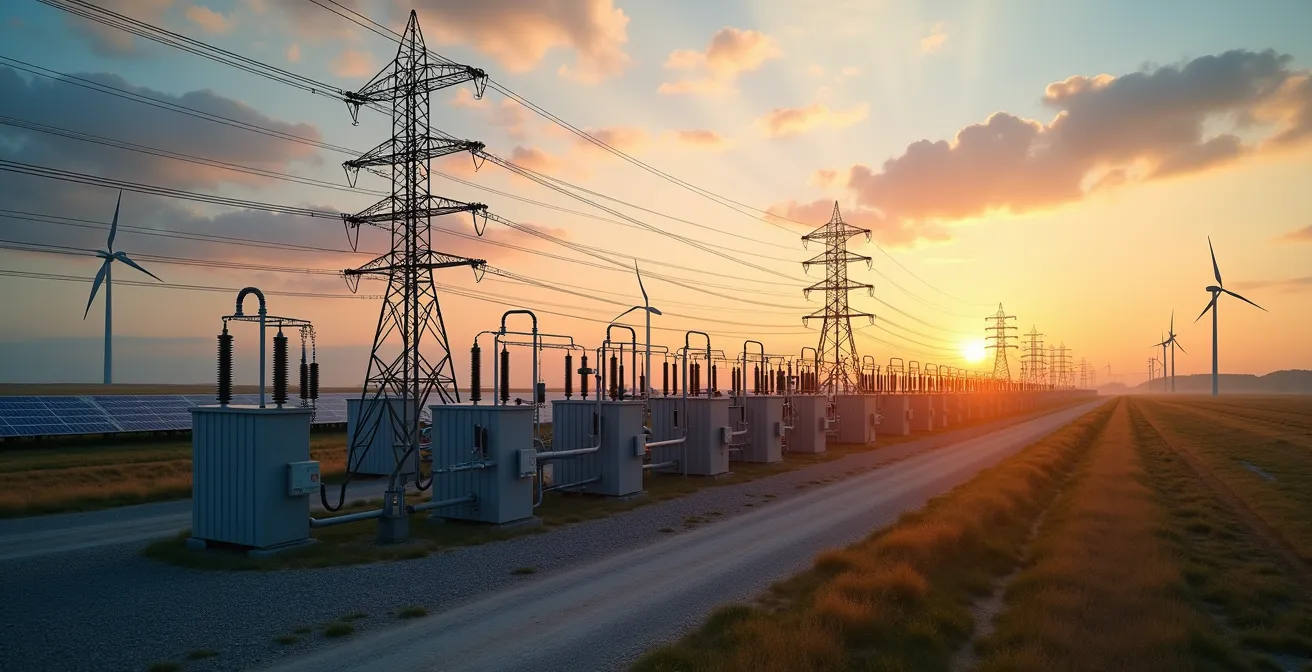
Achieving “five nines” reliability with high renewable penetration is not about finding a single silver bullet, but about mastering a portfolio of new system stability services.
- The decline of synchronous generators removes critical physical inertia, which must be synthetically replaced by inverter-based resources (IBRs).
- Fast-acting frequency response from technologies like flywheels and advanced grid-forming inverters is essential to manage millisecond-level volatility.
Recommendation: Grid operators must evolve from a static ‘baseload’ mindset to a dynamic ‘firm portfolio’ and active control strategy to ensure stability.
For a grid stability engineer, the mandate is absolute: maintain a frequency of 50 or 60 Hz, with near-zero tolerance for deviation. For decades, this reliability was an inherent byproduct of large, spinning synchronous generators. The transition to renewable energy sources, however, fundamentally rewrites these rules of physics. The common discourse often fixates on the obvious problem of intermittency—the wind doesn’t always blow, and the sun doesn’t always shine—and points to energy storage as the universal solution.
While true, this view is dangerously simplistic for the operators tasked with maintaining grid integrity. The real, underlying engineering challenge is far more complex. It’s not merely a fuel source problem; it is a fundamental physics problem of lost system inertia, disappearing reactive power support, and the introduction of volatility on a millisecond timescale that legacy systems were never designed to handle. Achieving 99.9% uptime is no longer a passive consequence of system design but an active, continuous battle against instability.
But if the core challenge is the loss of the stabilizing properties of thermal power plants, what are the specific, engineering-grade solutions? The answer lies not in a single technology, but in a meticulously orchestrated portfolio of services. This article moves beyond the platitudes to dissect the core stability challenges and the technologies required to solve them, providing a technical framework for grid operators to navigate the transition while upholding the non-negotiable requirement of reliability.
Summary: Achieving 99.9% Uptime: The Engineering Challenge of Integrating Renewables into Legacy Grids
- Why Is the Concept of “Base Load” Becoming Obsolete in Modern Grids?
- How to Use Flywheels to Stabilize Grid Frequency in Milliseconds?
- Nuclear vs Geothermal: Which Provides Better Zero-Carbon Firm Power?
- The Inertia Mistake: Removing Rotating Mass Without Synthetic Replacements
- How to Mix Solar and Wind Capacities to Flatten the Production Curve?
- Why Are Offshore Winds More Consistent Than Onshore Winds?
- Bridge Fuel or Dead End: Is Natural Gas Infrastructure Worth the 20-Year Investment?
- Why Decentralized Storage Is the Key to Grid Stability During Extreme Weather?
Why Is the Concept of “Base Load” Becoming Obsolete in Modern Grids?
The term “base load” traditionally refers to the minimum level of electricity demand over a 24-hour period, reliably met by large, slow-to-ramp power plants like coal or nuclear. These generators were designed to run continuously at a constant output, providing the stable foundation upon which variable “peaker” plants could operate. This entire paradigm was built on the assumption of predictable, dispatchable generation and relatively predictable load. The introduction of high penetrations of variable renewable energy sources (VREs) shatters this assumption.
With solar and wind, the generation side becomes the primary source of variability, not the load. A grid can experience periods where VREs supply nearly 100% of demand, followed by sharp drop-offs. In this environment, a large, inflexible “baseload” plant becomes a liability, not an asset. It cannot ramp down quickly enough during periods of excess renewable generation, leading to curtailment (wasted energy) and negative pricing. The grid of the future requires not a static base of power, but a portfolio of highly flexible and dispatchable resources that can adapt in real-time to the fluctuating output of VREs.
Case Study: Hawaii’s Shift Away from Baseload
The state of Hawaii provides a compelling real-world example of this paradigm shift. With a mandate to generate 100 percent of its electricity from renewable sources by 2045, the island state is actively moving away from the traditional baseload model. Its isolated island grids cannot rely on interconnections to smooth out variability, forcing them to pioneer flexible grid management strategies, including large-scale battery storage and demand response programs, to integrate massive amounts of solar and wind power effectively. This demonstrates a clear transition from a baseload-centric approach to a dynamic, renewable-focused system.
The focus is shifting from “baseload generation” to “firm capacity.” This firm capacity might come from geothermal, nuclear, hydro with reservoirs, or long-duration storage, but its defining characteristic is its availability on demand, not its continuous, unchanging operation.
How to Use Flywheels to Stabilize Grid Frequency in Milliseconds?
Grid frequency is the most critical indicator of grid health, representing the real-time balance between power generation and consumption. A sudden loss of a generator or a large load coming online can cause frequency to deviate, potentially leading to cascading failures. Traditional grids relied on the immense physical inertia of spinning turbines in thermal power plants to naturally dampen these fluctuations. As these plants are retired, the grid loses this inertia, becoming more fragile and susceptible to rapid frequency changes.
This is where fast-acting stability services become non-negotiable. Flywheel energy storage systems are a prime example of a mechanical, high-power solution. A flywheel stores energy kinetically by spinning a massive rotor in a near-frictionless vacuum chamber. When grid frequency dips, the system instantly acts as a motor, drawing power to accelerate the flywheel. Conversely, when frequency drops, the system acts as a generator, with the flywheel’s momentum driving the motor to inject power back into the grid. This exchange happens in milliseconds, far faster than most traditional generators can respond.
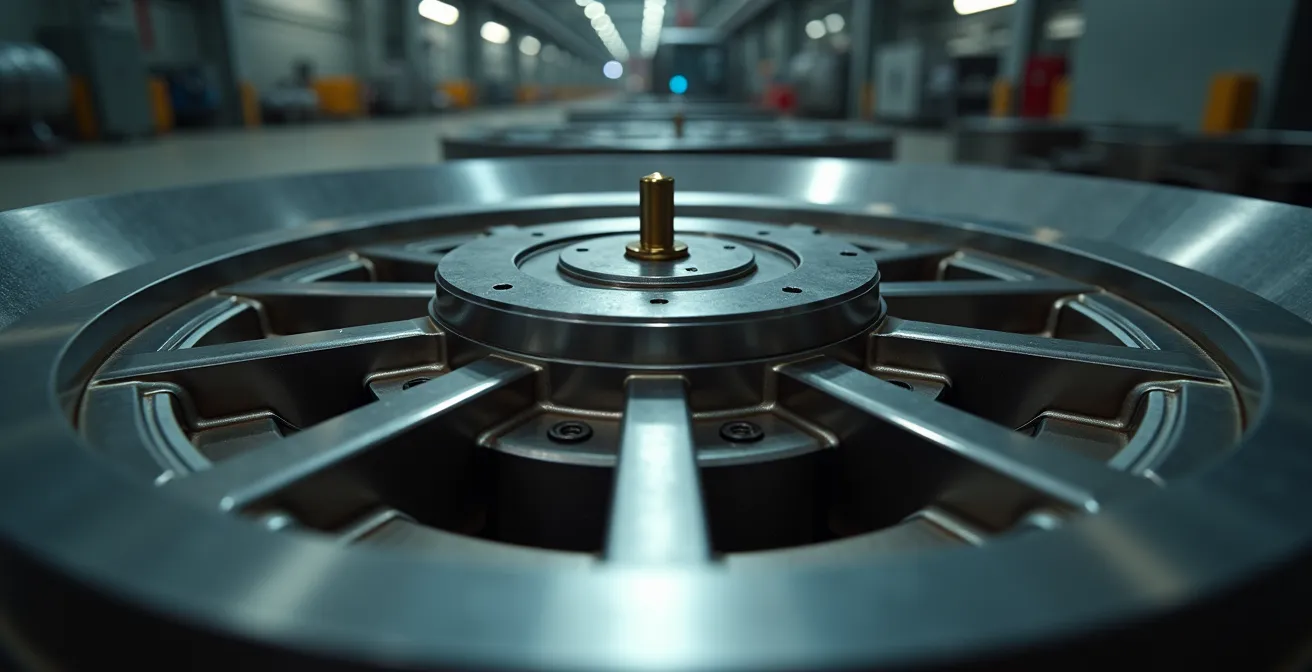
While batteries are excellent for energy arbitrage (storing energy for hours), flywheels excel at high-cycle, short-duration power injection for frequency regulation. They can perform hundreds of thousands of charge/discharge cycles with minimal degradation, making them a workhorse for maintaining grid stability second-by-second. Other technologies, like synchronous condensers, perform a similar role for inertia and voltage support, as noted by experts. As Dr. James F. Manwell of the University of Massachusetts Renewable Energy Research Laboratory explains:
Synchronous condenser is the name given to a synchronous machine that is connected into an electrical network to help in maintaining the system voltage
– Dr. James F. Manwell, University of Massachusetts Renewable Energy Research Laboratory
These technologies are not a substitute for long-duration storage but are a critical component of the stability services portfolio required to manage a low-inertia grid.
Nuclear vs Geothermal: Which Provides Better Zero-Carbon Firm Power?
As intermittent renewables dominate energy production, the need for a source of “firm,” dispatchable, zero-carbon power becomes paramount. This is the resource that can be called upon 24/7, regardless of weather, to ensure the grid never goes dark. The two leading contenders for this role are nuclear and geothermal energy. However, judging them on energy output alone is an oversimplification; for a grid operator, their operational characteristics are what truly matter.
Nuclear power, particularly new-generation Small Modular Reactors (SMRs), offers an exceptionally high capacity factor, often exceeding 90%. It is an incredibly dense and reliable power source. However, traditional nuclear plants have limited ramping capabilities, designed for steady-state operation. While SMRs offer more flexibility, they are still fundamentally thermal plants with constraints on how quickly they can change output. Geothermal, especially from Enhanced Geothermal Systems (EGS) that can be developed beyond traditional hotspots, offers a slightly lower capacity factor but boasts superior flexibility.
The following table, based on data from grid integration studies, highlights the key operational differences. As demonstrated in a comparative analysis by the U.S. Department of Energy, the choice is not about “better” but about “better for a specific need.”
| Characteristic | Nuclear (SMR) | Geothermal (EGS) |
|---|---|---|
| Capacity Factor | 90-95% | 75-90% |
| Ramping Rate | Limited (5%/min) | Flexible (10-20%/min) |
| Co-generation Potential | Limited | High (heat, hydrogen) |
| Geographic Flexibility | Moderate | Expanding with EGS |
| Water Requirements | High | Moderate to Low |
The choice between them depends on the grid’s specific needs: a system requiring an unwavering block of power might favor nuclear, while a system needing a flexible, load-following firm resource might lean towards geothermal. Furthermore, some regions demonstrate that other pathways are possible. For instance, Nova Scotia, lacking significant hydro or nuclear resources, is pursuing an 80% renewable grid by 2030 by focusing on wind, solar, storage, and regional interconnections, proving that a diverse portfolio can also provide firmness.
The Inertia Mistake: Removing Rotating Mass Without Synthetic Replacements
The single greatest, and most underestimated, threat to grid stability in the renewable transition is the silent loss of system inertia. Inertia is a physical property: the resistance of an object to a change in its state of motion. In a power grid, this property comes from the colossal rotating mass of turbines and generators in thermal and hydroelectric power plants. This combined, spinning mass acts as a massive kinetic battery, naturally resisting and smoothing out sudden changes in frequency. When a large industrial motor starts or a power line faults, the grid’s frequency doesn’t collapse instantly because this stored rotational energy provides a buffer, giving slower control systems time to react.
The “inertia mistake” is the assumption that we can replace these synchronous machines with static, inverter-based resources (IBRs) like solar panels and wind turbines on a 1-to-1 MWh basis without consequence. We cannot. IBRs connect to the grid through power electronics; they have no intrinsic physical inertia. As their penetration increases, the grid’s overall inertia plummets, making it more “brittle” and prone to violent frequency swings from minor disturbances. The Australian Renewable Energy Agency (ARENA) explicitly warns of this, stating that the “retirement of fossil-fuel generation… is projected to reduce both system strength and inertia.”
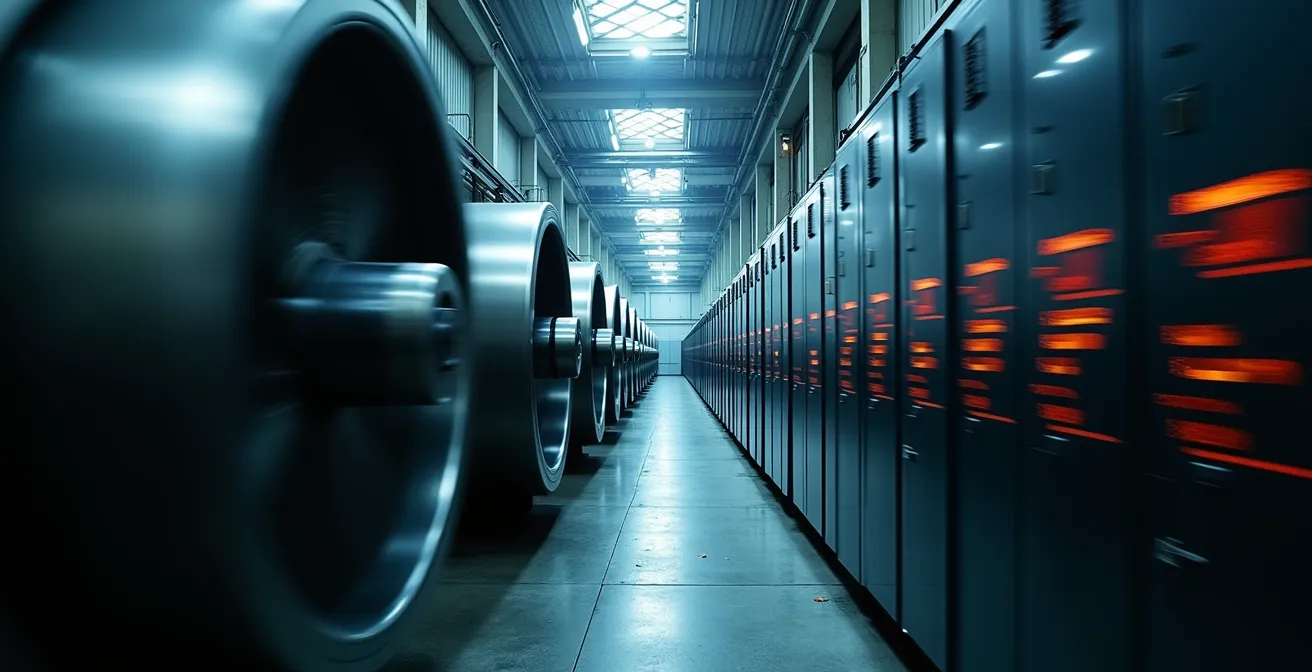
This is not an anti-renewable argument; it is a critical engineering problem that must be solved. The solution is synthetic inertia. Modern “grid-forming” inverters can be programmed to emulate the behavior of a synchronous generator. Using sophisticated algorithms and their own energy storage (either batteries or the DC-link capacitors), they can automatically and instantaneously inject or absorb power in response to frequency deviations, creating an electronic or “synthetic” inertia. Failing to mandate and properly compensate these services is the critical mistake. We are not just removing megawatts of coal; we are removing gigawatt-seconds of stabilizing inertia, and it must be replaced.
How to Mix Solar and Wind Capacities to Flatten the Production Curve?
While both solar and wind are variable, their patterns of variability are often complementary. Relying on a single renewable source creates a pronounced “peak and valley” generation profile that is difficult for the grid to manage. However, a strategic mix of geographically and technologically diverse VREs can significantly flatten this curve, reducing the need for storage and ramping capacity.
The fundamental principle is to exploit anti-correlation. Solar power production peaks midday and is non-existent at night. Wind power, particularly from large-scale onshore and offshore farms, often shows the opposite pattern, with higher production overnight and during morning/evening hours. A grid with a balanced portfolio of both can therefore achieve a more stable, “baseload-like” renewable generation profile. This strategy becomes increasingly critical as the scale of integration grows; some projections indicate a 9x growth in renewable installed capacity by 2050, making efficient integration essential.
Geographic diversification is the second dimension of this strategy. A weather front that causes cloud cover and reduces solar output in one region may simultaneously bring high winds to another region a few hundred kilometers away. By connecting these regions with robust HVDC (High-Voltage Direct Current) transmission lines, grid operators can treat a vast geographical area as a single, more stable “virtual power plant.” The key is to move beyond thinking of individual wind and solar farms and towards orchestrating a continental-scale system of complementary resources.
Action Plan: Optimizing the Renewable Mix for Grid Stability
- Deploy energy storage systems: Utilize batteries and other technologies to absorb excess generation during sunny, windy periods and release it during lulls, accommodating daily and multi-day fluctuations.
- Implement demand-side management: Incentivize large industrial and residential users to shift flexible loads (like EV charging or water heating) to align with periods of high renewable generation.
- Develop flexible ramping products: Create market mechanisms that compensate generators (both renewable and conventional) for the ability to rapidly increase or decrease their output, providing a crucial ancillary service.
- Connect anti-correlated regions: Invest in high-capacity HVDC transmission to link areas with different weather patterns (e.g., coastal wind and inland solar), smoothing out aggregate production.
- Integrate a third renewable source: Incorporate dispatchable renewables like hydropower, geothermal, or biomass where available to provide an additional layer of firm, zero-carbon diversification.
Why Are Offshore Winds More Consistent Than Onshore Winds?
For a grid operator focused on reliability, predictability is just as valuable as raw power output. In this regard, offshore wind represents a significant step up from its onshore counterpart. While both are variable, the nature and consistency of wind resources over the open ocean provide a more stable and predictable generation profile, making it a cornerstone for many nations’ decarbonization plans.
The primary reason for this enhanced consistency is the absence of surface friction and topographical obstructions. On land, wind must navigate hills, valleys, forests, and buildings. This creates turbulence and slows the wind down, leading to gusty, less predictable conditions. Over the vast, flat expanse of the sea, the wind experiences much less surface drag. This results in laminar flow, where the wind is stronger, smoother, and far more consistent in both speed and direction. This physical reality translates directly into higher capacity factors for offshore turbines, which can often achieve 50-60% compared to 30-40% for even the best onshore sites.
Furthermore, the diurnal cycle of offshore wind is often more favorable for grid integration. The land-sea temperature differential frequently causes offshore winds to pick up in the late afternoon and continue blowing strongly through the night, just as solar power fades and evening demand ramps up. This natural alignment provides a complementary generation profile that helps to fill the “duck curve” trough created by high solar penetration. As countries like Australia plan massive expansions of their renewable capacity, the superior profile of offshore wind makes it an indispensable component for ensuring system stability.
This higher predictability allows grid operators to schedule other generation resources more efficiently, reducing reliance on expensive, fast-ramping peaker plants and lowering overall system costs.
Bridge Fuel or Dead End: Is Natural Gas Infrastructure Worth the 20-Year Investment?
In the complex puzzle of grid transition, natural gas holds a deeply contentious position. Proponents label it the essential “bridge fuel,” a cleaner-burning, flexible partner to intermittent renewables that can be dispatched quickly to fill generation gaps. Opponents argue that investing in new gas infrastructure, with a typical asset life of 20-40 years, is a costly “dead end” that locks in fossil fuel dependency and creates stranded assets in a world racing towards net-zero emissions.
From a purely technical, reliability-focused standpoint, the appeal of natural gas is undeniable. A modern combined-cycle gas turbine (CCGT) offers fast start times and excellent ramping capabilities, services that are critically needed to balance wind and solar. It provides the dispatchable capacity that is being lost as coal plants retire. The operational question is not *if* it works, but for *how long* it will be the most economically and politically viable solution.
The alternative—building a fully decarbonized firm capacity system—is a monumental undertaking. It involves not only deploying renewables but also massive investments in long-duration storage, new nuclear or geothermal plants, and a vast expansion of the transmission network. Achieving net-zero goals requires staggering capital expenditure; for example, studies suggest that to reach net-zero by 2050, some regions would need to effectively double their transmission infrastructure investment to €550 billion per year by 2030. The argument for natural gas is that it “bridges” this gap, providing stability now while these other technologies mature and scale.
The risk for investors and grid planners is timing. If breakthroughs in long-duration storage or the rapid deployment of SMRs make gas obsolete in 10-15 years, any new pipeline or power plant built today becomes a financial liability. The decision to invest in gas is therefore a high-stakes wager on the pace of technological innovation and the stringency of future climate policy.
Key Takeaways
- The “baseload” power concept is obsolete, replaced by the need for a flexible “firm portfolio” of dispatchable resources to complement variable renewables.
- System inertia, a critical stability component lost with the retirement of thermal plants, must be actively replaced with synthetic inertia from grid-forming inverters and synchronous condensers.
- Achieving 99.9% uptime with high renewable penetration requires a diversified mix of technologies, including fast-frequency response, geographic diversification, and long-duration storage.
Why Decentralized Storage Is the Key to Grid Stability During Extreme Weather?
The traditional model of a centralized power grid, with a few large power plants serving millions of customers via long transmission lines, has a fundamental vulnerability: single points of failure. Extreme weather events—whether hurricanes, ice storms, or heatwaves—can sever these critical arteries, plunging entire regions into darkness even if the power plants themselves are operational. Decentralized storage, deployed in the form of microgrids and behind-the-meter batteries, offers a powerful solution to this problem by building resilience from the ground up.
A microgrid is a localized group of electricity sources and loads that can operate independently from the main grid. When the macrogrid fails, the microgrid can “island” itself, using its own local generation (like solar panels) and storage (batteries) to maintain power for critical facilities like hospitals, data centers, or community shelters. This creates pockets of resilience that can weather the storm and even aid in grid restoration efforts.

The value of this approach was starkly demonstrated during major weather events. For example, a detailed report on a Texas-based microgrid during a 2024 winter storm showed it maintained continuous operations while nearly 30% of the main grid failed, saving the operator an estimated US$4.5 million by avoiding downtime. On a smaller scale, aggregated residential batteries (a “Virtual Power Plant”) can also provide critical services, absorbing excess generation to prevent local over-voltage and injecting power to support local voltage during faults.
By distributing energy storage assets throughout the network, from utility-scale batteries down to individual homes, the grid becomes less like a fragile tree with a single trunk and more like a robust, resilient mesh. This distributed architecture not only enhances reliability during extreme weather but also provides a wealth of ancillary services—voltage support, frequency regulation, and peak shaving—during normal operation, making it a cornerstone of a modern, reliable grid.
For engineers and operators, the transition requires a profound shift in mindset and a deep investment in these new stability technologies. The next step is to evaluate which portfolio of inertia, frequency, and firming services is optimal for your specific grid topology and resource mix. This active management, not passive reliance on old paradigms, is the only path to a reliable, decarbonized future.