
The geopolitical tensions over critical minerals are often misattributed solely to trade disputes and China’s market dominance; the reality is that the supply chain is fundamentally brittle due to non-negotiable physical and environmental constraints.
- Hydrological limits and extreme water consumption in lithium extraction create unavoidable bottlenecks and local conflicts, regardless of national control.
- The inherent physics of battery chemistry (e.g., performance in cold) and geological realities (e.g., mineral co-production) dictate supply and demand far more than policy alone.
Recommendation: Supply chain and policy analysis must shift from a purely market-share perspective to a risk assessment model based on these physical chokepoints—water, geology, and chemistry—to build true resilience.
The global race for critical minerals like lithium, cobalt, and nickel—the lifeblood of the energy transition—is frequently framed as a new Great Game, a geopolitical chessboard dominated by China’s strategic foresight versus the West’s belated scramble for resources. Supply chain directors and policy analysts focus on diversifying away from single-source dependencies, securing new trade agreements, and countering resource nationalism. This perspective, while valid, dangerously overlooks the more fundamental truth: the entire system is built on a brittle foundation of non-negotiable physical constraints.
The most pressing geopolitical tensions are not just emerging from boardrooms and government ministries, but from the earth itself. They are dictated by the finite availability of water in arid mining regions, the immutable laws of chemistry that govern battery performance, and the geological lottery of mineral deposits. These are not problems that can be solved by trade tariffs or diplomatic missions alone. They represent deep, structural risks that render supply chains fragile in ways that traditional risk models fail to capture.
This analysis moves beyond the headlines of market control to dissect the underlying physical realities that are the true source of geopolitical friction. By understanding these constraints, we can begin to see the outlines of a more resilient strategy, one based not on simply finding new mines, but on mastering the entire material lifecycle, from innovative extraction techniques to advanced recycling and a circular economy. The challenge is not just to secure more minerals, but to build a system that respects their inherent physical and environmental limits.
To fully grasp the intricate web of challenges and opportunities, this article explores the key physical, technological, and economic factors shaping the new geopolitics of critical minerals. The following sections will provide a detailed analysis of each critical node in this complex supply chain.
Summary: The New Geopolitics of Critical Minerals
- Why Does Surface Mining Destroy Local Hydrology Permanently?
- How to Audit Your Supply Chain for Conflict Minerals Using Blockchain?
- Brine Extraction vs Hard Rock Mining: Which Has a Lower Water Footprint?
- The Tailings Dam Mistake That Risks Catastrophic Environmental Failure
- How to Use Bio-Leaching to Recover Copper from Low-Grade Ores?
- How to Accelerate Plastic Degradation Using New Enzyme Technologies?
- Why Do Lithium-Ion Batteries Lose Capacity in Extreme Cold?
- Why the “Take-Make-Waste” Model Is Bankrupting Manufacturers via Raw Material Costs?
Why Does Surface Mining Destroy Local Hydrology Permanently?
The most acute physical constraint in the critical mineral rush is not the quantity of lithium in the ground, but the availability of water needed to extract it. Surface mining, particularly lithium brine extraction, creates a permanent and destructive imbalance in local hydrology. In the arid regions of South America’s “Lithium Triangle,” this process involves pumping vast quantities of salty water from underground aquifers into massive evaporation ponds. This method is incredibly water-intensive, consuming up to 500,000 gallons of water per ton of lithium carbonate produced. This massive withdrawal of water from fragile desert ecosystems is irreversible.
The core problem is a fundamental overestimation of available water resources. As hydrologist David Boutt from UMass Amherst notes, the reality on the ground is far more dire than models suggest. While global water models indicated freshwater inflows of 90-230 mm per year in the region, his team’s study found a starkly different reality.
There is far less water available than previously thought. The two most commonly used global water models suggest freshwater flowing into the Lithium Triangle’s basins is approximately 90 and 230 mm per year, but actual inflow ranges from 2 to 33 mm per year.
– David Boutt, UMass Amherst hydrological study
This discrepancy creates a hydrological deficit that can never be replenished, leading to the disappearance of lagoons and wetlands. The impacts are not theoretical. In Chile’s Salar de Atacama, the aggressive expansion of lithium mining has caused an “irreversible” loss of water from the aquifer. This has devastated local ecosystems and the Indigenous Lickanantay communities who depend on them, facing loss of vegetation and the drying up of vital water sources. This creates a geopolitical chokepoint where social unrest and environmental collapse become direct threats to the global EV battery supply chain.
How to Audit Your Supply Chain for Conflict Minerals Using Blockchain?
Beyond environmental constraints, the sourcing of minerals like cobalt from politically unstable regions presents significant ethical and reputational risks for manufacturers. The term “conflict minerals” refers to raw materials extracted in a conflict zone and sold to perpetuate the fighting. Auditing a complex, multi-layered global supply chain to ensure it is free from such sources is a monumental task. Traditional paper-based certification methods are prone to fraud and lack real-time visibility, making it difficult for supply chain directors to guarantee compliance with regulations like the Dodd-Frank Act.
Blockchain technology offers a powerful solution by creating an immutable, decentralized, and transparent ledger. Each transaction or movement of minerals, from the mine to the smelter to the battery manufacturer, is recorded as a “block” of data. This block is cryptographically linked to the previous one, forming a “chain.” Any attempt to alter a past record would invalidate the entire subsequent chain, making tampering virtually impossible. This creates a digital passport for minerals, providing unprecedented traceability and accountability.
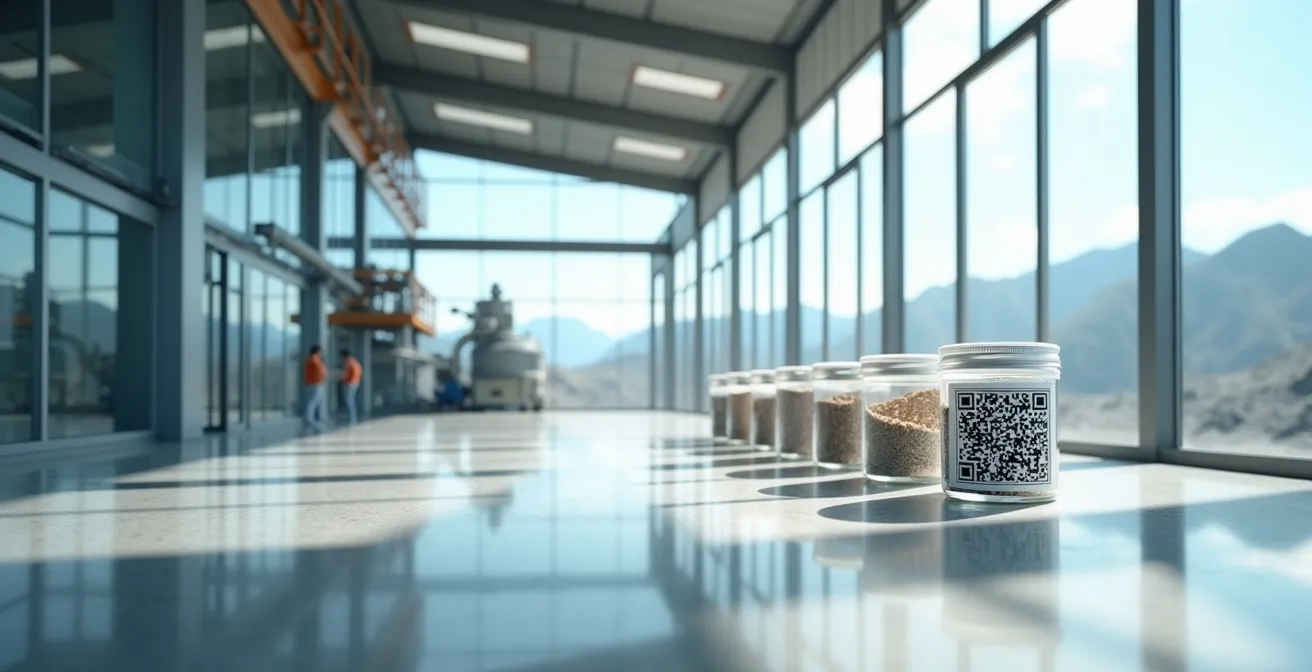
Practical implementation is already underway. For instance, the EU’s Raw Materials Radar Consortium (RMR) initiated a blockchain-based trial to enhance the transparency of artisanal and small-scale mining operations in Africa. By tracking the journey of minerals from off-grid sites, the project aims to legitimize responsible small-scale miners and provide buyers with verifiable proof of origin. For a supply chain director, adopting such a system transforms the audit process from a periodic, reactive exercise into a continuous, proactive monitoring system.
Action Plan: Auditing Your Supply Chain for Conflict Minerals
- Map Supply Chain Nodes: Identify every actor in your supply chain, from the mine and aggregator to the refiner and component manufacturer.
- Pilot a Blockchain Platform: Partner with a technology provider to run a pilot program on a single mineral stream (e.g., cobalt from one supplier) to test feasibility.
- Onboard Key Suppliers: Work with Tier 1 and Tier 2 suppliers to integrate their data into the blockchain ledger, establishing digital tokens for each batch of material.
- Establish Smart Contracts: Use smart contracts to automate compliance checks, ensuring payments are only released when materials are verified as conflict-free.
- Integrate with ESG Reporting: Link the blockchain data directly to your company’s ESG (Environmental, Social, and Governance) reporting for transparent and auditable claims.
Brine Extraction vs Hard Rock Mining: Which Has a Lower Water Footprint?
The choice of extraction method for lithium is a critical decision with profound implications for environmental impact and geopolitical positioning, especially concerning water usage. The two dominant methods, brine evaporation and hard rock mining, present a complex trade-off between water consumption, energy intensity, and processing time. With more than half the world’s lithium resources found in brine aquifers in Chile, Argentina, and Bolivia, understanding these differences is key to assessing supply chain vulnerabilities.
Brine extraction, common in South America, involves pumping lithium-rich salt water into vast ponds and letting it evaporate for 12 to 24 months. While it requires less energy for processing, its water footprint is enormous, leading to the hydrological destruction discussed earlier. Hard rock mining, prevalent in Australia, involves extracting lithium from spodumene ore. This process is much faster but is highly energy-intensive and creates large volumes of waste rock, known as tailings. While its direct water consumption is typically lower than brine extraction, it is by no means insignificant.
A third path, Direct Lithium Extraction (DLE), is emerging as a disruptive technology. DLE uses chemical processes to selectively remove lithium from brine in a matter of hours, not months. Crucially, most DLE technologies aim to reinject the water back into the aquifer, potentially reducing the net water footprint to near zero. The following table, based on an analysis of water use in lithium mining, highlights the key differences.
| Extraction Method | Water Usage per Ton of Lithium | Key Characteristics |
|---|---|---|
| Brine Extraction | Up to 500,000 gallons | Evaporation ponds, 12-24 months processing time, primarily in South America |
| Hard Rock Mining | 100,000-300,000 gallons | Energy-intensive processing, immediate extraction, creates tailings |
| Direct Lithium Extraction (DLE) | Significantly reduced (in development) | Chemical extraction, faster processing, water recycling potential |
For policy analysts, the geopolitical implication is clear: a country that masters and scales DLE technology could bypass the primary environmental and social conflicts associated with current methods, gaining a significant strategic advantage by producing lithium more quickly and sustainably.
The Tailings Dam Mistake That Risks Catastrophic Environmental Failure
The “take-make-waste” model of mining generates immense quantities of refuse, and nowhere is this risk more concentrated than in tailings dams. These are massive earthen structures, often holding millions of cubic meters of toxic, semi-liquid mining waste. A catastrophic failure—like the 2019 Brumadinho disaster in Brazil—can release a devastating wave of sludge, wiping out communities, poisoning entire river systems for decades, and instantly halting a significant source of global mineral supply. This represents a massive, under-appreciated physical risk in the critical minerals supply chain.
The mistake is viewing these dams as static engineering problems. In reality, they are dynamic systems highly vulnerable to another accelerating physical constraint: climate change. More intense and frequent rainfall events can oversaturate a dam, increasing pore pressure and leading to liquefaction and structural collapse. Conversely, prolonged droughts can dry out and crack the dam’s structure, weakening it before the next deluge. Water stress is already a major factor in mining operations, with an estimated 10% of global copper production facing supply risks related to droughts.
For supply chain directors, a tailings dam failure is a black swan event with crippling consequences. A single incident can remove a major producer from the market overnight, causing price spikes and severe shortages. The environmental cleanup and legal liabilities can bankrupt a mining company, and the social backlash can lead to a nationwide moratorium on new mining permits. Therefore, auditing a supplier’s tailings dam management practices—including their structural integrity, monitoring systems, and resilience to extreme weather events—is not just a matter of ESG compliance; it is a fundamental act of supply chain risk mitigation. The stability of these dams is a direct, physical dependency for the entire downstream industry.
How to Use Bio-Leaching to Recover Copper from Low-Grade Ores?
As high-grade mineral deposits are depleted, the mining industry is forced to turn to lower-grade ores, which are more costly and energy-intensive to process using traditional methods like smelting. Bio-leaching, or bio-mining, presents an innovative solution that leverages microbiology to extract metals like copper in a more environmentally friendly and economically viable way. This technology uses naturally occurring bacteria, such as *Acidithiobacillus ferrooxidans*, to oxidize sulfide minerals, effectively dissolving the target metal into a liquid solution from which it can be easily recovered.
The process involves piling the low-grade ore into large heaps and irrigating them with a weak acid solution containing the bacteria. As the solution percolates through the ore, the microbes go to work, breaking down the rock and releasing the copper. This “pregnant leach solution” is collected at the bottom and processed to extract the pure metal. The key advantages are significantly lower energy consumption compared to smelting and the ability to process ores that would otherwise be considered waste. This turns a liability—vast piles of low-grade ore—into a strategic asset.
From a geopolitical perspective, mastering bio-leaching contributes to what can be termed “full-stack sovereignty.” It allows a nation to maximize the output from its existing domestic mines, reducing its reliance on foreign sources. It also demonstrates a strategic approach to resource interdependence. For example, China has strategically sought to increase its production of copper from mines that also contain cobalt. This co-production strategy means that any effort to boost copper supply inherently increases the supply of cobalt, another critical battery mineral. This kind of operational intelligence, leveraging technology like bio-leaching to extract multiple value streams from a single operation, is a hallmark of a sophisticated national mineral security policy.
How to Accelerate Plastic Degradation Using New Enzyme Technologies?
A truly resilient mineral supply chain cannot rely on extraction alone; it must embrace a circular economy where materials are endlessly recycled. However, a lithium-ion battery is more than just its valuable metals. It contains significant amounts of plastics in components like separators and casings. Disposing of or recycling these plastics is a major challenge. As the Environmental and Strategic Studies Institute (EESI) points out, relying on complex international recycling streams carries its own dangers: “Supply chains dispersed across multiple countries are inherently susceptible to delays and geopolitical risk.” Developing local, advanced recycling capabilities is therefore a strategic imperative.
This is where new enzyme technologies offer a revolutionary breakthrough. Scientists have discovered and engineered enzymes, such as PETase and MHETase, that can break down common plastics like PET (polyethylene terephthalate) into their original chemical building blocks, or monomers. This process, known as enzymatic de-polymerization, is far superior to traditional mechanical recycling, which often results in down-cycled, lower-quality plastic. Enzymatic recycling, in contrast, can create virgin-quality monomers that can be used to make new, high-quality plastics, effectively closing the loop.

For the battery industry, this technology could be transformative. Imagine a recycling facility where shredded battery components are placed in a bioreactor. One set of processes extracts the cobalt, lithium, and nickel, while another uses specialized enzymes to dissolve the plastic separators and casings back into their base chemicals. These chemicals can then be used to manufacture new separators for the next generation of batteries. By mastering this technology, a nation or company can dramatically reduce its reliance on both foreign oil (for new plastics) and complex international waste streams, further bolstering its full-stack sovereignty over the entire battery lifecycle.
Why Do Lithium-Ion Batteries Lose Capacity in Extreme Cold?
Even with a secure supply of every critical mineral, the energy transition faces another non-negotiable physical constraint: the fundamental chemistry of lithium-ion batteries. A well-known issue for EV owners in northern climates is the significant loss of range and performance in extreme cold. This is not a manufacturing defect; it is an inherent property of the battery’s internal chemistry. In cold temperatures, the electrolyte inside the battery becomes more viscous, slowing down the movement of lithium ions between the anode and cathode. This increased internal resistance means the battery can discharge and charge much less efficiently, resulting in a temporary but dramatic loss of usable capacity.
This physical limitation has direct geopolitical consequences. It intensifies the race for technological superiority and drives demand for specific minerals. As the Belfer Center at Harvard notes, “Technology shifts which drive increased demand can outpace the ability to increase production, which intensifies the competition for minerals.” To combat poor cold-weather performance, researchers are developing new electrolyte formulations and battery chemistries that are more stable at low temperatures. These next-generation batteries may require different ratios of minerals, or entirely new ones, creating future supply chain shocks.
The urgency to innovate is compounded by soaring demand. The International Energy Agency’s net-zero scenario projects that the demand for critical minerals will need to triple by 2030 and quadruple by 2040. A battery technology that solves the cold-weather problem could capture a massive share of the global market, making its specific mineral inputs—whether lithium, sodium, or something else—the next great geopolitical prize. This illustrates how a seemingly small technical problem, rooted in basic physics, can ripple outwards to reshape global resource competition.
Key takeaways
- Geopolitical risk in mineral supply is driven more by physical constraints (water, geology, chemistry) than by trade policy alone.
- The current linear “take-make-waste” model creates extreme price volatility and environmental liabilities, making it economically unsustainable.
- True resource sovereignty requires mastering the entire material lifecycle, from innovative extraction and processing to advanced, localized recycling.
Why the “Take-Make-Waste” Model Is Bankrupting Manufacturers via Raw Material Costs?
The traditional linear economic model of “take-make-waste” is proving to be a recipe for bankruptcy in the age of the energy transition. This model relies on a continuous supply of cheap, accessible raw materials, an assumption that has completely broken down in the critical minerals sector. The result is a brittle supply chain characterized by extreme price volatility and geographic concentration of power. As the International Energy Agency has documented, lithium prices have fallen by over 80% since 2023 after increasing eightfold in the previous two years. This level of volatility makes long-term financial planning and investment in battery manufacturing incredibly risky.
This instability is exacerbated by the extreme concentration of processing and refining. As highlighted by Resources for the Future, China’s market position is no accident: “China’s dominance in critical mineral processing is the result of a longer-term industrial policy that allocated capital investment to critical minerals notwithstanding a somewhat modest rate of return.” This has created strategic geopolitical chokepoints where a single country controls the majority of the world’s refining capacity for multiple key minerals.
The data from the World Economic Forum paints a stark picture of this concentration, which is a direct consequence of China’s long-term industrial strategy, a key finding from a WEF report on supply chain challenges.
| Mineral | Primary Producer | Market Share | Primary Processor | Processing Share |
|---|---|---|---|---|
| Cobalt | Democratic Republic of Congo | 75% | China | 75% |
| Nickel | Indonesia | 50% | Indonesia/China | 60% |
| Rare Earth Elements | China | 67% | China | 90% |
| Lithium | Australia/Chile/Argentina | 70% | China | 60% |
Case Study: The US-Australia Critical Minerals Framework Agreement
In response to these vulnerabilities, Western nations are treating mineral security as a matter of national security. A prime example is the landmark Critical Minerals Framework Agreement signed by the US and Australia in October 2025. This pact committed each country to mobilize at least $1 billion in financing for new mining and processing projects. This move is a clear attempt to build alternative, resilient supply chains among allied nations, directly challenging the existing concentration of processing power and demonstrating a shift towards viewing minerals as strategic geopolitical assets.
The only viable path forward is a systemic shift towards a circular economy, coupled with strategic investments in diversifying not just mining locations, but processing and recycling infrastructure. This is the foundation of building a supply chain that is not just efficient, but truly resilient.
Ultimately, navigating the new geopolitical landscape requires a fundamental change in perspective. Policy analysts and supply chain directors must look beyond trade negotiations and assess the deep, physical risks embedded in their supply chains. Building resilience means investing in technologies that mitigate these risks—like DLE and enzymatic recycling—and forging partnerships based on shared technological and environmental standards, not just resource access. Begin today by auditing your supply chain not just for cost and origin, but for its exposure to these critical physical constraints.