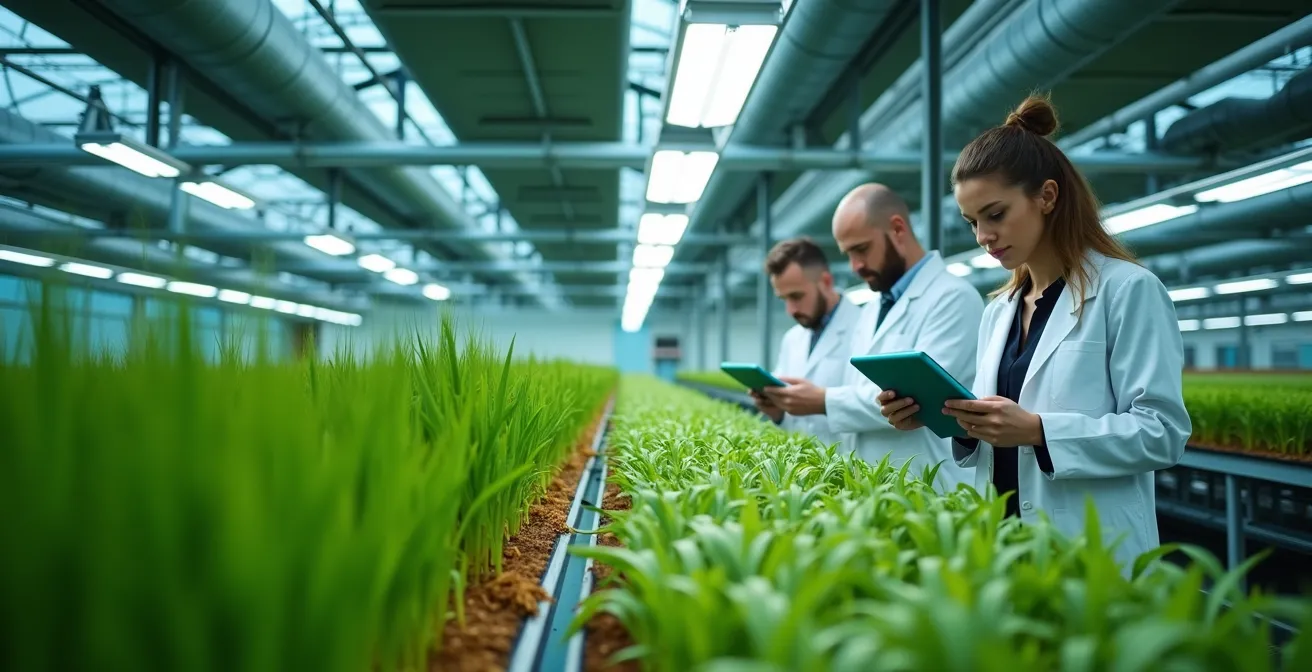
Future-proofing crops isn’t about finding a single resilient gene; it’s about strategically managing the genetic trade-offs between survival, yield, and breeding velocity.
- Success requires leveraging new tools like gene editing for precision and speed, moving beyond the slower pace of conventional methods.
- A systems-level approach, incorporating agroforestry and strategic crop diversification, is critical to building true farm-level resilience.
Recommendation: Breeders must act as portfolio managers, developing a diverse range of climate-adapted varieties rather than searching for a one-size-fits-all solution.
For seed breeders and agronomists on the front lines of climate change, the mission is no longer theoretical. Extreme heatwaves, prolonged droughts, and flash floods are now recurring variables in the agricultural equation. The conventional wisdom has been to chase specific resistance traits—a gene for drought tolerance here, another for heat resistance there. This siloed approach, however, is proving inadequate against the complex, overlapping challenges of our new climate reality. We are discovering that a hyper-focus on one trait can create unforeseen vulnerabilities elsewhere, such as a significant yield penalty.
The central challenge has shifted. It’s no longer just about identifying resilient genes, but about understanding and mastering the intricate genetic trade-offs between robust survival mechanisms and high productivity. The key question is not “Can we make a crop survive?” but “Can we make a crop thrive productively under stress, and can we do it fast enough?” This requires a paradigm shift, moving away from the search for a single magic bullet and toward a more holistic, portfolio-based strategy. We must think like systems engineers, not just geneticists.
This article will deconstruct this new reality. We will explore the precise biological failure points like pollen sterility, compare the acceleration potential of different genetic technologies, and analyze the critical mistake of sacrificing yield for survival. Ultimately, we will outline a forward-looking strategy that integrates advanced breeding with systems-level thinking to build a truly resilient agricultural future.
This guide provides a strategic overview for developing climate-resilient crops, moving from foundational genetic principles to global food security implications. The following sections break down the key challenges and innovative solutions at your disposal.
Summary: Breeding for Extremes: How to Ensure Crop Resilience Against Heatwaves and Floods?
- Why Does Pollen Sterility Occur Above 35°C in Major Crops?
- How to Test Seed Varieties for Drought Resistance on Your Farm?
- Transgenic vs Gene-Edited: Which Technology Accelerates Resilience Breeding Faster?
- The Breeding Mistake of Sacrificing Yield for Survival Traits
- How to Shift Planting Dates to Avoid Peak Heat Stress During Flowering?
- When to Plant Shade Trees to Maximize Summer Cooling for South-Facing Walls?
- The Global Trade Risk When Multiple Breadbaskets Fail in the Same Year
- Why Large-Scale Monocultures Are More Susceptible to Rapid Disease Spread?
Why Does Pollen Sterility Occur Above 35°C in Major Crops?
One of the most immediate and damaging effects of heatwaves on crop production occurs during the flowering stage, or anthesis. This is where the plant’s reproductive success is determined, and it is acutely vulnerable to thermal stress. For many major cereal crops, a critical environmental setpoint has been identified. Detailed research confirms that 35°C is the critical temperature threshold above which pollen viability drops dramatically, leading to fertilization failure and severe yield loss. At a cellular level, high temperatures disrupt the development of pollen grains, damaging their structure and rendering them sterile.

As the illustration above demonstrates, heat-stressed pollen appears shriveled and non-viable compared to healthy grains. This reproductive failure is a primary driver of yield collapse during heatwaves. Addressing this specific bottleneck is a major focus for modern breeders. The development of heat-tolerant varieties, such as the new wheat strains from CGIAR, represents a significant breakthrough. These varieties can maintain pollen viability and productivity at temperatures where traditional strains fail, demonstrating that the thermal tolerance of reproductive tissues can be significantly improved through targeted genetic selection.
How to Test Seed Varieties for Drought Resistance on Your Farm?
While laboratory analysis provides valuable genetic markers, nothing replaces field-level performance data when evaluating drought resistance. Agronomists and breeders need robust, practical methods to test how varieties perform under real-world water stress. The goal is to differentiate between simple survival and productive resilience—the ability to maintain acceptable yield with limited water. This involves moving beyond calendar-based irrigation and implementing managed stress environments to accurately assess a variety’s genetic potential. The distinction between drought resistance (survival) and drought tolerance (productive survival) is crucial here.
Implementing a structured on-farm testing protocol allows for the direct comparison of different cultivars under controlled stress. This data is invaluable for making informed selection decisions. Research from CGIAR, for example, shows that carefully selected drought-tolerant rice varieties can provide an 0.8-1.2 tons per hectare yield advantage over conventional varieties under water-scarce conditions. This proves that genetic gains can translate directly into tangible on-farm benefits. The key is a systematic approach to testing and measurement.
Your Action Plan: On-Farm Drought Resistance Testing
- Isolate Test Plots: Create small, replicated test plots where you can implement controlled irrigation shut-offs to simulate drought conditions uniformly.
- Manage Moisture: Use rainout shelters, often made from plastic sheeting on simple frames, to create managed stress environments and prevent unintended rainfall from interfering with the test.
- Monitor Plant Stress: Employ infrared thermometers to monitor the canopy temperature; a higher temperature is a reliable early indicator of water stress as the plant’s transpirational cooling decreases.
- Measure Recovery Capacity: After a period of stress, reintroduce water or wait for rainfall and meticulously measure the rate and extent of regrowth to test the variety’s recovery potential.
- Calculate Water Productivity: Go beyond simple yield and calculate the water productivity, measured in kilograms of grain produced per cubic meter of water applied, to identify the most efficient varieties.
Transgenic vs Gene-Edited: Which Technology Accelerates Resilience Breeding Faster?
The urgency of climate change has put immense pressure on breeders to accelerate the development of resilient cultivars. This has ignited a debate around the best technological pathways: traditional transgenic methods versus newer gene-editing techniques like CRISPR. Transgenic technology, which involves introducing foreign DNA into a plant’s genome, has a long history but often faces significant regulatory hurdles and public acceptance issues, which can slow down market entry. This “breeding velocity” is a critical factor in our ability to adapt.
Gene editing, particularly CRISPR-Cas9, offers a different paradigm. It allows for precise modifications to a plant’s existing DNA without necessarily introducing foreign genes. This can range from silencing an undesirable gene to tweaking the function of a beneficial one. For many regulatory bodies, if no foreign DNA is present in the final product, it may not be classified as a GMO, drastically reducing the time and cost of commercialization. This acceleration is arguably its greatest advantage in the race against climate change. As one leading research group notes, this precision is a game-changer.
CRISPR has raised strong hopes among plant scientists for precise integration of valuable traits and removal of undesirable ones. Genome editing using Site-Specific Nucleases (SSNs) is a good alternative to the plant breeding and genetic engineering approaches as it can modify the genomes specifically and precisely at the target site in the host genome.
– PMC Research Team, Raising Climate-Resilient Crops: Journey From Conventional Breeding to New Breeding Approaches
While both technologies are powerful, CRISPR’s ability to deliver targeted improvements with potentially fewer regulatory roadblocks gives it a distinct edge in breeding velocity. It enables a faster, more iterative approach to stacking multiple resilience traits, which is exactly what is needed to combat complex environmental stressors.
The Breeding Mistake of Sacrificing Yield for Survival Traits
A foundational error in early resilience breeding was the assumption of a simple, binary choice: yield or survival. Breeders often selected for plants that could withstand extreme stress, only to find that these “survivor” varieties carried a significant yield penalty under normal or moderately stressful conditions. This makes them economically unviable for farmers, who need consistent performance across a range of conditions, not just in worst-case scenarios. This flawed approach ignores the fact that resilience without productivity is not a solution.
The challenge is compounded by the slow pace of traditional development. Research indicates that the timeline for conventional cultivar development can take 10-14 years, a dangerously long period in a rapidly changing climate. This is where the concept of genetic trade-offs becomes central. The modern breeding goal is to “uncouple” negative correlations between survival traits and yield components. This requires sophisticated techniques that can pyramid multiple beneficial genes without bringing along undesirable traits. Innovations like IRRI’s Speed Breeding 3.0 are tackling this head-on, drastically shortening generation times and allowing for the efficient combination of complex traits to deliver both high yield and climate resilience.
How to Shift Planting Dates to Avoid Peak Heat Stress During Flowering?
While genetic improvement is the cornerstone of resilience, it is not the only tool. Agronomic management strategies play a vital complementary role. One of the most effective strategies is temporal avoidance: shifting planting dates to ensure that the crop’s most vulnerable reproductive stage—flowering—does not coincide with the period of highest probable heat stress. This is a data-driven approach that combines climate forecasting with an understanding of a variety’s specific developmental timeline (phenology).
Successfully implementing this strategy requires a new level of precision. Rather than relying on traditional calendars, agronomists must leverage modern tools to make informed decisions. Key tactics include:
- Using downscaled climate models to forecast heat stress windows for specific micro-regions.
- Implementing soil moisture sensors to enable condition-based planting rather than calendar-based routines.
- Selecting varieties with altered photoperiod sensitivity, offering greater flexibility in planting windows.
- Prioritizing the development of varieties with shorter flowering-to-maturity windows to escape terminal drought or heat.
This management approach works hand-in-glove with breeding efforts. For example, while breeders work to develop wheat that can endure higher temperatures, agronomists can simultaneously adjust planting schedules to provide an additional buffer. The existence of new varieties that, according to the Global Center on Adaptation, can endure temperatures up to 35°C gives farmers a wider, more flexible window for planting, making this strategy even more powerful. It transforms breeding from a standalone solution into an enabler of more sophisticated farm management.
When to Plant Shade Trees to Maximize Summer Cooling for South-Facing Walls?
Expanding our view from the individual plant to the entire farm system reveals other powerful levers for resilience. The principle of using shade trees, traditionally associated with cooling buildings, is directly applicable to crop microclimate management through agroforestry. By integrating trees into farming landscapes, we can create a more buffered and less volatile environment for the crops growing beneath or near them. This is not about building design but about ecological engineering at the farm scale.
The strategic placement of trees can significantly reduce canopy temperatures and water stress on understory crops. Field studies demonstrate that well-designed agroforestry systems can achieve a 2-5°C canopy temperature reduction, a substantial buffer during peak heat. This creates a more stable microclimate, protecting sensitive crops from the harshest temperature spikes and reducing evapotranspiration. Organizations like ICRAF (World Agroforestry), a CGIAR research center, are actively developing practical guides for farmers to design and implement these climate-resilient systems. Their work focuses on selecting the right tree species and placement to maximize benefits like shade, wind reduction, and soil health without competing excessively with crops for light and water.
For agronomists, this means thinking beyond the crop row and considering the farm as a holistic ecosystem. The “when” of planting trees is less about a specific season and more about a long-term farm plan. Trees should be established as part of a system designed to protect the most vulnerable fields from the most intense solar radiation, effectively creating permanent, living cooling infrastructure.
Key Takeaways
- Breeding for extremes is a game of managing genetic trade-offs, not just finding single resistance traits. Yield must be protected.
- New technologies like CRISPR are crucial for accelerating breeding velocity, a key factor in outpacing climate change.
- Systems-level thinking, including agronomic management and agroforestry, must be integrated with genetic improvements for true resilience.
The Global Trade Risk When Multiple Breadbaskets Fail in the Same Year
The focus on farm-level resilience is critical, but its ultimate importance is tied to global food security. Our modern food system is characterized by high efficiency and deep interconnectedness, but this also creates systemic vulnerabilities. We rely on a handful of major agricultural regions—”breadbaskets”—to feed the world. The risk of cascading failure arises when multiple of these breadbaskets experience simultaneous, climate-driven crop failures. A drought in North America, a flood in South Asia, and a heatwave in Eastern Europe occurring in the same year could trigger a global food crisis of unprecedented scale.
The numbers are already alarming. For instance, CGIAR data reveals that an estimated 4 million tons of rice are lost annually to floods in Bangladesh and India alone. When such events become more frequent and synchronized across the globe, the buffer capacity of international trade will be overwhelmed. This highlights a strategic flaw in our global food supply: over-reliance on a few key crops grown in a few key places. A more resilient system requires diversification at every level.
One of the most promising long-term strategies is the development and promotion of “orphan crops.” These are species like cowpea, finger millet, and grain amaranth that are highly adapted to marginal environments but have been neglected by mainstream agricultural research. As they are natural repositories of genetic diversity for stress tolerance, their integration into broader cultivation diversifies the food supply and reduces our dependence on a few vulnerable staples. This is not just a breeding strategy; it’s a global risk mitigation strategy.
Why Large-Scale Monocultures Are More Susceptible to Rapid Disease Spread?
The very foundation of our modern, efficient agricultural system—large-scale monoculture—is also its greatest weakness. Planting vast areas with a single, genetically uniform variety creates the perfect environment for the rapid evolution and spread of pests and diseases. A pathogen that can overcome the defenses of one plant can sweep through an entire region’s harvest with devastating speed. This lack of genetic diversity acts as a system-wide vulnerability, turning fields into an epidemiological highway for new disease strains, which are themselves often exacerbated by climate stress.
This risk is not theoretical. History is filled with examples, from the Irish Potato Famine to the southern corn leaf blight epidemic in the 1970s. In a future with more volatile weather, stressed plants will be even more susceptible to infection, amplifying the inherent risk of monocultures. The logical conclusion is that the most powerful long-term resilience strategy is the strategic deployment of genetic diversity. This doesn’t necessarily mean abandoning high-yield varieties, but rather managing a portfolio of different varieties with different resistance genes at a landscape level to create a genetic “firewall” against epidemics.
The raw material for this strategy lies within the world’s genebanks. These repositories are vast libraries of genetic potential. The CGIAR genebank network, for example, is a monumental effort to preserve this heritage, maintaining over 750,000 crop accessions. Tapping into this germplasm to continuously introduce new sources of resistance into elite cultivars is the ultimate future-proofing activity. It is the proactive antidote to the reactive crisis management that defines our current system.
By embracing a holistic approach that combines cutting-edge genetics with ecological principles and a deep respect for genetic diversity, we can develop the resilient, productive, and adaptable agricultural systems needed to feed the world in a changing climate.