Education and ecological awareness
Environmental challenges have never been more pressing, yet knowledge alone doesn’t guarantee action. The gap between understanding climate change and adopting sustainable behaviors reveals a fundamental truth: effective ecological education goes far beyond sharing facts. It requires engaging hearts and minds, fostering critical thinking, and empowering individuals to become agents of change in their communities.
Education and ecological awareness form the cornerstone of meaningful environmental progress. Whether teaching children about biodiversity, helping adults understand their carbon footprint, or training corporate leaders in sustainable practices, the methods we choose and the audiences we reach determine our collective ability to address ecological crises. This comprehensive exploration examines the principles, approaches, and impact measurement strategies that make environmental education truly transformative.
Why Ecological Education Matters Today
The relationship between environmental awareness and behavioral change is both profound and measurable. Research consistently demonstrates that communities with robust ecological education programs show significantly higher rates of recycling, energy conservation, and sustainable consumption patterns compared to those without such initiatives.
Consider the ripple effect of a single well-designed education program. When a child learns about ocean plastic pollution through hands-on beach cleanups, they don’t just absorb information—they become advocates who influence family purchasing decisions, inspire peers, and carry environmental values into adulthood. Similarly, when employees receive training in sustainability principles, organizations witness reduced waste, lower energy consumption, and innovative green solutions emerging from unexpected departments.
What makes ecological education particularly powerful is its multiplier effect. Unlike regulatory measures that enforce compliance, education cultivates intrinsic motivation. People who understand why forests matter, how ecosystems function, and what their daily choices mean for planetary health make informed decisions even when no one is watching. They become teachers themselves, spreading awareness through their social networks and creating cultural shifts that regulations alone cannot achieve.
Core Principles of Environmental Awareness
Building genuine ecological consciousness requires more than transferring information. It demands an approach grounded in three fundamental principles that transform passive learners into active environmental stewards.
Understanding Interconnected Systems
Effective environmental education reveals the invisible threads connecting human actions to ecological consequences. Rather than presenting isolated facts about endangered species or pollution levels, quality programs illustrate systems thinking—showing how a diet choice affects agricultural practices, which influence soil health, which impacts water quality, which determines aquatic ecosystem viability.
Think of it like understanding a spider web: touching one strand creates vibrations throughout the entire structure. When learners grasp these connections, they recognize that environmental protection isn’t about sacrifice—it’s about maintaining the systems that sustain all life, including our own prosperity and wellbeing.
Fostering Critical Thinking
Environmental education must equip people to evaluate claims, identify greenwashing, and navigate complex trade-offs. Critical thinking skills enable individuals to distinguish between meaningful sustainability efforts and superficial marketing, to weigh the environmental costs of different product choices, and to advocate for evidence-based policies.
This means teaching people to ask questions like: “What happens to this product after I’m finished with it?” or “What resources were consumed in creating this service?” Rather than prescribing rigid rules, this approach develops the analytical capacity to make informed decisions across diverse situations.
Encouraging Action and Responsibility
Knowledge without empowerment leads to despair. The most successful environmental education programs balance honest assessment of ecological challenges with actionable pathways for positive contribution. They help learners identify their unique capacity to create change—whether through consumer choices, community organizing, professional innovations, or civic engagement.
This principle recognizes that environmental responsibility looks different for everyone. A teacher might integrate sustainability into their curriculum, an accountant might champion green procurement policies, and a parent might model low-waste living for their children. Effective education helps each person discover their environmental role.
Effective Teaching Methods for Ecological Topics
The medium truly is the message in environmental education. Abstract lectures about ecosystem collapse rarely inspire lasting change, while immersive experiences that connect people emotionally and intellectually with nature create profound transformations.
Experiential and Outdoor Learning
Direct contact with natural environments remains unparalleled in building environmental connection. Programs that incorporate outdoor experiences—whether urban nature walks, wilderness expeditions, or hands-on conservation projects—create emotional bonds that purely classroom-based learning cannot match.
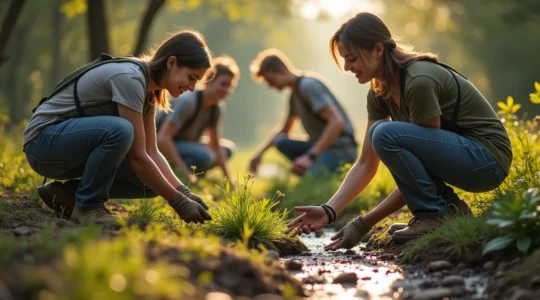
Participants who plant trees, monitor water quality, or observe wildlife behavior don’t just learn about ecology—they develop personal relationships with the natural world. These experiences are particularly powerful for young learners, whose outdoor childhood experiences strongly predict adult environmental values and behaviors. Even simple activities like maintaining a school garden or conducting neighborhood biodiversity surveys can spark lifelong ecological commitment.
Storytelling and Emotional Connection
Humans are wired for narrative. Environmental educators who harness storytelling—whether through documentary films, personal testimonials from affected communities, or case studies of successful restoration projects—tap into our capacity for empathy and imagination.
Stories make abstract concepts tangible. The journey of a single plastic bottle from a convenience store to a sea turtle’s digestive system creates more impact than statistics alone. Profiles of individuals who’ve reduced their carbon footprint by significant percentages inspire action more effectively than dire warnings. The key is balancing emotional resonance with factual accuracy, creating narratives that move people while maintaining scientific integrity.
Digital Tools and Interactive Resources
Technology expands the possibilities for environmental education dramatically. Interactive simulations allow learners to experiment with different scenarios—adjusting variables to see how energy choices affect climate projections, or how land-use decisions influence biodiversity. Virtual reality experiences can transport people to threatened ecosystems they might never visit physically, from coral reefs to Arctic tundra.
Mobile applications enable citizens to contribute to scientific research through biodiversity monitoring, pollution reporting, or phenology tracking. Online platforms connect learners globally, facilitating knowledge exchange across cultures and contexts. These tools don’t replace direct nature experiences, but they complement them, making environmental education more accessible, engaging, and participatory.
Tailoring Education to Different Audiences
One-size-fits-all approaches rarely succeed in environmental education. Different age groups, cultural contexts, and professional backgrounds require customized strategies that respect their unique perspectives, constraints, and opportunities for impact.
Children and Youth Programs
Early environmental education shapes lifelong values and habits. Effective programs for young learners emphasize wonder and curiosity rather than guilt or fear. Activities should be age-appropriate: preschoolers might explore sensory experiences in nature, elementary students could investigate local ecosystems, and teenagers might tackle community environmental challenges through service learning projects.
The most successful youth programs incorporate choice and leadership opportunities, allowing young people to identify environmental issues they care about and design their own solutions. This approach builds agency and demonstrates that environmental stewardship is about creation, not just restriction.
Adult and Community Education
Adult learners bring existing knowledge, established habits, and practical constraints. Effective programs acknowledge these realities while providing clear pathways for integration into busy lives. Community-based education often works best when it addresses local environmental concerns—water quality, air pollution, waste management—that directly affect participants’ health and wellbeing.
Peer-to-peer learning models, where community members teach each other skills like composting, energy efficiency, or sustainable gardening, create social connections that reinforce behavioral change. Adults are also motivated by economic benefits, so highlighting cost savings from energy conservation or local food production increases engagement.
Corporate and Professional Training
Workplace environmental education must connect ecological responsibility to professional identity and organizational success. Rather than generic sustainability overviews, effective corporate programs demonstrate industry-specific applications—how architects can design for climate adaptation, how supply chain managers can reduce transportation emissions, or how marketing teams can communicate authentic environmental commitments.
Professional training should also address the business case for sustainability, showing how environmental considerations drive innovation, reduce operational costs, manage regulatory risk, and enhance brand reputation. When employees understand how ecological thinking advances their career objectives and organizational goals, adoption accelerates dramatically.
Measuring Impact and Long-Term Change
Assessing the effectiveness of environmental education requires looking beyond immediate knowledge gains to examine behavioral change and long-term environmental outcomes. Successful measurement strategies typically combine multiple indicators:
- Knowledge assessments that evaluate understanding of ecological concepts and environmental issues
- Behavioral surveys tracking changes in consumption patterns, waste generation, energy use, and transportation choices
- Environmental metrics measuring actual ecological impact, such as reduced carbon emissions, increased recycling rates, or improved local biodiversity
- Social indicators examining how participants share knowledge, advocate for policies, or engage in community environmental initiatives
The challenge lies in the time lag between education and measurable environmental results. A child’s school program might not yield observable conservation behaviors for years. Corporate training might require months to influence procurement decisions. This reality demands patience and longitudinal evaluation approaches that track participants over extended periods.
Equally important is recognizing that not all impacts are quantifiable. Shifts in values, increased empathy for other species, or deeper connection to place represent profound outcomes that resist simple measurement yet fundamentally shape how individuals navigate environmental decisions throughout their lives.
The path to meaningful environmental progress winds inevitably through education and awareness. By grounding our efforts in solid pedagogical principles, employing diverse teaching methods, tailoring approaches to specific audiences, and thoughtfully measuring our impact, we transform ecological education from information delivery into genuine consciousness-building. Every person who develops environmental awareness becomes a potential catalyst for change, multiplying our collective capacity to address the ecological challenges we face together.
From Passive Observation to Active Stewardship: A Leader’s Guide to Mobilizing Communities for Local Restoration
Effective community restoration isn’t about organizing more events; it’s about designing a resilient ecosystem of engagement that transforms helplessness into empowerment. Local action provides a powerful antidote to eco-anxiety by giving individuals a tangible sense of agency and control. Volunteer…
Read more
The Psychologist’s Guide to Communicating Scientific Consensus Without Backlash
Communicating scientific consensus fails not from a lack of data, but from a misunderstanding of human psychology; success lies in navigating identity and building trust, not winning an argument. Beliefs are often protected by personal and group identity, making factual…
Read more
Why Environmental Literacy Is the Essential Skill for the Workforce of 2030?
The greatest challenge in preparing the 2030 workforce isn’t a lack of environmental facts, but a deficit in environmental systems thinking. True environmental literacy is a cognitive competency for managing complexity, not a test of memorized data. It shifts focus…
Read more