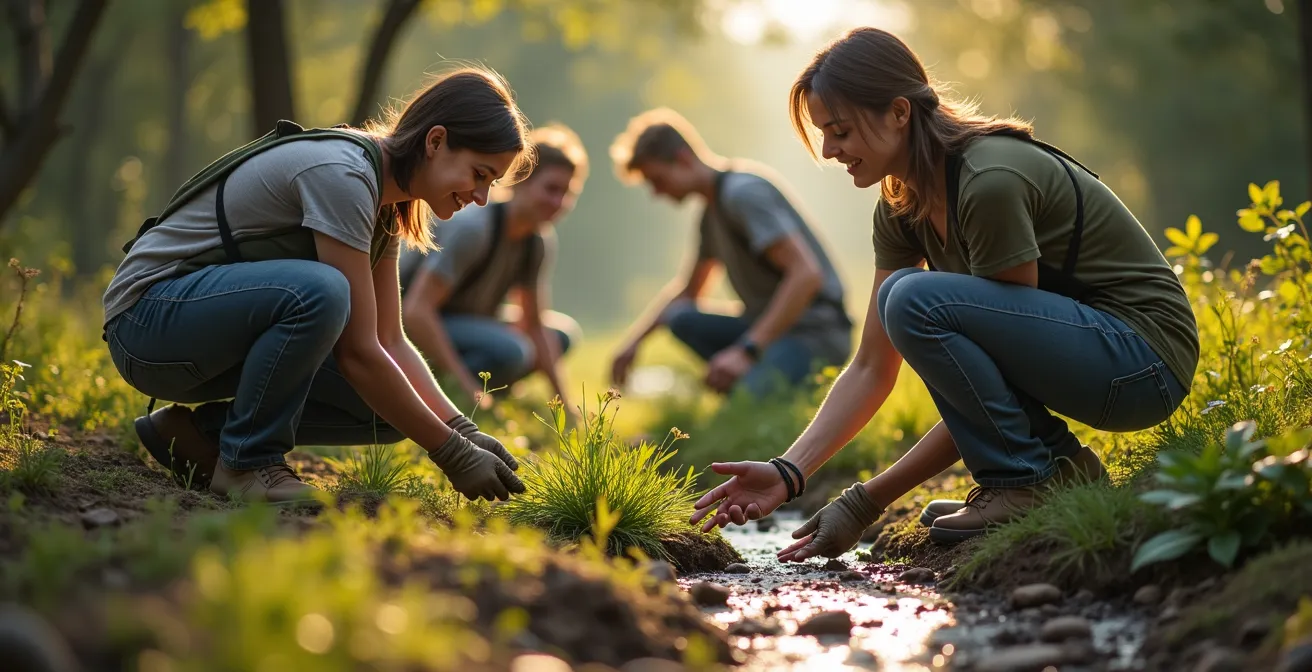
Effective community restoration isn’t about organizing more events; it’s about designing a resilient ecosystem of engagement that transforms helplessness into empowerment.
- Local action provides a powerful antidote to eco-anxiety by giving individuals a tangible sense of agency and control.
- Volunteer burnout is a systemic failure of leadership, not an individual’s problem. Diverse, flexible roles are key to long-term retention.
Recommendation: Shift your focus from simply recruiting volunteers to architecting a sustainable program that provides clear impact, diverse roles, and economic viability.
For many community leaders, the sight of a degraded local stream or an empty lot overgrown with invasive species sparks a familiar mix of frustration and a desire to act. The challenge, however, is immense. How do you transform the passive concern of a neighborhood into the active, coordinated force needed for meaningful ecological restoration? The common answer often involves organizing a local cleanup day, plastering flyers, and hoping for the best. This approach, while well-intentioned, frequently leads to a small group of overworked organizers and a cycle of one-off events with fleeting impact.
The conventional wisdom focuses on raising awareness or perfecting promotional tactics. But what if these are just symptoms of a deeper issue? The real challenge isn’t a lack of concern; it’s a lack of a clear, sustainable framework for engagement. People feel overwhelmed by the scale of environmental problems, and a single day of picking up trash, while satisfying, can feel like a drop in the ocean. This feeling of helplessness is the real barrier to sustained action.
This guide offers a different perspective. It argues that the key to mobilizing communities is not just to give them something to do, but to build an engagement ecosystem. This system is designed to directly counter feelings of helplessness by providing psychological agency, demonstrating measurable impact, and creating sustainable pathways for long-term stewardship. Instead of just planning an event, you will learn to architect a movement.
We will explore the psychological drivers that turn anxiety into action, the practical steps to ensure your projects have a real ecological impact, and the strategies to build a resilient, long-term volunteer force. This is your blueprint for moving from passive observation to active stewardship.
Summary: A Strategic Blueprint for Community-Led Restoration
- Why Does Participating in Local Cleanup Reduce Feelings of Helplessness?
- How to Organize a Stream Restoration Day That Actually Impacts Water Quality?
- Giving Money vs Giving Time: Which Builds Stronger Community Resilience?
- The Leadership Mistake That Exhausts Volunteers in 6 Months
- When to Launch a Campaign to Maximize Seasonal Volunteer Turnout?
- How to Identify the Keystone Species in Your Local Woodland or Wetland?
- How to Plan a Small-Scale Rewilding Project on Private Land?
- How Rewilding Projects Can Revitalize Rural Economies Through Ecotourism?
Why Does Participating in Local Cleanup Reduce Feelings of Helplessness?
The feeling of powerlessness in the face of global climate change is a significant emotional burden. In fact, studies indicate that 70-80% of adults experience some level of ecological anxiety. This widespread distress can lead to paralysis, but local, hands-on action provides a powerful antidote. Participating in a tangible project, like a stream cleanup, directly addresses the core psychological need for agency—the ability to exert control and see a direct result of one’s efforts. It shifts an individual’s role from a passive worrier to an active problem-solver.
This psychological shift is not just a feeling; it is a recognized therapeutic mechanism. As researchers have noted, tangible action provides a channel for empowerment. As one study in Frontiers in Psychology highlights:
Engaging in environmental activities provides individuals with a sense of control that can mitigate distress, serving as a therapeutic channel for converting feelings of helplessness into empowerment.
– Various researchers, Frontiers in Psychology Study 2025
When a volunteer removes a bag of trash from a riverbank, they are not just cleaning a physical space; they are reclaiming a piece of their own psychological agency. They can see the before and after, touch the results of their labor, and share the accomplishment with a community. This process transforms an overwhelming, abstract problem into a manageable, local, and solvable one, building momentum for more significant and sustained engagement.
How to Organize a Stream Restoration Day That Actually Impacts Water Quality?
A successful restoration day must be measured by more than just the number of volunteers or bags of trash. For long-term community buy-in, you must demonstrate real ecological impact. This requires an impact-led design approach, where planning begins with the question: “How will we know we made a difference?” The key is to move from a simple “cleanup” to a “restoration monitoring” event. This involves strategic site selection and, crucially, data collection.
Before the event, use local maps to identify high-impact zones, such as sensitive upstream habitats or key pollution entry points. During the event, go beyond simply collecting litter. Equip your team with simple tools to measure what matters. The presence or absence of specific aquatic macroinvertebrates, for example, is a powerful and visible indicator of water health.

As the image above illustrates, creatures like mayfly larvae and caddisflies are highly sensitive to pollution. Documenting their return to a restored area provides concrete, visual proof of improving water quality. You don’t need expensive lab equipment to start. Simple, community-friendly tools can provide a robust baseline.
The following table outlines accessible DIY methods that can transform your volunteers into citizen scientists, making the impact of their work undeniable.
| Tool | Cost Range | Measurement | Accuracy |
|---|---|---|---|
| DIY Turbidity Sensor | Under $50 | 0-4000 NTU | Comparable to commercial |
| Kick-net Method | $20-40 | Macroinvertebrates | Qualitative indicator |
| Photo Documentation | Free (smartphone) | Visual changes | Baseline comparison |
Giving Money vs Giving Time: Which Builds Stronger Community Resilience?
In the world of non-profits, financial donations are the lifeblood of operations. However, when the goal is to build genuine community resilience, the equation becomes more complex. While a donation is a transaction, volunteering is a transformational experience. Giving money supports an organization, but giving time builds a movement. It weaves the social fabric that financial support alone cannot buy. When community members invest their personal time and energy, they develop a sense of ownership and connection to the place and the people involved.
This shared effort is the foundation of an engagement ecosystem. A financial donor is a supporter; a volunteer becomes an advocate, a recruiter, and a future leader. They see the problems firsthand, celebrate the victories together, and develop the informal social networks that are critical during times of stress or crisis. This is the essence of community resilience—not just a restored habitat, but a network of people connected by a shared purpose and a proven ability to work together.
A prime example of this is the San Antonio River Authority’s “River Warrior” program. It doesn’t just ask for help; it builds a community. Volunteers are trained in new skills like rain garden construction and citizen science, giving them tangible expertise. They gain leadership opportunities and are recognized for their commitment. This model demonstrates that the true return on investment from volunteering isn’t just the work completed; it’s the creation of a dedicated, skilled, and interconnected community of stewards who are deeply invested in the long-term health of their watershed.
The Leadership Mistake That Exhausts Volunteers in 6 Months
The single most common leadership mistake in volunteer-led organizations is assuming that passion is a limitless resource. It is not. Relying solely on a small group of highly-motivated individuals to do all the heavy lifting—both literally and figuratively—is a direct path to burnout. When a dynamic new volunteer suddenly disappears after six months, it’s rarely because they stopped caring. It’s because the system failed them. Volunteer burnout is a failure of program design, not a lack of individual commitment.
The core mistake is a one-size-fits-all approach to engagement. Many programs are built around a single type of activity, typically strenuous manual labor on a Saturday morning. This immediately excludes a vast pool of potential talent: the parent who can’t commit to a full day, the retiree with physical limitations but deep organizational skills, or the student who could manage your social media from their dorm room. A resilient engagement ecosystem offers a “menu of roles” that caters to diverse skills, abilities, and time commitments.
To prevent burnout and build a sustainable volunteer base, leaders must actively distribute responsibility and empower their community. This involves several key shifts:
- Create a diverse “menu of roles” beyond manual labor: social media management, grant writing, data entry, photography, event planning, and community outreach.
- Establish clear metrics and celebrate small wins; volunteers need to see the tangible results of their specific efforts.
- Avoid centralizing all knowledge and decision-making in one leader. Empower volunteers to take ownership of specific projects or tasks.
- Offer flexible time commitments, from one-hour “micro-volunteering” tasks to multi-day projects.
- Provide role options that cater to different physical abilities, skill levels, and social preferences (e.g., group tasks vs. solo work).
When to Launch a Campaign to Maximize Seasonal Volunteer Turnout?
Strategic timing can dramatically amplify the impact of your restoration efforts and volunteer recruitment. Launching a campaign is not just about choosing a date on the calendar; it’s about aligning your activities with both ecological rhythms and community calendars. A well-timed campaign feels relevant, urgent, and easy to join. An ill-timed one feels like an uphill battle. The goal is to ride existing waves of energy rather than trying to create one from scratch.
Ecologically, different restoration activities have distinct optimal seasons. Planting native trees is best done in early spring to allow roots to establish before summer heat, while removing invasive species is most effective before they go to seed in late spring. Aligning your campaigns with these natural cycles ensures that volunteer efforts yield the best possible results, reinforcing their sense of impact.
From a community perspective, piggybacking on existing events is a powerful strategy. For instance, Project Clean Stream, organized by the Alliance for the Chesapeake Bay, brings together tens of thousands of volunteers annually by coordinating its main cleanup event around Earth Day. This leverages existing public awareness and media attention. Tying a water quality monitoring campaign to the start of the summer swimming season or a native seed collection drive to a local fall harvest festival are other ways to ensure your campaign is both timely and culturally resonant.
This table outlines how to align activities with the seasons for maximum ecological benefit.
| Season | Optimal Activities | Ecological Rationale |
|---|---|---|
| Early Spring | Tree planting | Optimal rooting before summer stress |
| Late Spring | Invasive removal | Before plants go to seed |
| Summer | Water quality monitoring | Peak recreational use awareness |
| Fall | Native seed collection | Seeds mature for next season |
How to Identify the Keystone Species in Your Local Woodland or Wetland?
When planning a restoration, there is a natural tendency to focus on charismatic species—the majestic hawk, the colorful butterfly. While important, a truly resilient ecosystem is built upon its often-overlooked workers: the keystone species. These are organisms whose impact on the environment is disproportionately large relative to their abundance. Identifying and supporting them is one of the most effective strategies for high-impact restoration.
A keystone species might be an “ecosystem engineer” like the beaver, whose dams create entire wetland habitats. It could be a super-pollinator like a specific native bee that is essential for the reproduction of dozens of plant species. Or it could be a primary seed disperser, like a particular bird or small mammal, responsible for planting the next generation of forest. Their absence creates a cascade of negative effects. Their presence supports a multitude of other life forms.
Identifying these crucial players doesn’t always require a PhD in ecology. It requires a shift in focus from “what is pretty?” to “what does the work?”. One of the most valuable and underutilized resources for this is traditional ecological knowledge. As a study on forest restoration highlighted, indigenous and local communities often hold multigenerational knowledge about species interactions and ecological functions that is invaluable. The Karen and Lawa ethnic groups in Thailand, for example, have used their traditional knowledge to significantly improve forest restoration practices by identifying key native species.
You can start this discovery process with your own community by:
- Organizing a local “BioBlitz” using apps like iNaturalist to create a collective species inventory.
- Interviewing local elders, long-time farmers, and bird-watching groups for historical data on species that were once common.
- Focusing on functional roles: which animals build, dig, or create habitat? Which plants are the first to colonize bare ground?
- Looking for primary seed dispersers and super-pollinators whose absence would cause a ripple effect.
How to Plan a Small-Scale Rewilding Project on Private Land?
Rewilding can sound like a colossal undertaking reserved for vast national parks. However, its core principles can be powerfully applied on any scale, even a suburban backyard. The most effective approach for small-scale rewilding on private land is often one of strategic subtraction, not addition. It’s less about what you plant and more about what you stop doing. This philosophy allows natural processes to resume, inviting biodiversity back with minimal cost and effort.
The modern manicured lawn is often an ecological desert, demanding constant inputs of water, fertilizer, and labor while offering little to no habitat for local wildlife. The first step in rewilding is to reclaim some of this space for nature. By simply ceasing to mow a portion of your lawn, you create the conditions for meadow grasses and wildflowers to emerge. By leaving fallen leaves and deadwood, you provide essential food and shelter for insects, amphibians, and fungi, which form the base of the food web.
This “less is more” approach is not just easier; it’s often more ecologically sound. Natural regeneration allows the plants best suited to your specific soil and microclimate to thrive. Furthermore, allowing a large number of individual plants to establish themselves naturally helps ensure the genetic diversity that is critical for long-term population health and resilience to change. Your role shifts from a ‘gardener’ imposing a design to a ‘curator’ facilitating natural succession.
Your Action Plan: The Subtraction Approach to Rewilding
- Stop Mowing: Designate specific sections of your lawn and allow them to grow wild to see what naturally emerges.
- Cease Pesticide Use: Immediately halt the use of all pesticides and herbicides to allow insect populations to recover.
- Leave the Leaves: In the fall, leave fallen leaves and deadwood on the ground to serve as vital wildlife habitat and natural mulch.
- Create Habitat Islands: Establish small, dedicated patches for wildflowers, a small pond or water feature, and brush piles for shelter.
- Connect the Islands: Plan wildlife corridors, like a line of native shrubs or an unmown strip, to connect your habitat islands and allow wildlife to move safely.
Key takeaways
- Community action is the most effective antidote to ecological anxiety, providing a tangible sense of agency.
- Focus on impact-led design by integrating simple monitoring and data collection into every event to prove your effectiveness.
- Volunteer burnout is a system failure; build a “menu of roles” with flexible commitments to create a sustainable engagement ecosystem.
How Rewilding Projects Can Revitalize Rural Economies Through Ecotourism?
For many rural communities, economic vitality can seem at odds with environmental protection. However, ecological restoration and rewilding projects are increasingly proving to be powerful engines for economic revitalization. By healing the land, communities can create new, sustainable revenue streams that are directly tied to the health of their local ecosystems. This isn’t about choosing between the economy and the environment; it’s about building a new economy based on the environment.
The most direct path is through ecotourism. A restored wetland or a rewilded forest becomes an attraction for bird watchers, hikers, and nature photographers. This brings tourist dollars into local cafes, shops, and guesthouses. But the economic benefits go much deeper. A restored ecosystem can produce a variety of valuable goods and services, creating what are known as stacked enterprises—multiple, layered revenue streams from the same piece of land.
A powerful example comes from Brazil’s Xingu region, where Indigenous peoples and local farmers have developed a restoration economy. Using a traditional technique called “muvuca,” they sow diverse mixes of up to 120 native species per hectare. This not only restores the forest but also produces valuable crops like cashew and açaí, creating direct economic returns while healing the land. The restored forest also provides opportunities for foraging workshops, native seed sales, and guided nature tours.
This model shows that a rewilding project can be structured as a business incubator. The table below illustrates potential revenue streams that a community can build upon a restoration project.
| Revenue Stream | Investment Level | Time to Income | Market |
|---|---|---|---|
| Foraging workshops | Low | Immediate | Local residents |
| Native seed sales | Medium | 1-2 seasons | Regional gardeners |
| Forest bathing sessions | Low | Immediate | Nearby towns |
| Rewilding consultation | Medium | After 2-3 years | Landowners/municipalities |
The path from passive observation to active stewardship is a journey of empowerment. By designing an engagement ecosystem that addresses the psychological needs of your community, proves its own impact, and builds economic resilience, you can create a movement that not only restores landscapes but revitalizes the human spirit. Your next step is to begin architecting this system for your own community.