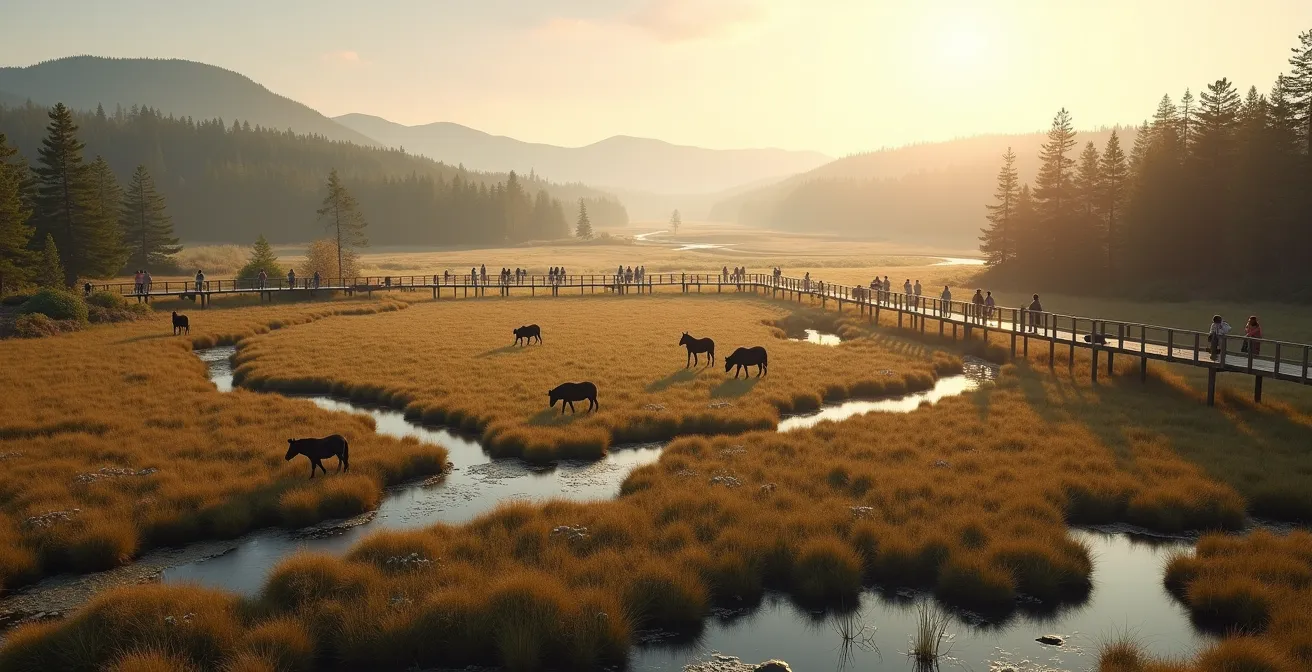
Rewilding transforms rural landscapes from potential liabilities into a profitable, diversified economic portfolio.
- It creates high-value ecotourism products by restoring natural processes and reintroducing keystone species.
- It generates new revenue from ecosystem services like flood control, while turning potential human-wildlife conflicts into financial opportunities through innovative business models.
Recommendation: Begin by mapping your area’s unique ecological capital and develop a phased business plan to unlock its economic potential.
For many rural community leaders and landowners, the term “rewilding” can evoke images of land abandonment and economic decline. The prevailing conversation often revolves around the costs of conservation and the challenges of coexisting with wildlife. This perspective, while understandable, overlooks a profound economic truth. The most common advice focuses on seeking grants or managing problems, treating nature as a passive element to be contained rather than a dynamic engine for growth.
But what if the entire framework is flawed? What if rewilding, far from being a retreat from productivity, is actually a strategic investment in a new, resilient, and high-value economic model? The true potential lies not in simply letting nature take over, but in actively guiding its restoration to build a sophisticated nature-based economy. This approach transforms ecological assets—like healthy rivers, thriving wildlife populations, and resilient wetlands—into a diversified portfolio of revenue streams, from premium ecotourism to monetized ecosystem services.
This article provides an economic roadmap for rural leaders. We will deconstruct the financial value of natural processes, outline a practical business model for small-scale projects, and explore strategies for turning ecological challenges into market advantages. It’s time to move beyond the debate of agriculture versus wilderness and embrace a more profitable synthesis: rewilding as a catalyst for rural revitalization.
text
For those who prefer a visual format, the following video offers an inspiring look at how rewilding acts as a powerful engine for biodiversity, which is the foundation of any thriving nature-based economy.
To understand how to harness this economic potential, we will explore the core components of a successful rewilding strategy. This guide breaks down the process, from the fundamental ecological principles to the advanced economic and communication strategies needed to ensure long-term success.
Summary: A Strategic Guide to Rewilding as an Economic Engine
- Why Do Wild Ponies Create More Diverse Habitats Than Mowers?
- How to Plan a Small-Scale Rewilding Project on Private Land?
- Fenced Reserves vs Wildlife Corridors: Which Better Supports Genetic Diversity?
- The Communication Mistake That Turns Local Farmers Against Rewilding Initiatives
- How to Protect Livestock When Wolves Return to the Area?
- When to Reintroduce Beavers to Mitigate Droughts Naturally
- Why Is a Wetland Worth More Than a Parking Lot in Flood Prone Areas?
- Why the Removal of Keystone Species Like Wolves Collapses River Ecosystems?
Why Do Wild Ponies Create More Diverse Habitats Than Mowers?
The foundation of a nature-based economy lies in understanding a simple principle: natural processes create more value than artificial ones. A manicured lawn, maintained by a mower, is an ecological desert. It’s a monoculture that requires constant input of energy and money. In contrast, a landscape grazed by wild or semi-wild herbivores like ponies becomes a complex, dynamic mosaic of habitats. This isn’t just an ecological benefit; it’s the first step in building ecological capital.
Ponies don’t graze uniformly. They selectively browse, trample certain areas, and leave others untouched, creating a varied structure of short and tall grasses, open ground, and scrubland. Their dung fertilizes the soil and supports a rich web of insects, which in turn feeds birds and other small animals. This complexity is precisely what attracts visitors and makes an ecosystem resilient. It’s the difference between a sterile green carpet and a living tapestry, and that tapestry has immense economic potential. The global market for this kind of experience is vast; a landmark report showed that wildlife tourism generates $343.6 billion globally, a figure built on the appeal of authentic, diverse ecosystems.
From an economic standpoint, using ponies as “ecosystem engineers” is far superior to mechanical mowing. They work 24/7, require minimal capital outlay compared to machinery, and their “output” is not just a tidy field but a thriving, biodiverse asset that forms the basis for ecotourism products like wildlife photography tours, bird watching, and educational walks. This is the first strategic shift: viewing land management through the lens of asset creation, not just maintenance.
How to Plan a Small-Scale Rewilding Project on Private Land?
Transitioning from a traditional land-use model to a nature-based economy requires a clear business plan, not just good intentions. For landowners, this means treating rewilding as a startup venture. The goal is to develop a phased approach that manages initial investment while building towards long-term profitability. This strategy de-risks the project and allows the business to grow in lockstep with the ecosystem’s recovery.

As the illustration suggests, modern rewilding is a data-informed, strategic process. A viable business model, championed by organizations like Rewilding Europe, often follows three distinct phases that align investment with emerging revenue opportunities:
- Phase 1: Foundational Investment. This initial stage focuses on kick-starting ecological recovery. It involves minimal-intervention habitat restoration, such as halting drainage, removing unnecessary fences, and potentially a small-scale reintroduction of key herbivores. The primary cost is the initial setup and foregoing previous income, but the goal is to build the core ecological asset.
- Phase 2: Pioneer Products. As the ecosystem begins to recover and wildlife returns, the first revenue streams can be launched. These are typically low-impact, high-value “pioneer” products like wildlife hides for photographers, exclusive guided tours focusing on the restoration story, or rustic, off-grid accommodation. These products test the market and generate early cash flow.
- Phase 3: Scaling the Business. With proven ecological success and market validation, the business can scale. This may involve developing more sophisticated accommodations, creating partnerships with local food producers, and marketing the area as a unique destination. At this stage, monitoring technology can be used for both conservation tracking and enhancing visitor experiences.
Crucially, this model is not about replacing agriculture but diversifying the land’s economic output. It positions the landowner as a producer of biodiversity, recreation, and ecosystem services—a far more resilient portfolio than relying on a single commodity.
Fenced Reserves vs Wildlife Corridors: Which Better Supports Genetic Diversity?
As a rewilding project matures, a critical strategic question emerges: is it better to create an isolated, fenced “island” of wilderness, or to connect with a larger network? From an economic perspective, the answer is clear. While fenced reserves can be easier to manage initially, wildlife corridors create far more valuable and resilient ecological assets. The reason is genetic diversity. Isolated populations are vulnerable to inbreeding and disease, making the “asset” fragile. Connected populations are robust, dynamic, and ultimately, more attractive.
Wildlife corridors act as arteries, allowing animals to move, breed, and exchange genes between different areas. This creates a larger, healthier meta-population that is more resilient to climate change and other pressures. For a nature-based economy, this translates directly into a better “product.” A larger, more dynamic ecosystem supports a greater abundance and variety of wildlife, offering more compelling visitor experiences. For example, evidence shows that connected wildlife corridors in Romania’s Carpathians attract thousands of visitors annually, drawn by the chance to see iconic species like bison, bears, and wolves in a vast, wild landscape.
The Velebit Mountains in Croatia offer a powerful blueprint for this approach. As Stuart Kenny from Much Better Adventures Magazine notes, Rewilding Europe has been instrumental in creating a large, connected landscape:
Rewilding Europe acquire 23,000-hectares of hunting concessions between two large national parks in the Velebit Mountains of Croatia, where they’re developing a nature-based economy in a unique habitat which supports Balkan chamois, red deer, brown bears, wolves, lynx and more
– Stuart Kenny, Much Better Adventures Magazine
By linking existing parks, they are not just protecting wildlife; they are creating a world-class ecotourism destination whose value is far greater than the sum of its parts. For local landowners, participating in such a corridor means their property becomes part of a much larger, more marketable story.
The Communication Mistake That Turns Local Farmers Against Rewilding Initiatives
The single biggest obstacle to many rewilding projects is not ecological, but social. The most common mistake is framing the initiative in purely environmental terms, using language that alienates the very people whose support is essential: local farmers and landowners. Talking about “restoring wilderness” or “land abandonment” can be perceived as a direct threat to their livelihood, heritage, and identity. A successful rewilding strategy must be, first and foremost, a successful communication strategy rooted in shared economic interests.
The key is to shift the narrative from ecological idealism to economic pragmatism. Instead of “wilderness,” use terms like “ecological health and profitability.” Instead of “abandonment,” frame it as “economic diversification.” This reframing is not just semantics; it’s a fundamental change in perspective that invites farmers to be partners in a new venture, rather than obstacles to a conservation project. The success of the River Otter Beaver Trial in the UK is a testament to this approach. Through careful engagement and focusing on shared benefits, a study showed that over the course of the trial, the number of people in favour of beaver reintroduction increased to an overwhelming 90%.
Engaging farmers as co-designers, not adversaries, is essential. By involving them in mapping project boundaries and integrating agricultural heritage into the ecotourism story, the project becomes a shared community asset. Showing how they can be paid for delivering ecosystem services—like flood control or carbon storage provided by a restored wetland—turns them into active suppliers in the new nature-based economy.
Action Plan: Communication Strategies That Win Farmer Support
- Frame rewilding as ‘Economic Diversification’ not ‘Land Abandonment’.
- Use language of ‘Ecological Health and Profitability’ instead of ‘Wilderness’.
- Host co-design workshops where farmers help map the project boundaries and identify opportunities.
- Integrate agricultural heritage into the ecotourism narrative, celebrating the complete history of the landscape.
- Demonstrate clear financial models where farmers are paid for producing ecosystem services like flood control or water purification.
Ultimately, a rewilding project’s success is measured not just in hectares restored, but in the strength of its community partnerships. The right communication builds a coalition for prosperity; the wrong one creates a battlefield.
How to Protect Livestock When Wolves Return to the Area?
The return of large predators like wolves is often the most contentious aspect of rewilding for rural communities, particularly for livestock farmers. The legitimate fear of economic loss from predation can derail a project before it begins. A purely defensive mindset, however, misses a significant economic opportunity. The most forward-thinking approach moves beyond conflict to create coexistence business models that can turn the presence of predators into a unique market advantage.
The foundation of this approach is effective, non-lethal livestock protection. Traditional methods, proven over centuries, are making a comeback. The use of specialized livestock guardian dogs (like Great Pyrenees or Maremma Sheepdogs), increased human presence (shepherding), and strategic fencing are highly effective at preventing attacks. These methods represent a proactive investment in asset protection, much like insuring a barn against fire.
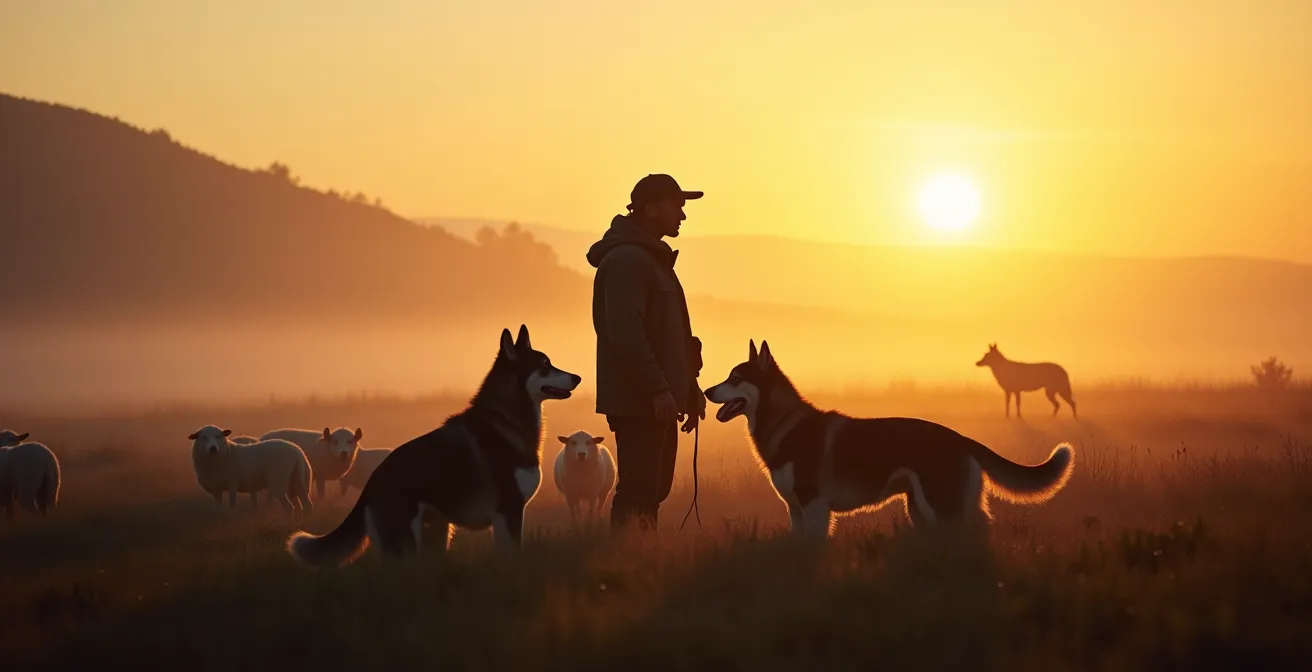
The truly transformative step, however, is to market this responsible stewardship. Consumers are increasingly willing to pay a premium for products that are ethically and sustainably produced. This has given rise to “predator-friendly” certification programs. By demonstrating that their livestock is raised in harmony with local wildlife, farmers can achieve premium pricing for predator-friendly certified products like meat, wool, or cheese. The wolf, once seen only as a liability, becomes a key part of the product’s story and value proposition. This is a powerful example of turning a perceived risk into a tangible revenue stream, fully integrating the wild ecosystem into the farm’s balance sheet.
When to Reintroduce Beavers to Mitigate Droughts Naturally
Beavers are not just charismatic animals; they are master ecosystem engineers and a prime example of a keystone species that can generate significant economic returns. The decision to reintroduce them should be made when a rural economy is looking to build resilience against climate extremes like drought and flood, while simultaneously creating new tourism revenue. A landscape with beavers is a landscape with more water, more biodiversity, and more economic potential.
Beavers build dams that create complex wetland systems. These wetlands act like natural sponges, storing water during wet periods and slowly releasing it during dry spells, effectively mitigating the impacts of drought. This service alone has immense value for agriculture and local communities. Furthermore, these wetlands are biodiversity hotspots. One study highlighted in a recent report on reintroducing beavers to Britain found that beaver-created wetlands can house 50% more species than those without them. This explosion of life—from dragonflies to fish to waterfowl—becomes the “product” for a new ecotourism economy.
The economic case is compelling. In areas that have embraced their beaver populations, the financial benefits are tangible. For instance, a KLC study showed that in one region, Beaver Dam tourism generated $22.4 million in regional economic impact in 2024 alone. Visitors are drawn to the unique landscapes beavers create and the chance to see these industrious animals at work. By reintroducing beavers, communities are not just restoring a species; they are hiring the world’s most cost-effective water management and tourism development consultants, who work for free.
Why Is a Wetland Worth More Than a Parking Lot in Flood Prone Areas?
In traditional economic thinking, development means converting natural landscapes into built infrastructure. A parking lot generates direct, measurable income. A wetland, on the other hand, is often seen as “unproductive” land. This view is dangerously outdated, especially in areas prone to flooding. When analyzed as a multifunctional asset, a healthy wetland is vastly more valuable to a rural economy than a stretch of asphalt.
The economic value of a wetland comes from the diverse “ecosystem services” it provides for free. These are benefits that would otherwise require massive investment in engineered solutions. A wetland’s ability to absorb and slow floodwaters, filter pollutants, and sequester carbon represents millions of dollars in saved infrastructure and cleanup costs. Moreover, it actively generates value. Studies consistently show higher property values near natural green spaces, and wetlands create prime opportunities for revenue-generating activities like birdwatching, kayaking, and educational tours. The following table breaks down this stark economic contrast:
| Service/Cost | Wetland Value | Parking Lot Cost |
|---|---|---|
| Flood Control | Natural absorption, reducing downstream damage | Increases runoff, requires expensive drainage infrastructure |
| Water Filtration | Free ecosystem service purifies water | Runoff carries pollutants, requiring treatment |
| Carbon Impact | Acts as a carbon sink (sequestration) | Contributes to heat island effect and has a large carbon footprint |
| Property Values | Can increase adjacent property values by 15-25% | Often depreciates over time and can lower nearby values |
| Tourism Revenue | Wildlife watching, recreation, and education income | Zero direct tourism value |
A parking lot offers a single, depreciating revenue stream. A wetland offers a portfolio of appreciating services: risk reduction, cost savings, and revenue generation. For any rural leader making long-term planning decisions, choosing to restore a wetland is not an environmental indulgence; it is a shrewd and profitable economic strategy.
Key Takeaways
- Rewilding is an economic strategy that transforms ecological assets into a diversified revenue portfolio for rural communities.
- Natural processes, driven by herbivores and keystone species, create more complex and economically valuable habitats than artificial management.
- Successful rewilding depends on a phased business plan, strong community communication, and innovative models that turn ecological challenges into market opportunities.
Why the Removal of Keystone Species Like Wolves Collapses River Ecosystems?
The ultimate power of rewilding as an economic engine is revealed when you understand the concept of a trophic cascade. This is the domino effect that occurs when a top predator, or “keystone species,” is removed from or returned to an ecosystem. The story of wolves in Yellowstone National Park is the classic example, illustrating how the health of an entire landscape—including its rivers—can hinge on a single species. This ecological integrity is the bedrock of a sustainable, high-value ecotourism economy.
When wolves were absent from Yellowstone, the elk population exploded. They overgrazed the vegetation along riverbanks, particularly young willows and aspens. Without these trees to stabilize the banks, the rivers began to erode, becoming wider, shallower, and less dynamic. The entire riparian ecosystem began to unravel. The return of wolves dramatically reversed this. By preying on elk, they changed their behavior, forcing them to avoid open valleys and riverbeds. This allowed the vegetation to recover. As the willows and aspens grew back, they stabilized the riverbanks, which narrowed and deepened. Songbirds returned to the trees, and beavers returned to build dams, creating pools that became habitats for fish, otters, and amphibians.

This cascade of positive effects created a richer, more resilient, and far more beautiful landscape. This is the “product” that visitors travel across the world to see. As Rewilding Britain notes, the economic impact is direct and local: “more people are visiting the area to see the resurgent wildlife, visit eco-tourism projects, and spend their money in local cafes, pubs and shops”. The wolf didn’t just restore the ecosystem; it revitalized the local economy by restoring the very asset on which tourism depends.
For rural leaders and landowners, embracing rewilding is not a step backward into an unmanaged past, but a strategic leap forward into a more profitable and resilient future. By reframing ecological restoration as an economic development strategy, you can unlock the immense value stored in your landscape and build a thriving, diversified economy for generations to come. Start today by identifying the ecological capital in your own backyard and begin crafting your plan for a nature-based future.