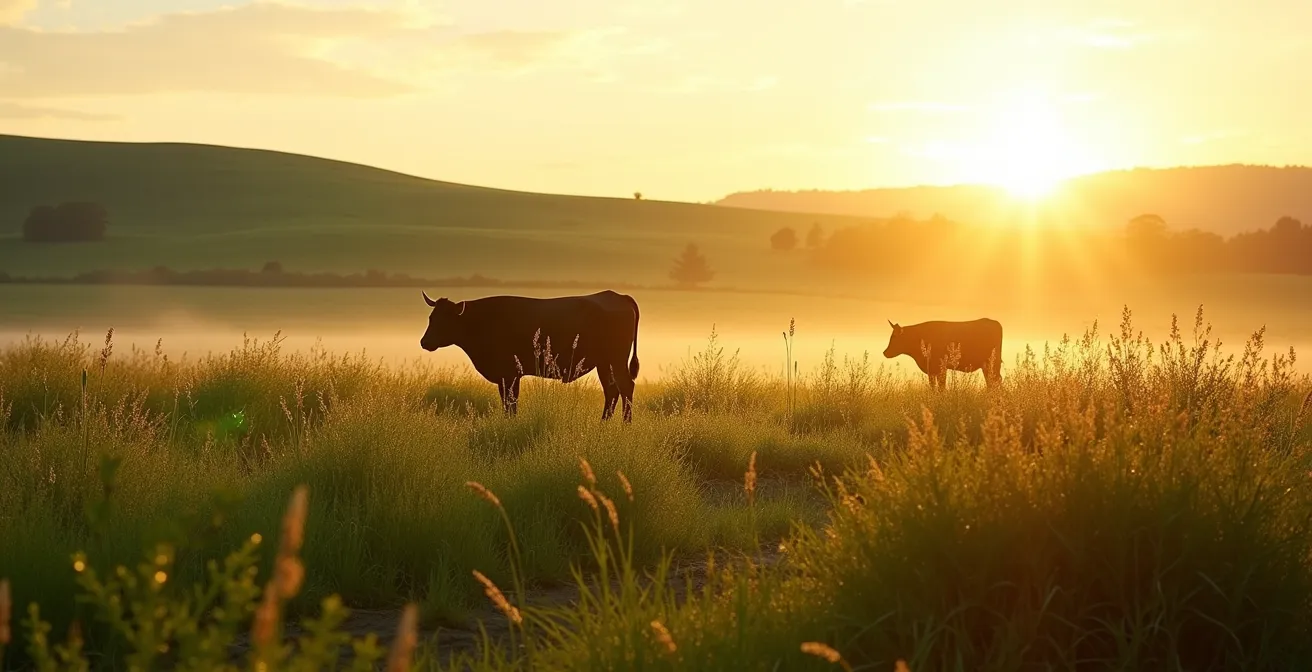
Moving cattle isn’t just about fresh grass; it’s the most powerful tool we have to actively build carbon-rich topsoil from the ground up.
- Managed grazing stimulates deep root growth, pumping liquid carbon to feed the hidden world of soil microbes.
- It prevents soil compaction, allowing the air and water needed to fuel the underground “biological engine.”
Recommendation: Start by observing your recovery periods. Giving grass more time to rest is the first step to unlocking this potential on your land.
We’ve all seen it: pastures that look tired, ground that’s hard as a rock, and grass that gives up at the first sign of a dry spell. For generations, the conventional wisdom was to spread cattle out and let them be. The common advice is to simply keep moving cattle to “give the grass a rest.” But this thinking barely scratches the surface. We’ve learned that the real magic isn’t just in the moving; it’s in how that movement orchestrates a powerful symphony of life beneath our boots.
The true potential of our land is not just in the forage we can see, but in the vast, invisible ecosystem we can cultivate. What if the key wasn’t just avoiding overgrazing, but actively using our herds as a tool to kick-start a biological engine? This engine doesn’t just grow grass; it builds soil, stores water, and pulls massive amounts of carbon from the atmosphere, turning it into the dark, rich, spongy earth we all dream of. It’s a fundamental shift from a mindset of extraction to one of regeneration.
This guide isn’t about complicated formulas or expensive inputs. It’s about understanding the natural processes our livestock can trigger. We’ll walk through how to avoid the common pitfalls that degrade soil, how to plan and observe like a seasoned grazier, and uncover the science behind how our animals can become our greatest allies in building a resilient and profitable ranch from the soil up.
For those who prefer a visual introduction, the following film offers a powerful look at the ranchers who are putting these regenerative principles into practice, transforming their land and their livelihoods.
To help you navigate this deep dive into soil health, we’ve structured this guide to build from the foundational problems to the advanced principles of regenerative grazing. You can explore the topics that matter most to you or follow the path from start to finish.
Summary: The Rancher’s Guide to Building Carbon-Rich Soil
- Why Does Overgrazing Stunt Root Growth and Dry Out Soil?
- How to Calculate Paddock Size Based on Herd Size and Grass Growth?
- Set Stocking vs Mob Grazing: Which Produces More Beef per Hectare?
- The Fencing Mistake That Leaves Cattle Without Water in Remote Paddocks
- When to Move the Herd: The 3 Visual Signs of Optimal Forage Utilization
- How to Enhance Soil Carbon Storage Through Grazing Management?
- Why Is Soil Compaction the Silent Killer of Agricultural Productivity?
- Why Functional Diversity Matters More Than Species Richness for Soil Health?
Why Does Overgrazing Stunt Root Growth and Dry Out Soil?
Under a continuous or “set stocking” grazing system, cattle behave like diners at a buffet with no closing time. They repeatedly graze their favorite, most palatable plants, never giving them a chance to recover. This constant stress has a devastating, though largely invisible, consequence underground. A plant’s ability to grow deep roots is directly proportional to the leaf area it has above ground. When a plant is repeatedly grazed down, it can’t photosynthesize enough energy to sustain its root system. The roots begin to shrink and die back, creating a negative feedback loop.
Shallow roots can’t access deeper water reserves, making the pasture incredibly vulnerable to drought. Worse, a weak root system means less organic matter is being added to the soil. The “soil carbon pump” sputters to a halt. The soil loses its spongy structure, becoming dense and compacted. Rain, instead of soaking in, runs off the surface, taking precious topsoil with it. The land becomes hotter, drier, and less productive every year. It’s a slow death for a pasture, and it all starts with not giving the plants enough time to recover.
Case Study: The Transformation of White Oak Pastures
A powerful example of reversing this damage comes from White Oak Pastures in Georgia. When they transitioned from conventional farming to regenerative grazing 25 years ago, their land was the typical red, degraded soil of the region. By implementing multi-species pasture rotations, they saw a dramatic transformation. This management style not only reduced greenhouse gas emissions by 66% compared to conventional beef, but it also visually transformed the land. The soil became a rich, dark black, teeming with life and capable of holding vast amounts of water—a clear demonstration of successful carbon sequestration in action.
In contrast, well-managed rotational systems give plants the critical recovery time they need. Research from the Canadian prairies shows this clearly, demonstrating a 26.4% higher dry matter yield with deferred-rotational grazing compared to continuous grazing. More biomass above ground equals a thriving root system below ground, which is the foundation of healthy, carbon-rich soil.
How to Calculate Paddock Size Based on Herd Size and Grass Growth?
Moving from the “why” to the “how” starts with planning. Many ranchers get bogged down trying to find a perfect, static formula for paddock size, but the real art is in adaptive management. It’s less about a fixed acreage and more about controlling time and density. The goal isn’t just to feed the cattle for a day; it’s to create the right “animal impact” for a short duration and then provide a long recovery period for the plants and soil life.
A good starting point is to think in terms of “stock-days per hectare.” This metric forces you to consider not just the immediate forage available but, more importantly, the recovery period the land will need. This period isn’t fixed; it changes dramatically with the seasons, rainfall, and the type of forage. In a fast-growing spring, your recovery might be 30 days, while in a slow, dry summer, it could stretch to 90 days or more. Your paddock size must be flexible enough to accommodate this.
The calculation should also factor in goals beyond just consumption. Are you trying to break up a soil crust? You might need a higher density for a shorter period to maximize hoof action. Are you trying to trample down mature grass to create “soil armor” before a dry season? That requires a different density and timing. The key is to stop thinking of paddocks as just holding pens and start seeing them as a dynamic tool for soil building.
Your Action Plan: Dynamic Paddock Planning
- Calculate stock-days per hectare based on the required recovery period, which varies by season, not just immediate forage availability.
- Factor in Animal Impact metrics beyond consumption; plan for hoof action to break soil crusts and trample litter.
- Monitor indicator species (both plants and insects) to fine-tune paddock moves in real-time, letting the environment guide you.
- Adjust stocking density for shorter periods to maximize the stimulation of soil microbes through dung, urine, and root exudation.
- Embrace adaptive management: make constant adjustments based on current conditions and the feedback your land is giving you.
By focusing on these principles, many regenerative farms report achieving up to 2x the stocking rates of their conventional neighbors over time. This isn’t because they have more land, but because they grow more forage and have created a more resilient, productive ecosystem.
Set Stocking vs Mob Grazing: Which Produces More Beef per Hectare?
The debate between grazing systems often comes down to a simple question: which is more productive? The answer, however, is complex. While set stocking (continuous grazing) requires far less labor and management, its long-term impact on the land often leads to diminishing returns. Mob grazing, a form of high-density rotational grazing (often called Adaptive Multi-Paddock or AMP grazing), requires more daily engagement but builds the land’s productive capacity over time, creating a more resilient and profitable operation.
In a set stocking system, cattle selectively graze, leading to a monoculture of less-desirable plants and leaving large areas of mature, un-grazed forage. The distribution of nutrients (manure and urine) is patchy. In contrast, mob grazing concentrates a larger herd on a smaller area for a very short period (often just a day). This encourages them to eat a wider variety of forages and ensures their hoof action and waste are distributed evenly, creating a powerful, uniform stimulus for the soil.

The visual impact of this hoof action is a key part of the system. The trampling incorporates organic matter into the ground, creating a protective layer of soil armor that feeds microbes, conserves moisture, and prevents erosion. This is the biological engine in action, and it yields results that go far beyond just beef production.
A comprehensive analysis directly comparing these systems highlights the stark differences in environmental and economic outcomes. The data shows that while AMP grazing is more management-intensive, it creates a system that is more profitable and ecologically sound in the long run.
| Metric | Adaptive Multi-Paddock (AMP) | Conventional Continuous Grazing |
|---|---|---|
| Annual cost savings | $50,000+ on nitrogen and fertilizer | Baseline (higher input costs) |
| Drought resilience | Higher – improved water retention | Lower – rapid failure in drought |
| Soil carbon increase | 13% more soil carbon | Baseline |
| Forage diversity | High – includes forbs and legumes | Low – selective grazing reduces diversity |
| Product nutrient density | Higher Omega-3s, vitamins | Standard nutrient profile |
The Fencing Mistake That Leaves Cattle Without Water in Remote Paddocks
As we get more sophisticated with our grazing plans, using temporary polywire to create dozens of small paddocks, a new logistical challenge emerges: water. A common and costly mistake is relying on a single, fixed water trough for multiple paddocks. This forces cattle to travel long distances, creating compacted “superhighways” of bare earth leading to the water point. These sacrifice zones become muddy, nutrient-leached wastelands that undermine the benefits of the rotation.
Even more dangerous is the miscalculation of hose or pipe length in a portable system. A grazier might set up a new paddock at the far end of the property, only to realize the water line is 50 feet too short. In the best-case scenario, this means a frantic scramble to move fences and re-plan the day. In the worst-case, especially in hot weather, it can lead to dehydrated, stressed animals, which directly impacts their health and weight gain. Water access should be the first consideration in paddock design, not the last.
The most elegant solutions integrate water into the very flow of the grazing system. Some of the most innovative graziers have moved beyond portable troughs entirely to solve this problem at its root.
Case Study: Neil Dennis’s Water Alley Innovation
Rancher Neil Dennis in Saskatchewan developed a brilliant solution: “water alleys.” Instead of moving water troughs, he designed his system with central laneways that contain the permanent water source. Cattle are moved from a paddock on one side of the alley, across the alley where they can drink, and into a new paddock on the other side. This simple design completely eliminates sacrifice zones around water points, ensures even nutrient distribution as cattle travel, and dramatically simplifies the daily workload. It’s a testament to how smart, system-level thinking can solve the most persistent practical challenges in managed grazing.
Whether using alleys or portable systems, the principle remains the same: ensuring consistent, low-stress access to water is non-negotiable. Planning your rotations around your water infrastructure, not in spite of it, is fundamental to a calm herd and a healthy landscape.
When to Move the Herd: The 3 Visual Signs of Optimal Forage Utilization
Once your plan is in place, the daily decisions are made out on the land, not on a spreadsheet. Learning to “read” the pasture, the soil, and the animals themselves is the most important skill a grazier can develop. Moving cattle based on a fixed calendar is a rookie mistake; the land will tell you when it’s time. There are several clear visual indicators to look for, but three stand out for their reliability.
First, observe the animal’s behavior. A content herd in a fresh paddock will graze with a steady, rhythmic intensity, often described as a “mower’s hum.” They are not wandering or picking selectively; they are eating efficiently. When you see them starting to roam, with their heads up, searching for better bites, it’s a clear sign that the best of the forage is gone and it’s time to prepare for a move. Second, assess the manure consistency. A healthy, well-formed “pie-like” pat indicates a balanced diet and good rumen function. If the manure becomes too loose or, conversely, too stacked, it’s a signal that their diet has shifted and the forage quality is declining.
Third, and most importantly, look at what’s left behind. A common mantra is “take half, leave half.” You want to move the herd when they have consumed about 50% of the available forage. That remaining leaf area is the solar panel the plant needs for rapid regrowth. Equally critical is the amount of trampled vegetation. You should see a good litter of “soil armor” covering the ground, protecting it from the sun and rain. This trampled material is the food source for the earthworms and microbes that build topsoil. If the ground is bare, you’ve stayed too long. If there’s no trampled litter, your density might be too low.
- Monitor Soil Armor: Check that the trampled vegetation provides adequate cover to protect the soil surface and feed decomposers.
- Observe Animal Behavior: A content “mower’s hum” indicates good grazing; wandering and selective picking signals it’s time to move.
- Assess Manure Consistency: Well-formed pats indicate a balanced diet; changes in consistency signal declining forage quality.
- Measure Forage Height: Aim to leave approximately 50% of the forage standing to ensure rapid, healthy regrowth.
- Check Soil Moisture: The ground should be moist and porous after grazing, not muddy or compacted.
How to Enhance Soil Carbon Storage Through Grazing Management?
The ultimate goal of regenerative grazing is to turn our soil into a massive carbon sponge, and this happens through a process we can call the “soil carbon pump.” It’s driven by photosynthesis. Plants pull carbon dioxide (CO2) from the air and use sunlight to turn it into liquid carbon in the form of sugars. While some of this energy is used to grow leaves and stems, a significant portion—up to 40% or more—is exuded through the roots directly into the soil. This is not a passive leak; it’s a deliberate act. The plant is feeding the microbial life in the root zone, or rhizosphere.
This is where the magic happens. The plant offers these liquid carbon snacks in exchange for services. It feeds bacteria and fungi that, in turn, unlock mineral nutrients from soil particles and protect the plant from pathogens. The most important of these partners are mycorrhizal fungi. These fungi form a vast, microscopic web that connects to the plant roots, acting as a “fungal superhighway.” They extend far beyond the reach of the roots, accessing water and nutrients the plant couldn’t get on its own and bringing them back in exchange for carbon.
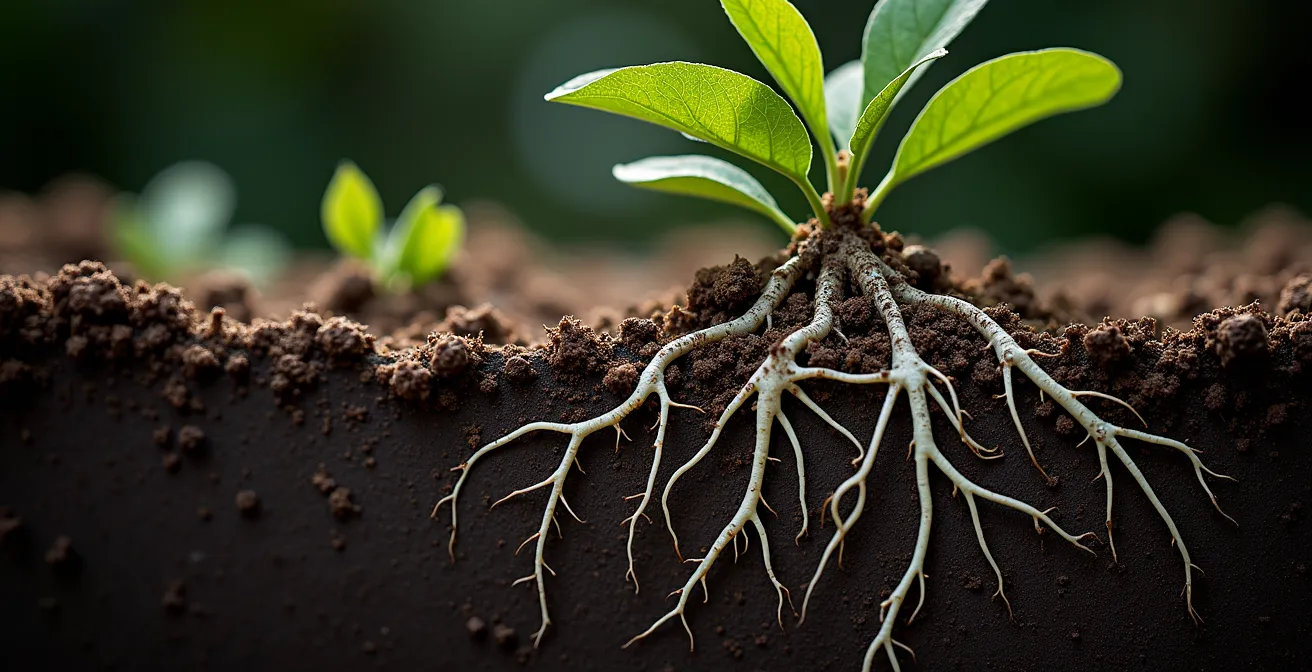
This fungal network is the primary architect of healthy soil structure. The fungi produce a sticky protein called glomalin, which acts as a superglue, binding tiny soil particles (sand, silt, and clay) together into stable aggregates. It is within these aggregates that carbon is protected and stored long-term. A well-aggregated soil is full of pore spaces, allowing it to hold water like a sponge and let air circulate. Managed grazing enhances this entire process by stimulating vigorous plant growth and root exudation during the growing phase, and then allowing a long rest period for the underground biological engine to work its magic.
When we manage our grazing properly, we are not just growing grass; we are actively managing a carbon-trafficking ecosystem. We are using our livestock to stimulate the pump, which feeds the fungi, which builds the soil that stores the carbon. It’s the most effective and natural carbon sequestration technology on the planet.
Why Is Soil Compaction the Silent Killer of Agricultural Productivity?
If the soil carbon pump is the engine of regeneration, then soil compaction is the hand that seizes it. Compaction is the quiet and insidious destruction of the very architecture of our soil. It happens when pressure, typically from machinery or the continuous presence of animals, destroys the pore spaces between soil aggregates. This has a catastrophic cascading effect on the entire soil ecosystem.
The first casualty is oxygen. The beneficial aerobic bacteria and fungi that drive the carbon cycle need to breathe. When compaction squeezes out the air, they die off. They are replaced by anaerobic microbes, which not only operate less efficiently but also release potent greenhouse gases like nitrous oxide and methane. This process is measurable; studies comparing grazing systems found 19.52% less cumulative soil respiration (a proxy for carbon loss) in well-managed AMP systems versus conventional grazing, largely due to better soil aeration.
The second casualty is water. Compacted soil cannot absorb rainfall. Instead of infiltrating and recharging the soil moisture profile, water pools on the surface, suffocating plant roots, or runs off, causing erosion. This creates a landscape that is simultaneously prone to both flooding and drought. The “compaction cascade failure” is a complete collapse of the soil’s life-support systems:
- Compaction eliminates macropores, cutting off oxygen to the aerobic bacteria essential for building carbon.
- Anaerobic conditions created by compaction produce nitrous oxide (N2O) and methane (CH4), potent greenhouse gases.
- Poor water infiltration leads to waterlogged pockets, causing plant root death.
- Dead roots starve the soil microbes, leading to a total collapse of soil structure and a release of stored carbon.
Managed grazing is the most powerful tool we have to prevent and even reverse compaction. By keeping animals concentrated for short periods, we provide a stimulating disturbance followed by a long rest. This allows the soil’s structure to remain intact and for plant roots and soil life to continuously build and maintain the porous, spongy structure that defines a healthy, productive soil.
Key Takeaways
- Overgrazing is not about how much is eaten, but about not allowing plants enough recovery time, which shrinks root systems.
- Effective grazing management is about controlling time and density to create positive “animal impact” followed by a long rest.
- Mob grazing (AMP) consistently outperforms set stocking in building soil carbon, improving water retention, and increasing biodiversity.
Why Functional Diversity Matters More Than Species Richness for Soil Health?
As we work to restore our land, it’s tempting to focus on simply planting as many different species as possible, a concept known as “species richness.” While a good starting point, a more advanced understanding reveals that functional diversity is far more critical for building a resilient and productive soil ecosystem. Functional diversity means having a mix of plants that perform different jobs for the soil.
Think of your pasture as a team. You don’t want a team of 11 quarterbacks. You need players in different positions. In a pasture, this means having:
- Deep-rooted perennials: Plants like chicory or certain native grasses that can punch through compacted layers and bring up minerals from deep in the soil profile.
- Nitrogen-fixers: Legumes like clover and vetch that have a symbiotic relationship with bacteria, allowing them to pull atmospheric nitrogen into the soil, providing free fertilizer for the entire plant community.
- Broadleaf forbs: These often have different mineral profiles than grasses and attract a wider range of pollinators and beneficial insects, adding another layer of resilience.
- Grasses with dense, fibrous root systems: These are the champions of creating soil aggregates in the top few inches of soil.
A pasture with high functional diversity is a self-regulating, self-fertilizing system. The deep roots create channels for water, the legumes provide nitrogen, and the variety of root structures and exudates supports a much wider array of soil microbes. This is the foundation of a robust “biological engine.” Managed grazing is the key to maintaining this diversity. By moving cattle frequently, we prevent them from selectively overgrazing their favorites, giving all plant types a chance to thrive and contribute their unique function to the whole.
Utilizing the natural interactions between cattle, plants, and soil, we can revolutionize the agriculture industry. This revolution can provide more nutritious food and provide a comfortable income for farming and ranching families while offering one significant solution to climate change, storing carbon in the soil.
– Peter Byck, USA Regenerative Agricultural Alliance
Ultimately, a healthy ecosystem is one that is complex and interconnected. By shifting our focus from merely the number of species to the variety of jobs they perform, we can accelerate our journey toward a truly regenerative and carbon-rich landscape.
Begin today by walking your pastures not just to check on your cattle, but to observe. Look at the plants, dig into the soil, and start the conversation with your land. The first step towards regenerating your soil is learning to see it for the living, breathing ecosystem it is.