
The critical failure of today’s insurance models isn’t just their reliance on historical data; it’s their inability to price correlated, systemic risks in a world of simultaneous climate shocks.
- Non-stationarity means past flood and storm patterns are no longer a reliable guide for future losses.
- Cascading failures across global supply chains from multiple, simultaneous weather events represent a new class of unpriced risk.
Recommendation: Risk models must evolve from single-event analysis to systemic stress-testing that values resilience and accounts for the depreciation of natural capital.
For actuaries and risk managers, the foundation of pricing risk has always been the past. Historical data provided a stable, predictable bedrock upon which to build models and set premiums. Yet, an unsettling reality is taking hold: year after year, “once-in-a-century” weather events are becoming commonplace, and the actuarial tables that once provided clarity now seem to describe a world that no longer exists. The industry’s response often centers on the need for better data or “forward-looking models,” but this conversation frequently misses the fundamental nature of the shift.
The core problem isn’t just that the weather is changing; it’s that the entire system of risk is behaving differently. We are moving from a world of largely independent, localized risks to one defined by interconnected, simultaneous, and cascading failures. A drought in one breadbasket, a flood disrupting a key shipping lane, and a wildfire taking down a component factory can now occur in the same fiscal quarter, creating a correlated shockwave that historical, siloed models are structurally blind to. This is a paradigm shift from predictable volatility to systemic instability.
This analysis moves beyond the platitude that “the past is no longer a guide.” It deconstructs the mechanical failure of legacy models in the face of this new risk landscape. We will explore why the statistical assumption of stationarity has broken down, how to stress-test for simultaneous shocks, and why accounting for natural capital is no longer an academic exercise but a balance sheet imperative. It is a strategic guide for recalibrating risk assessment for an era of profound and unpredictable change.
To navigate this complex new reality, this article breaks down the core challenges and provides actionable frameworks. The following sections detail the shift from historical data to systemic risk modeling, offering insights for actuaries and risk managers to adapt their strategies.
Summary: The New Calculus of Climate Risk: Adapting Insurance for a Non-Stationary World
- Why Past Weather Data Can No Longer Predict Future Flood Levels?
- How to Stress-Test Your Supply Chain Against Multiple Simultaneous Weather Shocks?
- Sea Walls or Carbon Cuts: Which Investment Reduces Long-Term Risk More?
- The Global Trade Risk When Multiple Breadbaskets Fail in the Same Year
- When to Retrofit Storm Drains: Waiting for Failure vs Preemptive Action
- The Investment Mistake of Ignoring Water Scarcity Risks in Portfolio Valuation
- The Insurance Risk of Relying on a Single Crop Variety for 100% of Revenue
- How to Account for Natural Capital on Your Balance Sheet?
Why Past Weather Data Can No Longer Predict Future Flood Levels?
The foundational principle underpinning traditional insurance modeling is stationarity—the assumption that the statistical properties of a system, like rainfall patterns or storm frequency, remain consistent over time. This allows actuaries to use historical data to confidently predict future events. However, climate instability has fundamentally broken this principle. The system is now non-stationary; the past is no longer a reliable prologue to the future.
This statistical breakdown is not a theoretical concern. As Hamed Moftakhari, a civil engineering expert at the University of Alabama, explains, the old assumption is no longer valid:
In stationarity, we assume that the patterns we have observed in the past are going to remain unchanged in the future, but there are a lot of factors under climate change that are modulating these patterns
– Hamed Moftakhari, University of Alabama Civil Engineering
This shift forces a complete overhaul of risk assessment tools. A prime example of this transition is the work being done by the U.S. National Oceanic and Atmospheric Administration (NOAA). For years, its Atlas 14 relied on historical precipitation data to define flood risks. Recognizing the limitations of this approach, NOAA is now developing Atlas 15, a next-generation tool designed to incorporate non-stationarity. It will not only update historical estimates but also integrate international climate models to project how weather patterns will shift, providing a more accurate basis for infrastructure design and insurance pricing.
How to Stress-Test Your Supply Chain Against Multiple Simultaneous Weather Shocks?
While property damage from a single weather event is well-understood, the greater, often unpriced, risk lies in correlated, cascading failures across global supply chains. A single hurricane might disrupt a port, but what happens when that hurricane occurs simultaneously with a drought impacting raw material production and a flood disabling a key manufacturing hub? These compound events, causing disruptions that an analysis from FreightWaves shows are already creating immense economic pressure, demand a new approach to stress-testing that moves beyond isolated incidents.

The image above visualizes this new reality: a system where multiple, disparate climate stresses (represented by ice and heat) impact different nodes of the same network at once. Traditional models that assess risk at each node independently fail to capture the exponential impact of their simultaneous failure. This is where a systemic view becomes critical for accurate risk valuation.
Case Study: MIT’s Time-to-Recover (TTR) Methodology
To address this challenge, MIT’s David Simchi-Levi developed a powerful stress-testing framework based on two key metrics. The Time to Recover (TTR) measures how long it takes for any single node in a supply chain (a factory, a port, a warehouse) to return to full capacity after a disruption. The Time to Survive (TTS) calculates the maximum time the supply chain can continue to meet demand after that disruption. By mapping these values across an entire network, companies can identify hidden vulnerabilities where a combination of high-TTR nodes could trigger a systemic collapse, a methodology that accurately predicted the supply chain impacts of the COVID-19 pandemic and can be applied to simultaneous weather shocks.
Sea Walls or Carbon Cuts: Which Investment Reduces Long-Term Risk More?
With global insured losses from natural disasters already hitting formidable figures, financial institutions and governments face a critical dilemma: do they invest in adaptation (e.g., building sea walls) or mitigation (e.g., cutting carbon emissions)? A sea wall offers localized, near-term protection, while carbon cuts provide global, long-term risk reduction. Historically, the immediate and quantifiable benefit of adaptation made it the easier choice to model and finance. However, this calculation is changing.
The flaw in a purely adaptation-focused approach is that it treats the underlying threat as a static variable. It assumes that building a wall to withstand a Category 3 hurricane is sufficient, without accounting for the fact that climate change is making Category 4 and 5 hurricanes more frequent. Mitigation, by contrast, addresses the root cause, reducing the probability of those more severe events occurring at all. The long-term risk reduction value of mitigation is therefore arguably higher, but it has been notoriously difficult to price into financial models.
This is where regulatory and modeling innovation becomes essential. For instance, California, facing escalating wildfire and storm risks, has introduced new regulations allowing insurers to use forward-looking catastrophe models to set premiums. Instead of relying only on historical loss data, these models incorporate evolving climate trends to forecast future risk. This shift is critical because it enables the financial system to more accurately price the long-term benefits of mitigation efforts and incorporate those future risks into today’s asset valuations, making a more informed choice between a sea wall and a carbon credit.
The Global Trade Risk When Multiple Breadbaskets Fail in the Same Year
The concept of agricultural risk is often viewed through the lens of a single regional drought or flood. However, the true systemic threat to global trade and food security is the rising probability of simultaneous, large-scale failures in multiple “breadbasket” regions within the same year. As climate patterns become more erratic, the historical assumption that a poor harvest in North America would be offset by a good one in Eastern Europe or Australia becomes increasingly fragile. This correlated risk can trigger price shocks, supply shortages, and social instability on a global scale.
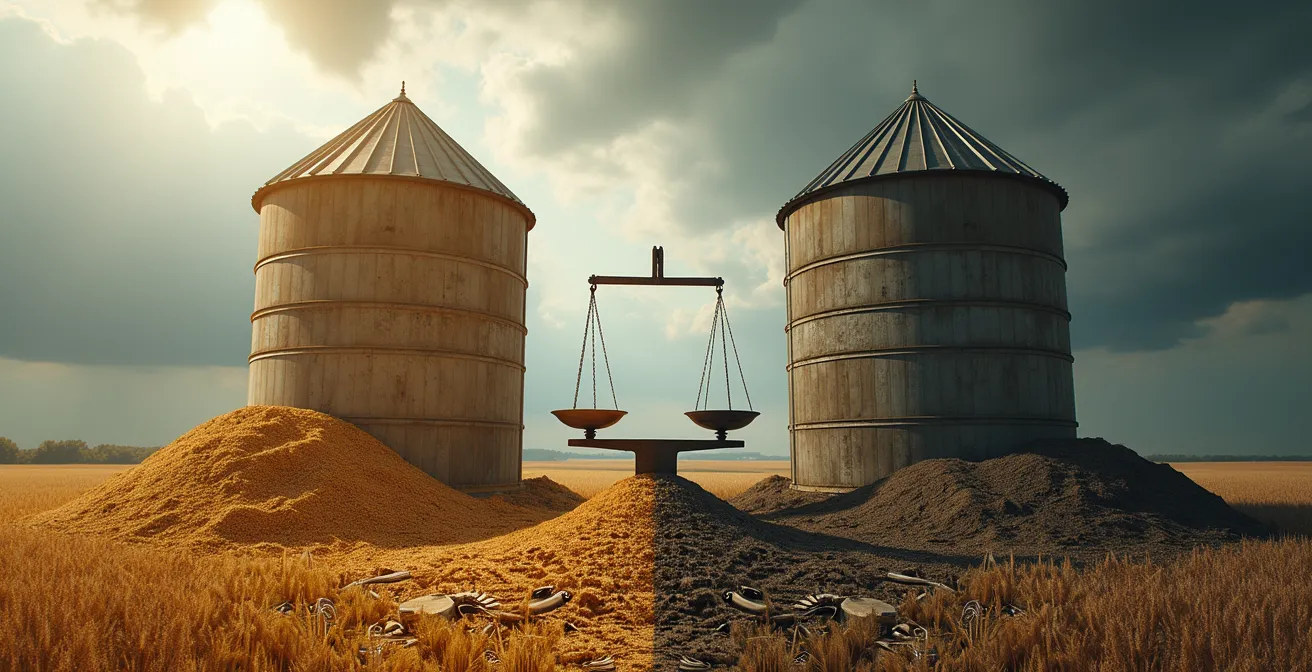
This risk of synchronized failure is not confined to agriculture. The same logic applies to other critical resource supply chains. A recent analysis by the Network for Greening the Financial System (NGFS) highlighted how intensifying climate hazards could lead to shortages of critical minerals needed for the green transition. Climate disasters in key mining regions could create simultaneous bottlenecks, with macroeconomic spillovers that make the transition to clean energy far more costly and volatile. The underlying mechanism is identical: over-reliance on a few key production zones whose risks are becoming dangerously correlated.
For insurers and financial analysts, this means portfolio risk can no longer be assessed on a region-by-region basis. A portfolio with exposure to Australian agriculture, Chilean copper mining, and Southeast Asian manufacturing may have appeared diversified under old models. In a world of correlated climate shocks, it may represent a concentration of systemic risk that is currently unpriced and unhedged.
When to Retrofit Storm Drains: Waiting for Failure vs Preemptive Action
For municipalities and the insurers who cover them, infrastructure maintenance presents a constant financial balancing act. Is it better to proactively retrofit a city’s storm drains to handle future, more intense rainfall, or to wait for a catastrophic failure and then rebuild? Historically, the “wait for failure” approach often won out, as the cost of reconstruction was seen as a distant, uncertain liability. This logic is now dangerously flawed. As infrastructure cost analysis indicates a staggering 55% increase in structural replacement costs between 2020 and 2022 alone, the financial case for preemptive action has become overwhelming.
The cost of inaction is escalating due to two factors: rising material and labor costs, and the fact that future failures will be caused by events far more severe than historical precedents. Rebuilding a drainage system after a 500-year flood event is exponentially more expensive than retrofitting it for a 100-year storm. The decision is no longer about simple cost-benefit analysis but about identifying the financial tipping point where the cost of waiting surpasses the cost of acting. This requires a sophisticated, forward-looking assessment framework.
Action Plan: Infrastructure Tipping Point Assessment
- Calculate current drainage system capacity using non-stationary flood frequency models that account for future climate projections.
- Model the specific runoff volume thresholds that would trigger catastrophic backflow and cascading failures across the infrastructure network.
- Quantify the full cost differential between a preemptive, planned retrofit and an emergency, post-failure reconstruction, including economic disruption.
- Apply Real Options Analysis to value the flexibility of investing in modular upgrade pathways, allowing for staged, adaptive infrastructure improvements.
- Implement an adaptive infrastructure design strategy that allows for incremental capacity increases as climate risk predictions are updated over time.
The Investment Mistake of Ignoring Water Scarcity Risks in Portfolio Valuation
While floods and storms grab headlines, the slow-moving, chronic risk of water scarcity may pose an even greater, and more deeply mispriced, threat to investment portfolios. Assets ranging from agricultural land and manufacturing plants to entire real estate developments are often valued with little to no consideration for their long-term water security. This oversight creates a significant gap between perceived value and actual, climate-adjusted risk, leading to a systemic overvaluation of assets in water-stressed regions.
This is not a hypothetical problem. An analysis by the First Street Foundation already reveals that in the United States, there are 39 million homes insured at prices incommensurate with their actual risk from events like flooding. A similar, if not larger, mispricing is occurring with water scarcity. A portfolio manager might see a collection of properties in the American Southwest as geographically diversified, but if they all rely on the shrinking Colorado River, they share a single point of failure that is not reflected in their individual valuations.
For risk managers, rectifying this requires a fundamental shift in due diligence. Investment analysis must now include a water risk audit, assessing not just current water rights but also the long-term stability of the water source under various climate scenarios. This includes modeling the impact of reduced rainfall, increased evaporation rates, and potential regulatory changes restricting water use. Ignoring this crucial input is akin to ignoring credit risk in a bond portfolio—it’s a failure to price a fundamental variable that could determine the long-term viability of the asset.
The Insurance Risk of Relying on a Single Crop Variety for 100% of Revenue
In modern agriculture, the pursuit of efficiency has led to widespread monoculture—the reliance on a single, high-yield crop variety across vast areas. While this maximizes output in a stable climate, it creates extreme vulnerability in an unstable one. A single new pest, a specific type of drought, or an unusual heatwave to which that one variety is susceptible can wipe out an entire region’s revenue. For an insurer, underwriting a portfolio of farms that all grow the same patented corn variety is not a diversification of risk; it is a massive concentration of it.
This is a classic example of mistaking geographic distribution for genuine risk diversification. An insurer might cover farms across three different states, but if all are planting the same crop, they are all exposed to the same specific biological and climatic threats. The risk is systemic, not localized. A comprehensive study combining climate models and economic data highlighted this vulnerability, showing how weather shocks in monoculture-heavy regions propagate through supply chains, with low-income groups being most exposed to the resulting supply failures and price hikes.
To correctly price this risk, insurers must move beyond simple acreage and revenue data. A more sophisticated underwriting process would involve a genetic diversity discount, where farms or regions with a wider variety of crops receive lower premiums. It would also require modeling the correlated risk of specific weather patterns affecting a single crop variety across a wide geographic area. This approach better reflects the true nature of the risk and incentivizes the agricultural sector to build resilience through diversification, reducing the likelihood of catastrophic, single-point-of-failure loss events.
Key Takeaways
- The principle of stationarity is broken; risk models must now assume a dynamic, non-linear future where past performance is not indicative of future results.
- The greatest emerging threat is correlated risk—simultaneous, cascading failures across previously independent systems like supply chains and infrastructure.
- Moving forward requires new tools: systemic stress tests (like TTR/TTS), real options analysis for infrastructure, and formal accounting for natural capital.
How to Account for Natural Capital on Your Balance Sheet?
For too long, the services that nature provides—clean water, stable soil, flood protection from wetlands, and a predictable climate—have been treated as externalities: valuable, but absent from the corporate balance sheet. As climate instability grows, this accounting error is becoming untenable. The Network for Greening the Financial System projects that a 2°C warming scenario could lead to 15% of global GDP losses by 2050, much of it from the degradation of this “natural capital.”
For risk managers, the challenge is to move this concept from an ESG report into a quantifiable financial metric. Natural capital accounting is the framework for doing so. It involves identifying and valuing the natural assets a company relies on and the risks associated with their depletion. For example, a beverage company’s primary natural capital is its access to clean aquifers. A model that tracks the depletion rate of those aquifers under various drought scenarios can assign a real financial cost to water scarcity risk.
Several methods are emerging to formally integrate this into financial reporting. The choice of method depends on the specific asset and risk being measured, but all share a common goal: to make the invisible visible and the unpriced quantifiable.
| Accounting Method | Application | Climate Risk Integration |
|---|---|---|
| Liability-Based Approach | Quantifies financial cost if natural services are lost | Direct link to climate impact scenarios |
| Asset Depreciation Model | Tracks depletion of natural resources like aquifers | Accounts for accelerated depletion from climate stress |
| Risk-Adjusted Valuation | Values natural assets based on risks they mitigate | Value increases as climate risks intensify |
The next logical step is to integrate these forward-looking stress tests and natural capital valuations into your own portfolio analysis to identify and mitigate unpriced climate risks before they materialize.