
Your farm’s long-term profitability isn’t just in your crop yield; it’s in the unseen resilience of its biotic web.
- Simplified, monoculture ecosystems are brittle and dangerously vulnerable to climate shocks and pest outbreaks.
- A diverse biotic web provides free, essential services like pollination and pest control, acting as a powerful form of natural insurance.
Recommendation: Begin valuing your farm’s ecological network not as an externality, but as a primary asset for risk management and stable, long-term production.
For farmers and agronomists, the conversation around crop yields has long been dominated by inputs: fertilizer, water, pesticides, and seed genetics. The goal is to maximize output from every hectare. Yet, despite our best efforts, yields can be frustratingly volatile, crashing due to a sudden pest outbreak, a dry spell, or a mysterious drop in fruit set. We often look for a single culprit, a single broken part in the machine. This approach, however, overlooks the most critical component of agricultural stability.
The common solutions—more potent chemicals or hardier crop varieties—are merely patches on a system that is fundamentally weakening. The real issue lies in the invisible architecture that supports the entire farm: the biotic web. This complex network of interactions between plants, animals, fungi, and microbes is not just a passive backdrop; it’s an active, working asset. But what if the key to durable yields wasn’t in adding another input, but in strengthening this underlying ecological infrastructure? What if we treated our farm’s ecosystem like a diversified financial portfolio?
This article reframes the biotic web from a vague ecological concept into a tangible framework for agricultural risk management. We will move beyond simply saying “biodiversity is good” and dissect the mechanisms that make it essential for food security. We will explore how to measure it, why its complexity creates resilience, and how its collapse triggers cascading failures that directly impact your bottom line. By understanding this domino effect, you can shift from a strategy of constant intervention to one of building inherent, self-sustaining stability.
This guide breaks down the critical connections between ecosystem health and agricultural output. The following sections will provide practical insights into the structure of biotic webs, the economic value of their services, and the key principles for fostering resilience on your land.
Summary: How the Biotic Web’s Collapse Triggers Domino Effects in Agriculture?
- Why Do Simple Food Chains Fail Faster Than Complex Biotic Webs?
- How to Map Species Interactions in a 1-Hectare Forest Plot?
- Rainforest vs Tundra: Which Biotic Web Recovers Faster After Fire?
- The Pollinator Mistake That Reduces Fruit Yields by 40% in One Season
- When to Reintroduce Native Predators: The 3 Critical Success Factors
- Yield per Hectare vs Total System Output: Which Is Higher in the Long Run?
- How to Assign Monetary Value to Pollination Services for Your Agribusiness?
- Why Functional Diversity Matters More Than Species Richness for Soil Health?
Why Do Simple Food Chains Fail Faster Than Complex Biotic Webs?
A simple food chain, like one found in a monoculture field—crop, pest, predator—is inherently brittle. If a single link is removed or weakened, the entire chain can break. For example, if a pesticide eliminates the pest’s predator, the pest population can explode, devastating the crop. This is the essence of trophic brittleness. A complex biotic web, in contrast, functions like a safety net. It contains multiple, redundant pathways. If one predator species declines, others can step in to control the pest. This redundancy provides stability and resilience against shocks.
Modern agriculture has systematically simplified these webs, favoring efficiency over resilience. This simplification has removed a huge portion of the natural insurance that ecosystems provide. The consequences are now becoming clear on a global scale. In fact, startling research confirms that more than 50% of terrestrial mammal food web links have disappeared, creating vast, simplified landscapes that are far more vulnerable to collapse. This loss isn’t just an ecological tragedy; it’s a direct operational risk for food producers.
Think of it as an investment portfolio. A simple food chain is like investing all your capital in a single stock. A complex biotic web is a diversified portfolio with stocks, bonds, and real estate. The single stock might offer a high return in a good year, but it’s one market shock away from total loss. The diversified portfolio, while perhaps offering a slightly lower peak return, is vastly more stable and secure over the long term. By removing species and interactions, we are unknowingly cashing out our most reliable assets, leaving our agricultural systems exposed to catastrophic failure.
How to Map Species Interactions in a 1-Hectare Forest Plot?
To manage an ecological asset, you first need to measure it. Traditionally, mapping species interactions was a painstaking process involving visual observation and trapping. However, advancements in technology, particularly in bioacoustics, now allow for a more comprehensive and non-invasive assessment of your farm’s biotic web. By deploying passive acoustic recorders, you can capture the soundscape of an area and use it to identify the species present and even their behaviors.
This method allows you to “listen in” on the health of your ecosystem. A rich and varied soundscape, with different species calling at different times of day and night, indicates a complex and functioning web. A silent or monotonous soundscape is a red flag for low biodiversity and high trophic brittleness. This data provides a baseline to measure the impact of management changes, such as planting hedgerows or reducing pesticide use. It transforms the abstract concept of “biodiversity” into a measurable Key Performance Indicator (KPI) for your operation.

The setup involves placing specialized microphones at various heights, from near the ground to the canopy, to capture the full spectrum of sounds, from insects and amphibians to birds and bats. This provides a three-dimensional view of ecosystem activity, revealing interactions that are invisible to the naked eye. This actionable data is the foundation of building a portfolio ecology approach on your farm.
Your Action Plan: Mapping Your Farm’s Acoustic Biodiversity
- Deploy passive acoustic recorders at multiple heights and locations to capture the full soundscape spectrum (1-96 kHz).
- Analyze acoustic complexity indices, which measure the richness of the soundscape, to assess overall biodiversity without needing to identify every single species.
- Use automated AI-powered tools like BirdNET or Merlin for real-time species identification from the audio recordings, creating a rapid inventory.
- Combine ultrasonic (for bats/insects) and audible range recordings to get a complete picture of both nocturnal and diurnal activity.
- Apply soundscape ecology metrics to identify potential predator-prey interactions by analyzing the temporal patterns of calls and responses.
Rainforest vs Tundra: Which Biotic Web Recovers Faster After Fire?
The speed at which an ecosystem recovers from a disturbance like a fire depends on its inherent resilience. This resilience is directly tied to the complexity of its biotic web and the environmental conditions. A tropical rainforest, despite its immense biodiversity, can be surprisingly fragile. Its species are highly specialized and adapted to stable conditions. After a severe fire, recovery can be incredibly slow because the foundational seed banks and soil organisms are destroyed. In some cases, the system may never return to its original state; in fact, some research indicates the Amazon rainforest could shift to a savannah-type ecosystem within 50 years if a tipping point is reached.
A tundra ecosystem, while having far fewer species, is adapted to frequent, natural disturbances. Its species are often generalists, and the system has evolved mechanisms like deep root systems and resilient seed banks to bounce back quickly after a fire. This doesn’t mean tundra is “stronger” than a rainforest, but rather that its biotic web is adapted to a different disturbance regime. This highlights a crucial point for agriculture: resilience isn’t just about species count, but about the *right* species and functions adapted to the local environment and its likely shocks (e.g., drought, flood, pests).
As Wikipedia contributors note in an article on the topic, this dynamic is a fundamental principle of ecology:
Ecosystems with low resilience may collapse even during a comparatively stable time, which then typically leads to their replacement with a more resilient system in the biosphere. However, even resilient ecosystems may disappear during the times of rapid environmental change.
– Wikipedia contributors, Ecosystem collapse – Wikipedia
For a farm, this means that simplifying the ecosystem to a single crop (like a rainforest with low disturbance tolerance) makes it extremely vulnerable. Building a system with functional diversity adapted to local pressures (like the tundra’s recovery mechanisms) is a far better long-term strategy for ensuring your operation can withstand and recover from the inevitable shocks.
The Pollinator Mistake That Reduces Fruit Yields by 40% in One Season
The most common pollinator mistake in agriculture is relying on a single species, primarily the European honeybee (Apis mellifera), for pollination services. While honeybees are fantastic generalist pollinators, this over-reliance creates a fragile system, a monoculture of pollination. If a disease like Varroa mite or a colony collapse event strikes, pollination services can plummet, directly impacting yields. This isn’t a hypothetical risk; an analysis reveals that 40% of invertebrate pollinators, particularly bees and butterflies, are at risk of extinction.
A resilient pollination strategy involves fostering a diverse community of native pollinators. Different pollinators have different strengths: some fly in cooler weather, some are more effective for specific flower shapes, and some are active at different times of the day. This diversity provides functional insurance. If one species has a bad year, others can compensate, ensuring consistent and complete pollination. This is often the difference between a full, heavy fruit set and a disappointing one. Relying on a single managed pollinator is like having only one employee who knows how to operate a critical piece of machinery.
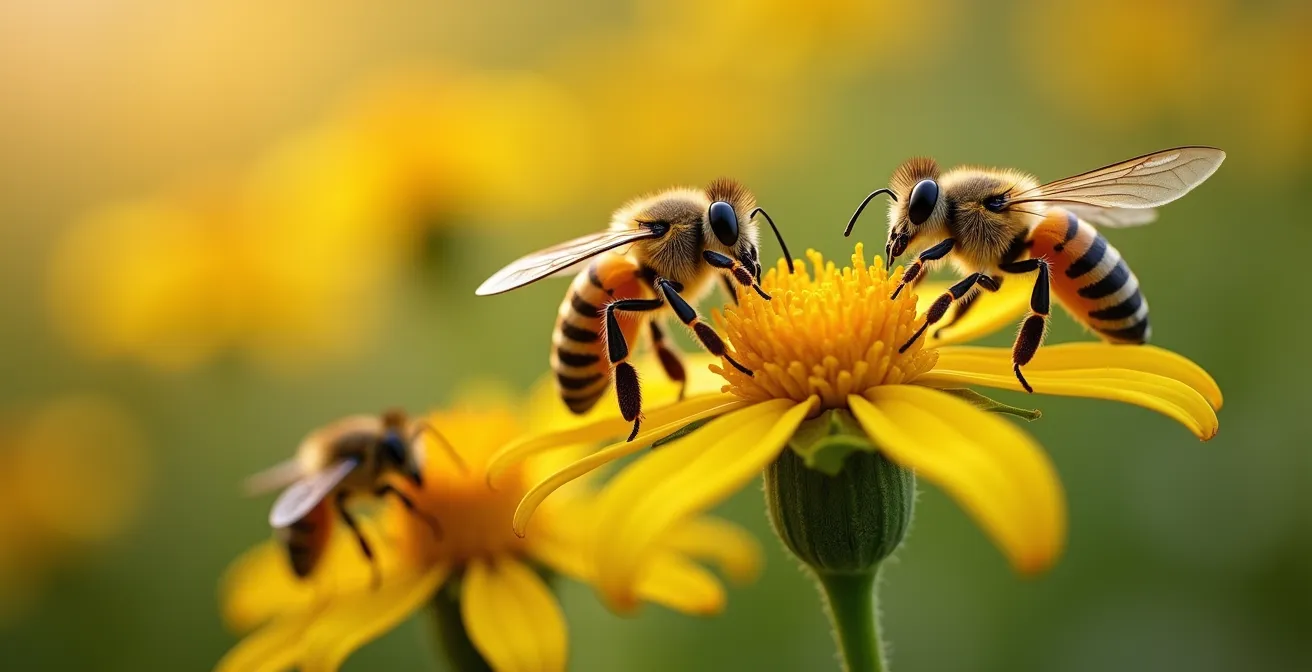
The economic stakes are staggering. Globally, agriculture is deeply dependent on this free service from nature. This is not a small, niche benefit; it’s a cornerstone of global food production.
Case Study: The Multi-Billion Dollar Value of Pollinators
According to a landmark assessment by the Intergovernmental Science-Policy Platform on Biodiversity and Ecosystem Services (IPBES), between US$235 billion and US$577 billion worth of annual global food production relies on direct contributions by pollinators. The volume of agricultural production dependent on animal pollination has increased by 300% over the last 50 years. Worryingly, these pollinator-dependent crops show lower growth and stability in yield than crops that do not depend on pollinators, signaling that this critical ecological asset is already under stress and failing to keep up with demand.
When to Reintroduce Native Predators: The 3 Critical Success Factors
Reintroducing native predators to an agricultural landscape can be a powerful tool for natural pest control, reducing reliance on chemical inputs. However, it’s a delicate process that, if done incorrectly, can fail or even backfire. Success hinges on ensuring the ecosystem is ready. The current biodiversity crisis, where the current extinction rate is 100-1000 times the background rate, means many ecosystems lack the top-down regulation that predators provide. Restoring this function requires careful planning.
Before any reintroduction, three critical factors must be assessed to ensure the intervention will be a net benefit to the system’s stability and your farm’s productivity. These factors move beyond simply releasing animals and focus on the underlying ecological capacity of the landscape.
- Assess ‘Trophic Room’ Availability: The most crucial first step is to ensure the food web can support the new predator. This means verifying that the populations of prey species (the lower trophic levels) are robust enough to sustain the predators without collapsing themselves. Introducing a predator into a system with insufficient food will lead to starvation for the predator and potential over-pressuring of already stressed prey populations.
- Evaluate Landscape Connectivity: Predators, especially larger ones, require significant territory. The landscape must have sufficient corridors—like hedgerows, riparian buffers, or woodlots—that allow the predator population to move, hunt, and expand. Isolated pockets of habitat will lead to genetic bottlenecks and local extinctions, dooming the reintroduction effort in the long run.
- Mitigate Ecological Mismatch: In the time a predator has been absent, its prey may have lost its anti-predator behaviors. Furthermore, new or invasive species may have entered the system, creating novel predator-prey dynamics that are unpredictable. An assessment must be made to ensure the reintroduced predator will not have unintended negative effects on other native species.
Only when these three conditions are met can a predator reintroduction be considered a viable and sustainable component of an integrated pest management strategy. It is about restoring a function, not just adding a species.
Yield per Hectare vs Total System Output: Which Is Higher in the Long Run?
For decades, the primary metric of success in agriculture has been yield per hectare. This single-minded focus has driven the simplification of landscapes into highly productive but extremely brittle monocultures. While this approach can deliver impressive short-term gains, it ignores the hidden costs and risks. An alternative and more resilient metric is Total System Output. This broader measure considers not just the cash crop but also the other benefits the ecosystem provides: water retention, soil formation, pest control, pollination, and carbon sequestration. It evaluates the farm as a whole, integrated system.
The “yield per hectare” model is a high-risk, high-reward strategy. It is highly vulnerable to climate volatility and market shocks. The “Total System Output” model, which relies on a complex biotic web, is more akin to a diversified, lower-risk portfolio. It may not always produce the absolute highest yield of a single crop in a perfect year, but it provides far better and more stable risk-adjusted returns over the long run. It builds natural capital instead of depleting it. As Matthew R. Sanderson and Stan Cox state in Foreign Policy, this simplification is our primary vulnerability.
Industrial agriculture simplifies ecosystems, rendering us more vulnerable to threats.
– Matthew R. Sanderson and Stan Cox, Foreign Policy
The following table, based on analysis from a Foreign Policy report, contrasts the two approaches, clearly showing how the focus on a single metric can obscure significant long-term risks to an agricultural operation.
| Metric | High Yield per Hectare | Total System Output |
|---|---|---|
| Risk Profile | High-risk, high-reward | Diversified, lower-risk portfolio |
| Climate Resilience | Brittle under volatility | More resilient to extremes |
| Hidden Benefits | Limited to crop yield | Water retention, pest control, carbon sequestration |
| Long-term Stability | Vulnerable to collapse | Better risk-adjusted returns |
How to Assign Monetary Value to Pollination Services for Your Agribusiness?
Treating pollination as a manageable asset requires assigning it a monetary value. While it may seem difficult to put a price on a “free” service from nature, there are several established methods agribusinesses can use to quantify this asset and justify investments in its conservation. This process turns a vague ecological benefit into a hard number on a balance sheet, making it legible to managers, investors, and insurers. The scale of this value is immense; a 2016 report highlighted a 300% increase in pollinator-dependent food production over the prior half-century, with an annual market value that may be as high as US$577 billion.
Quantifying this value is essential for making informed business decisions. For instance, if you can demonstrate that wild pollinators are contributing $50,000 annually to your farm’s revenue, it becomes much easier to justify a $5,000 investment in planting a pollinator-friendly hedgerow. It shifts habitat restoration from an “expense” to a capital investment with a clear Return on Investment (ROI). Here are four practical methods for valuing pollination services:
- Avoided Cost Method: This is the most direct approach. Calculate what it would cost to pollinate your crops by hand if natural pollinators disappeared. This figure represents the direct cost savings the ecosystem provides each year.
- Insurance Premium Approach: A proactive method where you invest a small percentage (e.g., 1-2%) of the total value of your pollinator-dependent crops into habitat conservation. This acts as an insurance premium to protect your larger revenue stream.
- Factor Income Method: This statistical approach uses models to determine what percentage of your total yield can be directly attributed to the activity of wild pollinators versus other factors. This isolates the specific financial contribution of the biotic web.
- Risk Assessment: Evaluate the market volatility and rising costs of renting commercial beehives. The increasing price and uncertain availability of managed bees represent a significant business risk, which in turn increases the value of having a free, reliable, and diverse population of native pollinators.
By using these methods, you can build a powerful business case for investing in the ecological infrastructure of your farm. It’s a critical step in moving from a reactive to a proactive risk management strategy.
Key takeaways
- Complex biotic webs with redundant pathways are inherently more stable and resilient to shocks than simple, linear food chains found in monocultures.
- Pollination is a multi-billion dollar ecosystem service. Relying on a single pollinator species creates massive financial and operational risk for agriculture.
- True ecosystem resilience comes from functional diversity—having multiple species performing the same critical job—which acts as a form of natural insurance for soil health and crop yields.
Why Functional Diversity Matters More Than Species Richness for Soil Health?
The final, and perhaps most important, piece of the biotic web puzzle lies beneath our feet. A healthy soil is not just dirt; it’s a teeming, complex ecosystem. For a long time, the focus was on “species richness”—simply having a high number of different microbial species. However, cutting-edge research shows that functional diversity is far more critical for soil health and, by extension, crop productivity. Functional diversity means having multiple different species that can perform the same essential job, such as nitrogen fixation, carbon decomposition, or disease suppression.
This functional redundancy is the soil’s insurance policy. If a change in conditions (like a drought or a pH shift) harms one group of nitrogen-fixing bacteria, another, more tolerant group can take over, ensuring the vital function continues uninterrupted. A soil with high species richness but low functional diversity is brittle; if the few species performing a key task are lost, the entire system can fail. As Nature Communications research demonstrates, the soil microbiome can account for over 25% of the variation in key enzymatic activities that drive nutrient cycling.
A landmark study in eLife provided clear evidence for this. Researchers found that microbial diversity stabilized all ecosystem functions over time. The stabilizing effect was directly linked to asynchrony among different soil microbes, where different fungi and bacteria promoted different ecosystem functions at different times. This demonstrates that a diverse “workforce” in the soil, with different members “clocking in” under different conditions, is what creates a truly resilient and productive agricultural foundation. Fostering this functional diversity through practices like cover cropping, reduced tillage, and diverse crop rotations is the ultimate strategy for building a farm that can weather future storms.
Begin today by assessing the ecological assets your own operation depends on. Mapping the services your local biotic web provides—from the predators in the sky to the microbes in the soil—is the first, most critical step toward building a more resilient, stable, and profitable agricultural future.