
Moving to a plant-based diet isn’t just about ethics; it’s a powerful strategy based on the fundamental physics of energy.
- Each step up the food chain, about 90% of energy is lost, creating a massive “ecological tax.”
- The type of food you eat (e.g., beef vs. peas) has a far greater impact on your carbon footprint than where it comes from.
Recommendation: Start by understanding Feed Conversion Ratios (FCRs) to make more efficient protein choices, even within meat or fish categories.
As a conscious consumer, you’re likely bombarded with advice on how to reduce your environmental impact. “Eat local,” “avoid plastic,” “buy organic.” While all are valuable, they can sometimes feel like small drops in a very large ocean, leaving you wondering which actions truly move the needle. The noise around sustainable eating often overlooks the single most powerful principle governing the environmental cost of our food: the flow of energy through an ecosystem.
Many discussions simplify this to a “meat is bad, plants are good” binary. But what if the key wasn’t just sacrifice, but understanding? What if you could look at your dinner plate not as a collection of ingredients, but as a miniature ecosystem? This is the shift in perspective that changes everything. By understanding the fundamental rules of energy transfer, or “trophic levels,” you move from following prescriptive rules to making empowered, intelligent choices. It’s about grasping the “why” behind the “what,” transforming your diet from a source of anxiety into a tool for significant, positive change.
This article will guide you through the science of trophic efficiency. We’ll explore why energy “leaks” at every step of the food chain, how this translates to the resource cost of beef versus fish or crickets, and even how it can impact your personal health through toxin accumulation. By the end, you’ll be equipped to manage your personal food ecosystem with confidence and clarity.
Table of Contents: How Eating for Energy Efficiency Reduces Your Footprint
- Why Is Only 10% of Energy Transferred From Prey to Predator?
- How to Calculate Feed Conversion Ratios for Carnivorous vs Herbivorous Fish?
- Beef vs Crickets: Which Protein Source Requires Less Land per Calorie?
- The Tuna Consumption Error That Exposes You to High Mercury Levels
- When to Protect Apex Predators to Prevent Herbivore Overpopulation
- How to Calculate How Many Earths Your Lifestyle Requires?
- How to Calculate Your Household Carbon Footprint Using Utility Bills?
- How to Replicate Nature’s Continuous Nutrient Cycle in Modern Agriculture?
Why Is Only 10% of Energy Transferred From Prey to Predator?
The foundation of eating lower on the food chain is a simple but brutal rule of ecological physics often called the “10% Rule.” It states that when an organism is eaten, only about 10 percent of energy stored as biomass in that organism is passed on to the predator. This isn’t just a general guideline; it’s a recurring pattern across virtually all ecosystems. So, where does the other 90% of the energy go? It’s lost, primarily as metabolic heat during the organism’s life.
Think of it as an “ecological tax” at every step. A plant converts sunlight into 1,000 calories of energy. A cow eats the plant but uses most of those calories just to live—to breathe, move, and stay warm. Only a fraction is stored in its tissues. When you eat a steak from that cow, you’re only getting a tiny percentage of the sun’s original energy that the plant first captured. This massive “energy leakage” is the core reason why producing animal protein is so resource-intensive.
Case Study: The Warm-Blooded vs. Cold-Blooded Energy Tax
The amount of energy lost varies. Endotherms (warm-blooded animals like mammals and birds) spend a huge amount of energy maintaining a constant body temperature. Ectotherms (cold-blooded animals like insects and reptiles) don’t. This has a dramatic effect on their energy efficiency. For example, the Net Production Efficiency (NPE) for a squirrel eating acorns might be as low as 1.6%, meaning very little of the acorn’s energy becomes squirrel biomass. In contrast, a caterpillar eating leaves can have an NPE of 18%. This ten-fold difference helps explain why insect protein is vastly more efficient to produce than beef.
This fundamental inefficiency is the engine driving the high carbon footprint of diets rich in meat. Each step up the trophic ladder requires exponentially more energy, land, and water from the level below. Understanding this isn’t about guilt; it’s about recognizing the physics of your food.
How to Calculate Feed Conversion Ratios for Carnivorous vs Herbivorous Fish?
The concept of energy efficiency becomes even more nuanced when we dive into the world of aquaculture. Not all fish are created equal. The key metric here is the Feed Conversion Ratio (FCR), which measures how much feed is required to produce one kilogram of animal biomass. A lower FCR means higher efficiency. This single number can tell you a lot about the ecological footprint of the seafood on your plate.
Carnivorous fish like salmon or tuna are predators. In aquaculture, they are often fed fishmeal and fish oil derived from smaller, wild-caught “forage fish.” This means you are essentially raising fish to feed other fish—a process that sits higher on the trophic ladder and is inherently less efficient. In contrast, herbivorous or omnivorous fish like tilapia, carp, and catfish can be raised on plant-based feeds, placing them on a lower, more efficient trophic level. Their FCRs are often more favorable, though farming practices matter immensely.
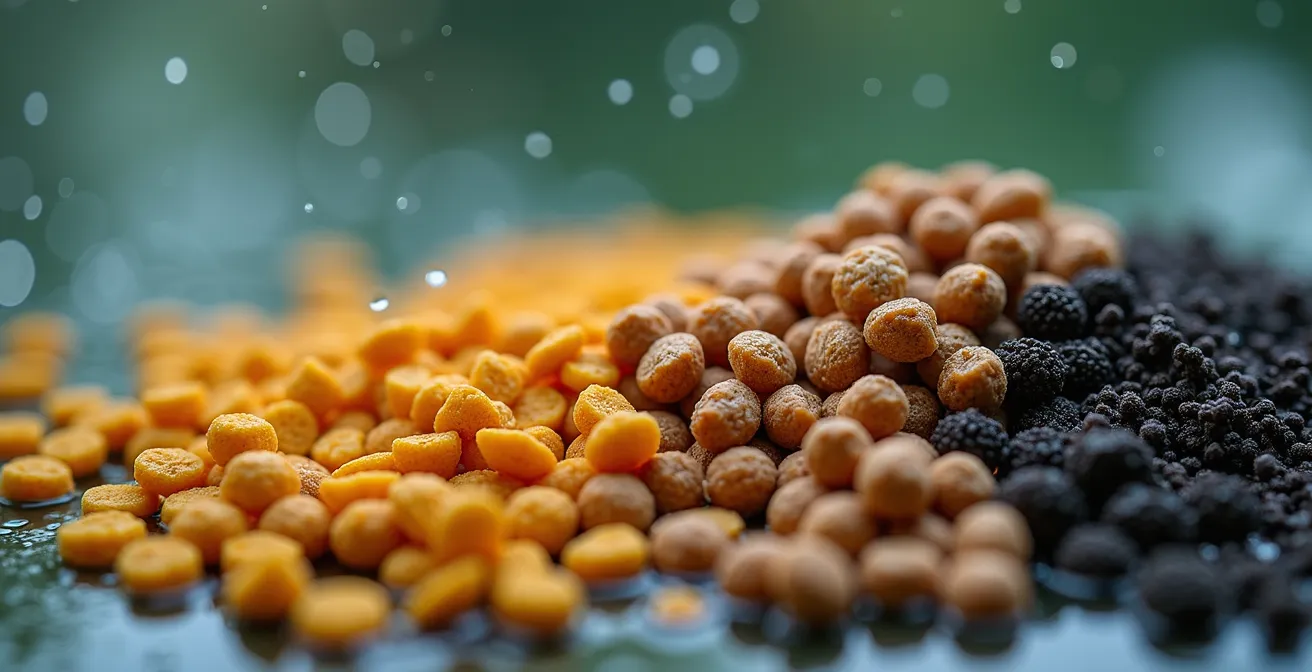
The industry is making strides. For instance, the FCR for farmed salmon has improved significantly, but the fundamental challenge of feeding predators remains. The table below illustrates the general differences in FCR and protein retention, highlighting why the *type* of fish you choose is so important.
| Fish Type | Feed Conversion Ratio (FCR) | Protein Retention |
|---|---|---|
| Atlantic Salmon (Carnivore) | 1.0-1.2 | ~19% |
| Herbivorous Carp (Omnivore) | 1.5-2.0 | 14-28% |
| General Carnivorous Species | 1.0-2.4 | 14-28% |
While salmon may appear highly efficient with an FCR near 1.0, this figure can be misleading if the feed itself is composed of wild fish. A more holistic measure, the “Fish In, Fish Out” (FIFO) ratio, reveals that it once took several kilograms of wild fish to produce one kilogram of farmed salmon. Though this has improved, choosing fish that are naturally lower on the food chain, like carp or tilapia, is often a more direct path to sustainable seafood consumption.
Beef vs Crickets: Which Protein Source Requires Less Land per Calorie?
Nowhere is the trophic inefficiency more pronounced than in the production of red meat, particularly beef. Cows are ruminants, large and warm-blooded, placing them high on the “ecological tax” scale. The resources required to produce a single calorie of beef are staggering compared to plant-based or even insect-based proteins. The most critical resources impacted are land use and greenhouse gas emissions.
Research consistently shows that beef production is an outlier in its environmental impact. According to a comprehensive analysis by Our World in Data, producing a kilogram of beef emits 60 kilograms of greenhouse gases (CO2-equivalents). For comparison, producing a kilogram of peas emits just one kilogram. This isn’t a small difference; it’s a monumental gap that highlights the power of food choice. This disparity is almost entirely due to two factors: the energy lost moving up the food chain to the cow, and the methane—a potent greenhouse gas—that cows produce during digestion.
In contrast, crickets and other edible insects are ectotherms (cold-blooded) and have incredibly efficient FCRs, often around 1.7. They require a fraction of the land, water, and feed as cattle. While the idea of eating insects may still be a cultural hurdle for many, their ecological credentials are undeniable. They represent the logical endpoint of eating for trophic efficiency. Choosing beans, lentils, or peas over beef achieves a similar, massive reduction in your environmental footprint, sidestepping the “yuck factor” for a more familiar and equally efficient protein source.
Overall, red meats such as beef and lamb, along with cheese, have the highest carbon footprint. … One step that people can take to reduce their personal carbon footprint is to go meatless on Mondays.
– Ken Cook, Environmental Working Group
Shifting even a portion of your protein intake from beef to sources lower on the trophic scale—whether it’s chicken, fish, beans, or even crickets—is one of the most impactful lifestyle changes you can make for the planet.
The Tuna Consumption Error That Exposes You to High Mercury Levels
Eating high on the food chain doesn’t just come with an ecological cost; it can carry a direct health risk. This is due to a process called biomagnification (or bioaccumulation). Certain persistent substances, like the heavy metal mercury, are not easily broken down by organisms. When a small fish consumes plankton containing tiny amounts of mercury, that mercury gets stored in its fatty tissues. A larger fish then eats many of these small fish, accumulating all of their mercury. This process continues all the way up the food chain.
The result? Apex predators at the top of the aquatic food web, like large tuna, shark, and swordfish, can contain mercury levels thousands of times higher than the water they live in. For humans, consuming these fish is the primary route of exposure to methylmercury, a potent neurotoxin. This is a classic example of your “plate ecosystem” having a direct and negative consequence on your well-being.
A common mistake consumers make is treating all canned tuna as the same. However, different species of tuna occupy different positions on the food chain. Consumer safety data clearly shows that canned albacore (“white”) tuna has around three times the amount of mercury found in canned skipjack (“light”) tuna, on average. This is because albacore are larger, live longer, and prey on larger fish than skipjack. Choosing canned light tuna over white albacore is a simple, effective way to reduce your mercury intake while still getting the benefits of fish.
The following guidelines help navigate these choices safely:
- Light canned tuna and skipjack tuna: Generally considered safe for 2-3 servings per week for adults.
- Albacore (canned white tuna) and yellowfin: Limit consumption to one serving per week maximum.
- Bigeye tuna: Often found in sushi, this species has some of the highest mercury levels and is categorized by many health agencies as a “choice to avoid,” especially for children and pregnant women.
By opting for smaller, shorter-lived fish lower on the food chain (like sardines, anchovies, or skipjack tuna), you not only choose a more sustainable option but also a healthier one.
When to Protect Apex Predators to Prevent Herbivore Overpopulation
After exploring the inefficiencies of eating high on the food chain, it might seem logical to conclude that all apex predators are “bad” for the environment. This is a dangerous oversimplification. In natural ecosystems, apex predators play an irreplaceable role in maintaining balance and biodiversity through a process called a trophic cascade.
When top predators are removed from an ecosystem, the populations of their prey—often large herbivores like deer or elk—can explode. This overgrazing can decimate plant life, leading to soil erosion, reduced biodiversity, and a complete unraveling of the ecosystem’s structure. The classic example is the reintroduction of wolves to Yellowstone National Park, which controlled the elk population, allowing aspen and willow trees to recover, which in turn brought back beavers and songbirds. This “ecology of fear” created by predators is essential for a healthy landscape.

This principle extends to the oceans. Large marine animals, from sharks to whales, are crucial for ecosystem function. For example, whales play a vital role in the “blue carbon” cycle. They feed in the deep ocean and release nutrient-rich feces near the surface, a process that fertilizes phytoplankton. These phytoplankton form the base of the marine food web and absorb vast amounts of carbon dioxide. The decline of whale populations has disrupted this planetary nutrient pump, with unquantified consequences for climate regulation.
The lesson here is one of context and balance. While it is inefficient for humans to *farm* predators for food, it is vital to *protect* them in the wild. The goal of a sustainable food system isn’t to eliminate the top of the food chain, but for humans to step down from that position. By choosing to eat plants, we reduce the pressure on wild ecosystems and allow natural trophic cascades to function as they should.
How to Calculate How Many Earths Your Lifestyle Requires?
Translating trophic levels into a personal metric can feel abstract. This is where tools like the Ecological Footprint calculator come in. Developed by the Global Footprint Network, this tool aggregates your lifestyle choices—your home energy use, transportation, and, critically, your diet—to estimate how many “Earths” would be required if everyone lived as you do. Food is one of the biggest levers in this calculation.
Your dietary choices directly influence your demand on Earth’s biocapacity. A diet heavy in processed foods and red meat requires vast amounts of land for grazing and feed crops, energy for processing, and has a high carbon output. According to an analysis from Shrink That Footprint, this is reflected in the final numbers: a meat lover has the highest carbon footprint at 3.3 tons of greenhouse gas emissions annually from their diet alone. In stark contrast, a vegan’s diet accounts for just 1.5 tons. The difference of 1.8 tons is equivalent to a round-trip flight from London to New York.
These calculators make the abstract tangible. By inputting your weekly consumption of beef, pork, poultry, fish, and dairy, you can see in real-time how your footprint shrinks as you substitute these with plant-based options. It gamifies the process of eating lower on the trophic scale. It’s no longer just about “saving the planet” in a vague sense; it’s about actively reducing your personal demand from, for example, 2.5 Earths to 1.7 Earths.
The United Nations confirms the scale of this issue, noting that about a third of all human-caused greenhouse gas emissions are linked to our food system. The journey to a one-planet lifestyle is challenging, but the path is clear: the most significant first step for most people in developed nations is to shift their position on the food chain.
Key Takeaways
- The “10% Rule” dictates that 90% of energy is lost at each step up the food chain, making meat production inherently inefficient.
- The type of food you eat has a much larger carbon footprint than its transportation distance (“food miles”).
- Eating high on the aquatic food chain (e.g., large tuna) increases your exposure to biomagnified toxins like mercury.
How to Calculate Your Household Carbon Footprint Using Utility Bills?
While a full Ecological Footprint provides a holistic view, you can get a more granular look at your food-related carbon footprint right from your kitchen. It’s less about your utility bills—which primarily reflect home energy—and more about auditing your grocery receipts and food waste. Your food choices are a massive, often invisible, part of your household’s emissions.
The first step is to categorize your food spending. Look at your receipts for a typical month and tally up the kilograms or pounds of different protein sources you buy: beef, lamb, pork, poultry, fish, cheese, and plant-based proteins like beans and lentils. Using a carbon footprint table, like the one below adapted from Our World in Data, you can make a rough but revealing calculation of your food’s “embedded” emissions.
| Food Product | kg CO2e per kg | Comparison |
|---|---|---|
| Beef | 60 | Highest impact |
| Lamb & Cheese | 20+ | High impact |
| Poultry | 6 | Medium impact |
| Pork | 7 | Medium impact |
| Peas | 1 | Lowest impact |
The second, and equally important, part of a household audit is food waste. Wasted food is not just a waste of money; it’s a waste of all the energy, land, and water that went into producing it. When organic waste ends up in a landfill, it decomposes anaerobically and produces methane. According to the UN, food waste is a colossal problem, contributing more than 8-10 percent of global greenhouse gas emissions. If food waste were a country, it would be the third-largest emitter in the world. A simple audit of what you throw away each week can reveal patterns and lead to better meal planning and purchasing habits.
Action Plan: Your 5-Step Food Footprint Audit
- Track Your Proteins: For one month, keep your grocery receipts and log the weight (in kg or lbs) of beef, lamb, cheese, chicken, pork, and fish you purchase.
- Calculate Your Baseline: Use the table above to multiply the weight of each protein by its CO2e factor. This gives you a baseline emissions number for your protein consumption.
- Audit Your Bin: For one week, track the edible food you throw away. Be honest. Is it leftover bread? Wilted salad? Expired yogurt? Note the type and approximate quantity.
- Identify Your “Leakage” Points: Look at your data. Is your footprint dominated by weekly steak nights? Is food waste concentrated in fresh produce you don’t get to? Pinpoint your top 1-2 problem areas.
- Make a “One Swap” Plan: Don’t try to change everything at once. Create a simple plan. “This month, I will swap one beef meal for a bean chili,” or “I will plan two meals around using up leftover vegetables before they spoil.”
By making your food’s invisible footprint visible, you empower yourself to manage it effectively, one meal and one grocery list at a time.
How to Replicate Nature’s Continuous Nutrient Cycle in Modern Agriculture?
The ultimate goal is to create a food system that mimics the efficiency of nature. In a natural ecosystem, there is no “waste.” Every output is an input for another part of the system. Modern industrial agriculture, particularly animal farming, breaks this cycle by creating linear, wasteful systems. However, innovative approaches are emerging that seek to close this loop.
One of the most promising examples in aquaculture is Integrated Multi-Trophic Aquaculture (IMTA). In an IMTA system, the waste from one species becomes the food for another. For example, the nutrient-rich waste from farmed fish (like salmon) is used to feed shellfish (like mussels or oysters), which filter organic particles from the water. The dissolved waste products are then used to grow seaweed or other aquatic plants. This creates a circular system that increases productivity, reduces pollution, and produces multiple valuable products from a single feed input.
This approach directly addresses the core inefficiency of modern food production. As researchers Poore and Nemecek highlighted, animal agriculture is incredibly resource-intensive, occupying over 80% of farmland to produce just 18% of global calories. The shift towards systems like IMTA, or more broadly, regenerative agriculture on land, is about creating food webs, not just production lines. It’s a move towards farming low-trophic-level species and integrating different types of production to create a more resilient and less wasteful whole.
For consumers, supporting this shift means looking for products from these advanced systems when possible. But more broadly, it means championing the principle of circularity. By reducing our own food waste and choosing foods that are inherently more efficient (i.e., lower on the trophic scale), we reduce the overall burden on the agricultural system, making it easier for farmers to transition to these more sustainable, nature-inspired models. Every plant-based meal you choose is a vote for a more circular and efficient food future.
Start today by auditing one meal. Look at what’s on your plate, identify its trophic level, and consider one small swap for a more energy-efficient choice. That is the first step to mastering your personal food ecosystem.