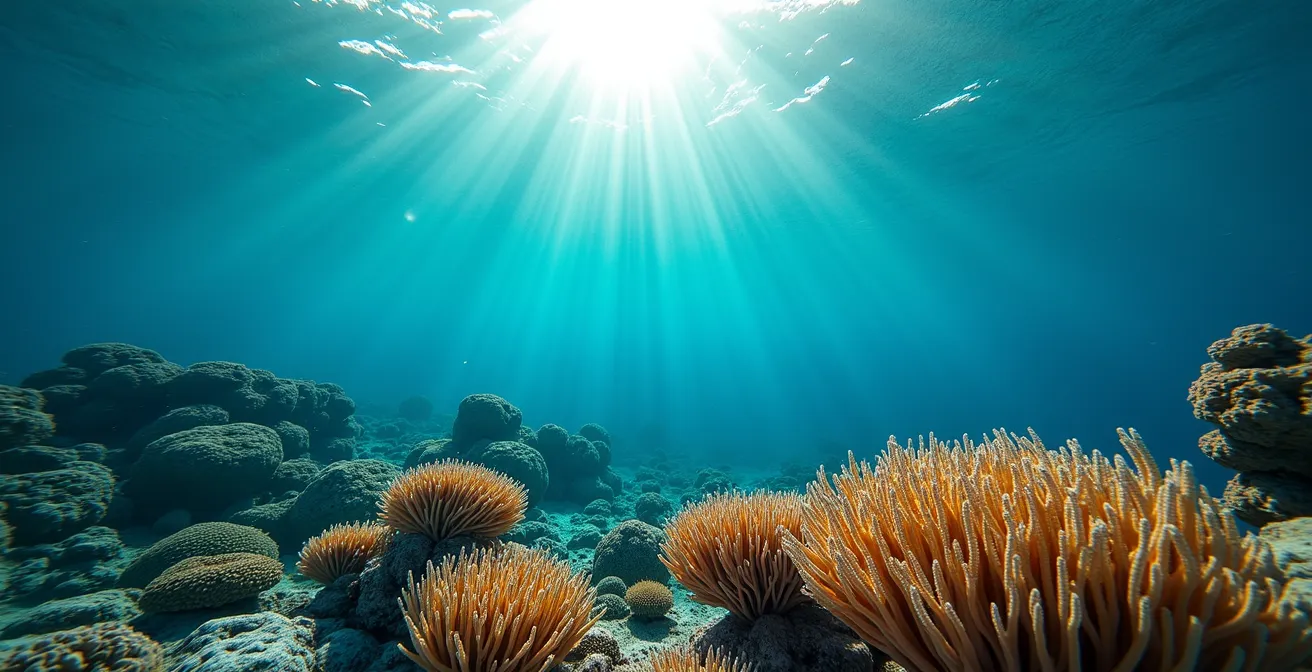
Natural coastal defenses like coral reefs are not just “green” alternatives; they are superior financial assets that appreciate and self-repair, unlike depreciating concrete walls.
- Symbiotic ecosystems like reefs actively grow and adapt to rising sea levels, whereas concrete infrastructure has a fixed lifespan and requires costly maintenance.
- The failure of these biological assets, like coral bleaching, is a predictable biochemical cascade that can be factored into risk management models.
Recommendation: Shift coastal management strategies from a reliance on short-term concrete fixes to long-term investment in the preservation and restoration of these invaluable biological assets.
For coastal property owners and tourism boards, the sight of a shrinking beach is a direct threat to their livelihood and investments. The conventional response has been to erect hard barriers: concrete levees, sea walls, and breakwaters. These solutions feel solid and immediate, offering a sense of security against the encroaching sea. However, this approach often overlooks a more efficient, resilient, and ultimately more cost-effective system of defense that has been operating for millennia: marine symbiosis.
The intricate partnerships within ocean ecosystems, particularly the relationship between corals and the algae living within their tissues, create a living infrastructure that protects coastlines. This isn’t merely about placing a barrier in front of the waves; it’s about managing a dynamic, self-maintaining, and appreciating biological asset. Yet, if the core of this asset’s value lies in its symbiotic machinery, its greatest vulnerability lies there as well. The conversation must shift from a simple “nature versus concrete” debate to a more sophisticated analysis of risk, depreciation, and long-term return on investment.
This article re-frames the value of marine symbiosis from a purely ecological curiosity to a critical component of coastal asset management. We will dissect the mechanisms that make these living systems work, quantify their economic value, and analyze the cascading failures that occur when these delicate partnerships break down. Understanding this is not just about environmentalism; it’s about making smarter, more sustainable financial decisions for the future of our coastlines.
This comprehensive analysis will guide you through the intricate world of marine symbiosis, evaluating its role as a coastal defense mechanism. By exploring the mechanics, vulnerabilities, and economic implications of these natural systems, you’ll gain a deeper understanding of why they represent a superior long-term investment for coastal protection.
Summary: The Superior Investment Case for Symbiotic Coastal Defenses
- Why Does rising Water Temperature Break the Symbiotic Bond in Corals?
- How to Establish a Symbiotic Clownfish and Anemone Tank Successfully?
- Mutualism vs Parasitism: Which Interaction Drives Evolution Faster in the Ocean?
- The Overfishing Error That Starves Cleaner Fish and Spreads Disease
- How to Use Cleaner Shrimp to Reduce Parasites in Salmon Farms Naturally?
- Concrete Levees vs Mangroves: Which Asset Depreciates Slower?
- Sea Walls or Carbon Cuts: Which Investment Reduces Long-Term Risk More?
- How Ocean Acidification Processes Are Dissolving the Foundation of the Marine Food Web?
Why Does rising Water Temperature Break the Symbiotic Bond in Corals?
Rising water temperature breaks the symbiotic bond in corals by triggering a state of severe cellular stress within the coral’s algal partners, the zooxanthellae. This thermal stress causes the algae, which normally provide the coral with up to 90% of its food through photosynthesis, to produce damaging molecules called reactive oxygen species (ROS). This turns the beneficial partner into a toxic tenant, forcing the coral to expel the algae in a desperate act of self-preservation, which we observe as coral bleaching.
This process is not a simple separation but a complex biochemical breakdown. As experts in the field note, the phenomenon is a direct result of system failure at the cellular level. This perspective is outlined by Helgoe et al. in their research on coral thermal tolerance:
Heat stress disrupts coral-algal symbiosis through a cascade of cellular events, including protein denaturation, accumulation of reactive oxygen species, and oxidative stress
– Helgoe et al., Spotlight on coral thermal tolerance research
Case Study: Egyptian Red Sea Bleaching Event Analysis 2023
The 2023 bleaching event along the Egyptian Red Sea coast provided a stark real-world example of this symbiotic failure cascade. As documented in a scientific review, the abnormally warm waters triggered thermal stress in the reef’s corals. The symbiotic zooxanthellae began producing detrimental reactive oxygen species (ROS) instead of vital nutrients. These highly reactive ROS molecules created havoc within the coral cells, leading to widespread cellular damage. To prevent the death of its own tissues from this internal toxicity, the coral was forced to expel its algal partners, resulting in the large-scale bleaching observed by researchers.
Understanding this mechanism is crucial for coastal managers. It reframes coral bleaching from a vague environmental issue into a predictable asset failure. The coral reef is a piece of living infrastructure, and heat stress is the operational condition that pushes it past its breaking point, compromising its structural integrity and its ability to protect the coastline.
How to Establish a Symbiotic Clownfish and Anemone Tank Successfully?
While seemingly distant from coastal erosion, successfully establishing a clownfish and anemone symbiosis in an aquarium provides a powerful micro-level analogy for managing large-scale reef assets. It demonstrates the extreme specificity and fragility of these partnerships. It is not enough to simply place two symbiotic species together; a complex set of environmental conditions must be meticulously managed to foster the relationship and prevent rejection or harm.
This process reveals the hidden “operating manual” of symbiotic relationships. For the clownfish to safely approach and inhabit the anemone, whose sting can be lethal, specific chemical signals and physiological adaptations must be perfectly aligned. The process requires careful selection, gradual introduction, and constant monitoring, mirroring the delicate balance needed to maintain a healthy, functional coral reef.
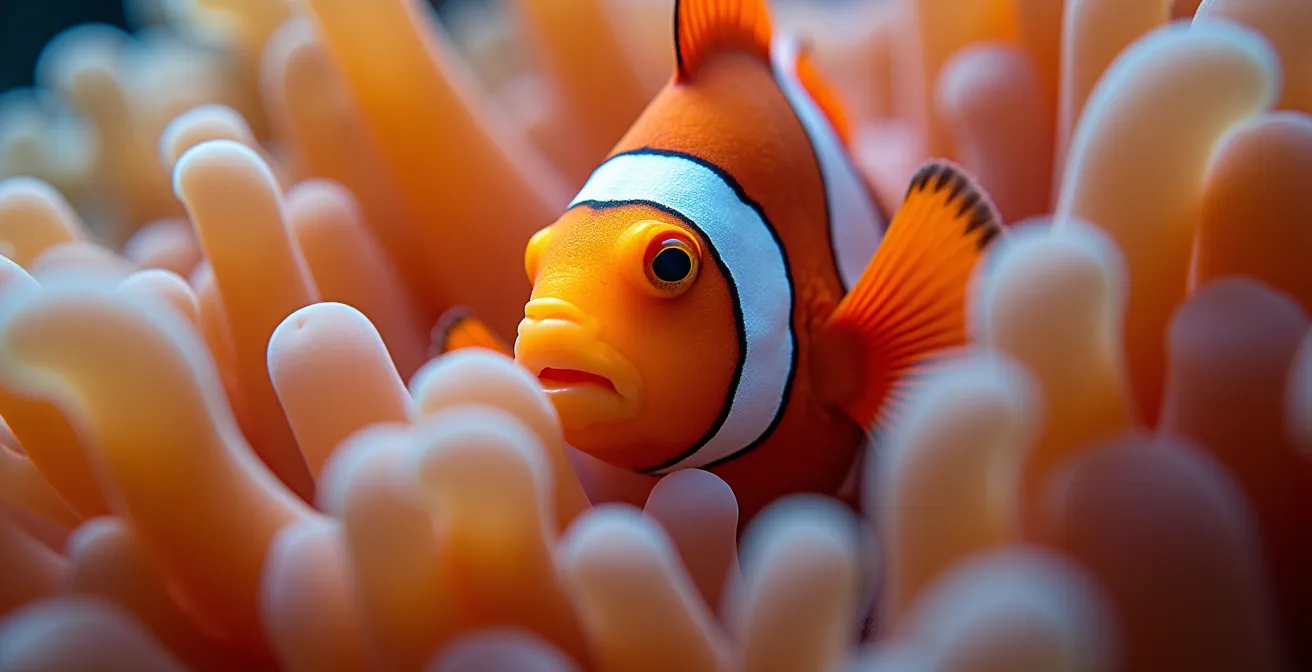
As the image above illustrates, the intimacy of the bond is physical. The clownfish relies on a protective mucus layer to inhibit the anemone’s stinging nematocysts. The health of this layer, and thus the success of the entire relationship, is directly tied to water chemistry and the fish’s stress levels. This highlights that a symbiotic asset is only as strong as the environment that supports it.
Your Action Plan: Key Steps for Successful Clownfish-Anemone Symbiosis
- Select compatible species: Only 10 anemone species coexist with 26 tropical clownfish species from over 1,000 total anemone varieties. Mismatching is a common failure point.
- Establish proper water chemistry: Maintain stable parameters to support the complex compounds in the clownfish’s mucus layer, which are essential for preventing the anemone’s nematocyst firing.
- Introduce captive-bred clownfish gradually: Use target training and a slow acclimation process to help restore innate host-approaching behaviors that can be lost in captivity.
- Monitor water quality for chemical signaling: Ensure optimal parameters that support the subtle chemical signaling between the two partners, which governs recognition and acceptance.
- Create a stable microenvironment: Replicate the low-flow, stable conditions of natural reef habitats where these pairs are found to minimize stress on both organisms.
Mutualism vs Parasitism: Which Interaction Drives Evolution Faster in the Ocean?
In the ocean, both mutualism and parasitism are powerful evolutionary forces, but they operate on different principles and create vastly different outcomes. Parasitism often drives rapid, cyclical evolution in a constant “arms race,” as seen in Red Queen dynamics where host and parasite are locked in a struggle for survival. However, it is mutualism that drives transformative leaps in evolution, leading to the creation of entirely new, complex systems like coral reefs. Mutualism isn’t just an interaction; it’s a construction engine.
The symbiosis between coral and algae is a prime example of this constructive power. This partnership allows corals to thrive in nutrient-poor tropical waters, effectively creating an oasis of life in an oceanic desert. The efficiency of this mutualism is staggering; research demonstrates that approximately 90% of nutrients from the algae’s photosynthesis are transferred directly to the coral host. This incredible “biochemical ROI” is the foundation upon which the entire reef structure—the physical asset protecting the coastline—is built.
This comparison highlights that mutualism builds value, while parasitism often consumes it. One creates complex, resilient ecosystems that provide billions of dollars in services, while the other leads to an endless, energy-draining battle. For coastal managers, the goal is to foster conditions that favor mutualism, the engine of asset creation.
| Aspect | Mutualism | Parasitism |
|---|---|---|
| Rate of Change | Slower iterative changes | Rapid cyclical evolution |
| Type of Evolution | Transformative leaps (symbiogenesis) | Arms race dynamics |
| Example | Creation of coral reef ecosystems | Red Queen dynamics in host-parasite systems |
| Environmental Response | Enables colonization of extreme habitats | Drives defensive adaptations |
The Overfishing Error That Starves Cleaner Fish and Spreads Disease
A critical, often overlooked, error in fisheries management is the overfishing of “non-commercial” cleaner species like certain fish and shrimp. This mistake has cascading consequences that degrade the health of the entire reef ecosystem, effectively sabotaging the “maintenance crew” of this vital coastal defense asset. Cleaner species perform a crucial service by removing parasites, dead skin, and fungi from larger “client” fish, including many commercially important species. This is a classic mutualistic relationship where the cleaner gets a meal, and the client gets a health treatment.
When cleaner species are removed from the system, the results are swift and damaging. Parasite loads on the remaining fish populations skyrocket, leading to increased stress, disease, and mortality. This directly impacts the resilience of the entire ecosystem. Healthy fish are essential for grazing algae that would otherwise smother corals and for contributing to the overall biodiversity that makes the reef robust.
Case Study: The Impact of Cleaner Species Removal
Studies on the removal of cleaner shrimp (Lysmata amboinensis) and cleaner wrasse provide clear evidence of this negative cascade. When these cleaners are absent, larger client fish populations are directly impacted. These species are observed spending significantly more energy on self-cleaning behaviors, such as rubbing against rocks, rather than on crucial activities like foraging and breeding. This behavioral shift, combined with the physiological stress from increased parasitic loads, weakens the fish, making them more susceptible to disease and predation. This degradation of a key service undermines the health of the entire reef asset.
The consequences are not just ecological; they are quantifiable. In degraded reef habitats where these crucial symbiotic partnerships are broken, the entire system becomes less viable. For fish populations, experimental data shows that mean survivorship drops to 6.5% in degraded reefs compared to healthy ones. This demonstrates a catastrophic loss of value and function, triggered by the removal of a seemingly minor component.
How to Use Cleaner Shrimp to Reduce Parasites in Salmon Farms Naturally?
The principles of mutualistic symbiosis can be harnessed as a powerful, natural tool in commercial settings, offering a compelling business case for understanding these relationships. In salmon aquaculture, a major challenge is the management of sea lice, a parasite that can devastate stocks and requires costly chemical or thermal treatments. An innovative solution involves introducing cleaner species, such as certain types of wrasse or shrimp, into the salmon pens to create a managed symbiotic system.
This “biological control” method leverages the natural cleaning behavior of these species to continuously remove parasites from the salmon. It represents a shift from reactive, often harsh treatments to a proactive, ecosystem-based management strategy. For salmon farms, this can lead to reduced chemical use, improved animal welfare, and access to premium markets for “sustainably-raised” or “chemical-free” products. It transforms a natural process into a direct economic benefit.
Implementing such a system requires careful planning and an understanding of the symbiotic partners’ needs. The goal is to create an environment where the cleaning interaction can occur efficiently without the cleaner species being preyed upon by the salmon. This involves calculating optimal stocking densities and designing habitats that provide refuge for the cleaner species.
The successful application of cleaner shrimp in aquaculture is a tangible demonstration that symbiotic services are a marketable asset. It proves that investing in and understanding these natural relationships can yield direct financial returns, moving the concept of symbiosis from the wild reef to the modern balance sheet. This approach provides a sustainable alternative to costly and environmentally impactful conventional methods.
Concrete Levees vs Mangroves: Which Asset Depreciates Slower?
When viewed through the lens of asset management, the choice between concrete levees and natural systems like mangroves or coral reefs becomes a clear-cut financial decision. A concrete levee is a depreciating asset with high upfront costs and a fixed lifespan. A healthy mangrove or reef system, however, is a self-maintaining and potentially appreciating asset that grows and adapts over time.
The primary function of these assets is wave energy reduction. On this front, natural systems are extraordinarily effective. For instance, NOAA research confirms that healthy coral reefs can absorb up to 97% of wave energy before it reaches the shore. While a concrete wall also stops waves, it does so at a much higher long-term cost and with none of the co-benefits.
The key difference lies in their response to time and environmental stress. A concrete levee begins to degrade the moment it is built, requiring ever-increasing maintenance costs until its eventual, costly replacement. A mangrove forest, by contrast, builds soil, traps sediment, and can grow vertically, naturally keeping pace with a gradual rise in sea level. Its failure mode is gradual, not catastrophic like the breaching of a levee. Furthermore, the natural asset provides billions in co-benefits—such as fisheries, tourism, and carbon storage—that a concrete wall can never offer.
| Factor | Concrete Levees | Mangrove/Reef Systems |
|---|---|---|
| Initial Cost | $5-15 million per km | $0.5-3 million per km restoration |
| Maintenance | Increasing costs over time | Self-maintaining ecosystem |
| Lifespan | 30-50 years fixed | Indefinite with proper management |
| Failure Mode | Catastrophic above threshold | Gradual degradation |
| Co-benefits | None | Fisheries, tourism, carbon storage |
| Adaptation Capacity | Fixed height | Grows with sea level rise |
Sea Walls or Carbon Cuts: Which Investment Reduces Long-Term Risk More?
The debate over coastal protection is often framed as a choice between local engineering (sea walls) and global policy (carbon cuts). From a risk management perspective, this is a false dichotomy. The most effective strategy involves recognizing that coral reefs and other natural defenses are invaluable assets, and the “investment” is not just in physical restoration but also in mitigating the systemic threats that degrade them—primarily climate change and ocean acidification.
Investing in a sea wall is a localized, defensive measure. It protects one specific stretch of coast but does nothing to address the root cause of increasing storm surge and sea-level rise. Investing in carbon cuts, by contrast, is a proactive measure that reduces the long-term risk for all coastal assets globally by stabilizing the conditions they need to survive and thrive. One is a short-term patch; the other is a long-term cure.
The economic value of these natural assets makes this investment case compelling. According to a U.S. Geological Survey analysis, U.S. coral reefs provide $1.8 billion annually in flood protection benefits alone. Allowing these assets to degrade is equivalent to writing off billions in infrastructure. The risk of inaction is starkly quantified in the same research:
The degradation of coral reefs raises flood risks by increasing the exposure of coastal communities to storms. With a 1-m loss in reef height, the 100-year floodplain would increase across the U.S. by 104 km², imperiling 51,000 more people and $5 billion in property
– U.S. Geological Survey, The Value of U.S. Coral Reefs for Risk Reduction
This data reframes the conversation. Carbon cuts are not just an environmental policy; they are a necessary investment to protect trillions of dollars in coastal property and infrastructure that are currently shielded by these living systems. The long-term risk reduction from preserving the asset (via carbon cuts) far outweighs the temporary protection of a depreciating sea wall.
Key Takeaways
- Coral reefs and mangroves should be managed as valuable, self-maintaining ‘biological assets,’ not just features of the environment.
- The failure of these assets, such as coral bleaching, is a predictable biochemical ‘failure cascade’ triggered by environmental stressors like heat.
- The economic value of these natural defenses is immense, providing billions in quantifiable flood protection and preventing catastrophic damage to coastal properties.
How Ocean Acidification Processes Are Dissolving the Foundation of the Marine Food Web?
Ocean acidification, driven by the absorption of excess atmospheric CO2, is a slow, insidious process that dissolves the very foundation of marine life by making it harder for organisms to build their skeletons and shells. This chemical assault directly attacks the base of the marine food web and the structural integrity of our most important coastal defense assets. For calcifying organisms like corals, pteropods, and shellfish, acidification increases the energetic cost of building their calcium carbonate structures while simultaneously making the surrounding water more corrosive to their existing skeletons.
This creates a devastating “double threat” when combined with warming waters. Warming causes the immediate metabolic stress that can lead to bleaching, while acidification weakens the coral’s underlying structure, making it more brittle and susceptible to storm damage. It’s like trying to fight a fever while your bones are slowly dissolving.
Research on Acropora corals highlights this compounding effect. Studies have shown that deoxygenation, a related consequence of climate change, can lower the thermal bleaching threshold by a full 1°C. The study found that hypoxia (low oxygen) triggers oxidative stress similar to heat stress, with enhanced ROS production disrupting cellular activity. This means that as the ocean acidifies and deoxygenates, corals become even more vulnerable to bleaching at lower temperatures. This is a classic cascading failure, where one system stress amplifies the damage from another.
The stakes are astronomical. Globally, coral reefs globally prevent an estimated $94 billion in annual coastal damage from storms and erosion. By dissolving this foundational asset, ocean acidification is systematically dismantling a global infrastructure network responsible for protecting millions of people and trillions of dollars in property. It’s an invisible threat that is quietly liquidating one of the planet’s most valuable assets.
Ultimately, safeguarding our coastlines requires a paradigm shift. We must move beyond the 20th-century mindset of concrete barriers and embrace a 21st-century approach centered on managing and restoring the living, symbiotic systems that have protected shorelines for millennia. The next step is to integrate the valuation of these biological assets into all coastal risk assessments, infrastructure planning, and long-term investment strategies.
Frequently Asked Questions on How Marine Symbiosis Between Coral and Algae Protects Coastlines from Erosion?
What is the optimal cleaner shrimp to salmon ratio?
Research suggests ratios vary based on farm density, typically ranging from 1:50 to 1:100 depending on parasite prevalence and water conditions.
How do cleaner shrimp compare to chemical treatments?
While chemical treatments provide immediate results, cleaner shrimp offer continuous parasite control without chemical residues, supporting premium ‘chemical-free’ salmon markets.
Can cleaner shrimp survive in salmon farm conditions?
Yes, with proper habitat modifications including refuge areas and optimal water flow patterns to facilitate cleaning station establishment.