
The pervasive threat of microplastics extends far beyond ocean pollution and landfills. The most significant risk of human contamination originates from invisible fragmentation pathways within our own homes. Everyday activities, such as doing laundry and drinking bottled water, systematically break down plastics into microscopic particles that directly enter our food chain and, ultimately, our bloodstream. Understanding these hidden vectors is the first critical step toward mitigating personal exposure.
The presence of plastic in our environment is a well-documented crisis, often visualized through images of floating islands of debris in the ocean. As health-conscious individuals and parents, we diligently avoid single-use plastics and sort our recycling, believing these actions are the primary solution. However, this focus on macro-pollution, while important, dangerously overlooks a more insidious threat: the systemic infiltration of microplastics and even smaller nanoplastics into our bodies through sources we interact with daily.
The core of the problem is not merely the existence of plastic but the constant, low-level fragmentation that occurs during a product’s lifecycle. These microscopic particles are shed from our clothes in the wash, leach from our food and water containers, and are even created during the very recycling processes designed to solve the problem. They become airborne, settle in our food, and are ingested, eventually crossing biological barriers to enter our bloodstream.
But if the real danger lies in these invisible fragmentation pathways, how can we identify and address them? This article moves beyond the headlines to provide a research-based examination of the specific mechanisms by which microplastics contaminate our food and water. We will dissect the most significant sources of exposure, from synthetic textiles to bottled water, and outline evidence-based strategies to reduce your personal particle load. By understanding these vectors of contamination, we can move from passive concern to informed action.
To navigate this complex issue, we will explore the critical junctures where macroplastics become a microscopic threat. The following sections break down the primary sources of contamination and the design principles that can offer a systemic solution.
Summary: The Lifecycle of Microplastic Contamination
- Why Washing Synthetic Clothes Is the #1 Source of Ocean Microfibers?
- How to Install Filters That Capture 90% of Microfibers in Your Laundry?
- Bottled Water vs Tap Water: Which Contains More Microplastic Particles?
- The Recycling Error That Turns Macro-Plastics into Micro-Plastics
- How to Accelerate Plastic Degradation Using New Enzyme Technologies?
- How to Choose Monomaterials to Ensure 100% Recyclability?
- The Design Mistake That Alienates Customers and Invites Regulation
- Eco-Design Principles: How to Reduce Product Impact by 80% During the Concept Phase?
Why Washing Synthetic Clothes Is the #1 Source of Ocean Microfibers?
While industrial waste and plastic litter are highly visible pollutants, the single largest source of primary microplastics in our oceans is far more subtle and originates in our homes: our clothing. According to a report from Fashion Revolution, textiles are responsible for 34.8% of global microplastic pollution. This is because a significant portion of modern clothing is made from synthetic materials like polyester, nylon, and acrylic—which are, in essence, forms of plastic.
The primary fragmentation pathway occurs during laundering. The mechanical and chemical stress of a washing machine cycle abrades the surface of these synthetic fabrics, causing them to shed microscopic fibers. These particles are too small to be caught by standard wastewater treatment plants and are discharged directly into rivers and oceans. The scale of this issue is staggering; research from Ocean Wise reveals that a single wash cycle of synthetic clothing can release over 700,000 individual microfibers into the water system.
These fibers not only accumulate in marine ecosystems but also re-enter our food chain. They are ingested by plankton and fish, which are in turn consumed by humans. Furthermore, microfibers released into waterways can become part of the water cycle, eventually falling with rain and settling on agricultural land, contaminating crops. This makes the washing of synthetic clothing a primary, yet often overlooked, vector of contamination for the human food supply.
How to Install Filters That Capture 90% of Microfibers in Your Laundry?
Given that domestic laundry is a major fragmentation pathway for microplastics, intervention at the source is the most effective strategy. Preventing fibers from entering the wastewater stream in the first place is significantly more manageable than trying to remove them from the ocean. Fortunately, several technologies are now available to consumers that can dramatically reduce microfiber shedding, with some external filters proven to capture up to 90% of fibers released during a wash.
These solutions range from simple, in-drum devices to more comprehensive external filtration systems. The key is choosing a method and using it consistently. The visual below illustrates how an external filter integrates with a standard washing machine to intercept particles before they escape. This principle of point-of-use filtration is gaining regulatory traction; in a landmark move, France has mandated that all new washing machines be equipped with microfiber filters by 2025, signaling a shift toward producer responsibility.
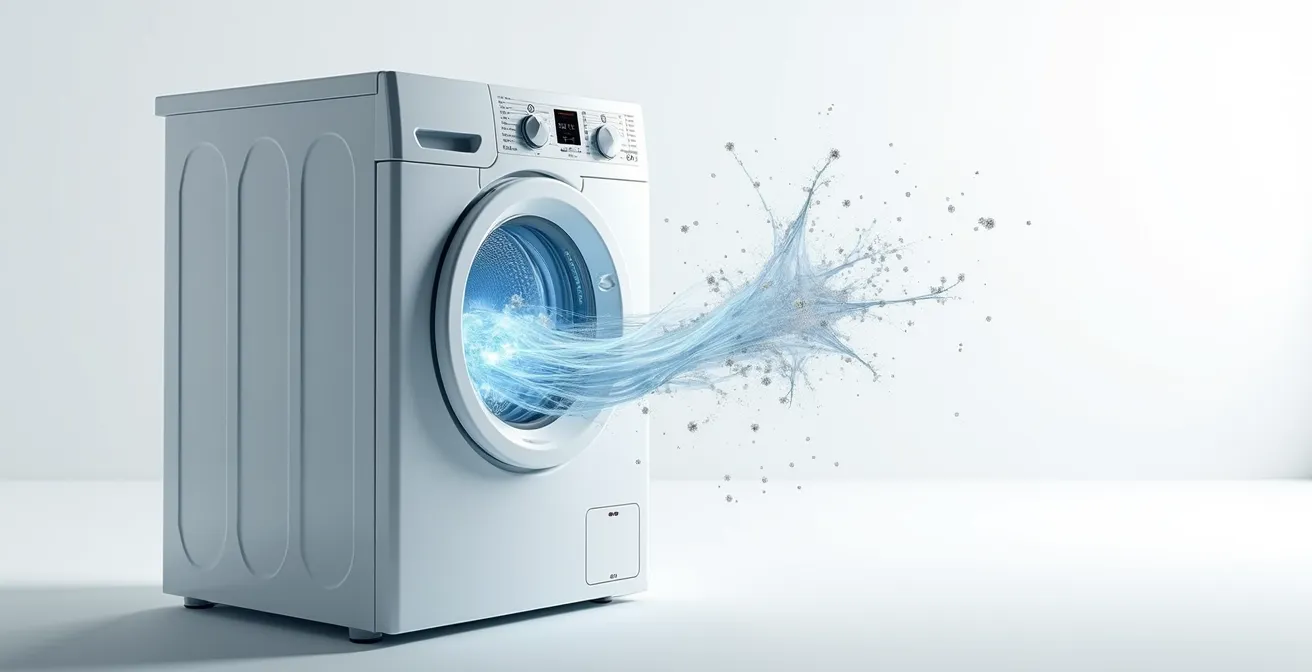
For households looking to take immediate action, implementing a filtration system is a direct and impactful step. While external filters offer the highest capture rate, even simpler solutions provide a significant reduction in pollution, contributing to a lower overall environmental particle load.
Your Action Plan: Implementing Microfiber Filtration at Home
- Install an External Filter: Choose a dedicated external lint filter like LINT LUV-R or Filtrol. According to Ocean Wise testing, these systems can capture up to 90% of polyester microfibers and are plumbed into your machine’s drainage hose.
- Use In-Drum Solutions: For a less permanent option, use devices like the CoraBall, which can reduce microfiber release by 26%, or a Guppyfriend washing bag, which contains garments and traps shed fibers inside.
- Adjust Washing Habits: Minimize fiber shedding by washing clothes in cold water, using liquid detergent instead of powder, and only running full loads to reduce friction between garments. Most importantly, wash clothes only when necessary.
- Ensure Proper Disposal: The captured fibers are a concentrated form of plastic pollution. Scrape them from the filter or bag, seal them in a dedicated container (like a glass jar), and dispose of them in the solid waste trash. Never rinse them down the drain.
- Advocate for Policy: Support legislative efforts modeled after France’s 2025 mandate, which requires built-in filters on all new washing machines, to make microfiber capture a standard industry practice.
Bottled Water vs Tap Water: Which Contains More Microplastic Particles?
Another major vector for microplastic ingestion is drinking water, but the source matters immensely. While consumers often choose bottled water for perceived purity, scientific evidence shows it is a significant source of plastic particle contamination. A groundbreaking 2024 study using advanced imaging technology revealed for the first time the alarming extent of nanoplastics—particles smaller than one micrometer—in this common product.
The study, conducted by researchers at Columbia University, found that a one-liter bottle of water contains, on average, 240,000 detectable plastic fragments. Critically, about 90% of these were nanoplastics, which are small enough to pass from the gut into the bloodstream and travel to organs like the heart and brain. These particles primarily originate from the bottle itself (polyethylene terephthalate, or PET) and the cap (polypropylene), which degrade and shed fragments into the water through physical stress like squeezing the bottle or repeatedly opening and closing the cap.
In contrast, while tap water is not entirely free of microplastics—often containing particles from aging PVC pipes or atmospheric deposition—studies consistently show its concentration is far lower. A comprehensive comparison shows that the total particle load in bottled water can be 10 to 100 times higher than that found in typical tap water. This makes choosing tap water over bottled a direct and effective measure to reduce personal ingestion of nano- and microplastics.
| Water Source | Microplastic Particles | Nanoplastic Particles | Total Average | Primary Plastic Types |
|---|---|---|---|---|
| Bottled Water | ~24,000/L (10%) | ~216,000/L (90%) | 240,000/L | PET from bottle, PP from cap |
| Tap Water | Lower concentration | Expected lower levels | 10-100x less than bottled | PVC/PE from pipes, atmospheric fibers |
The Recycling Error That Turns Macro-Plastics into Micro-Plastics
Recycling is promoted as a cornerstone of the circular economy and a key solution to plastic waste. However, the mechanical recycling process itself is a significant, yet largely unrecognized, fragmentation pathway that generates vast quantities of secondary microplastics. This paradox represents a fundamental flaw in our current waste management systems: in the attempt to solve the problem of macro-plastic waste, we are inadvertently creating a more pervasive micro-plastic problem.
The process of mechanical recycling involves shredding, washing, and melting used plastics to create pellets for new products. Each of these steps creates friction and physical stress that breaks off small fragments. The initial shredding phase is particularly aggressive, creating a cloud of plastic dust and shards. Research from Ocean Wise has shown that mechanical processing can cause immense fiber release, indicating that industrial-scale fragmentation is a massive source of pollution. A significant portion of these microplastics can be lost into wastewater during the washing stages of recycling or become airborne, eventually settling on land and water.

This “recycling error” means that even when we diligently sort our plastics, we are contributing to a system that generates microscopic particles that are nearly impossible to contain. The implication is profound: we must not only improve recycling rates but also fundamentally re-engineer the recycling process itself to include containment systems for microplastic byproducts. Without this, recycling facilities will continue to act as concentrated sources of microplastic pollution.
How to Accelerate Plastic Degradation Using New Enzyme Technologies?
While filtration and better design can reduce the creation of new microplastics, the question of how to deal with existing plastic pollution remains. Conventional plastics can persist in the environment for hundreds of years. However, a promising field of biotechnology is emerging that harnesses the power of nature to accelerate this degradation process: enzymatic recycling.
Researchers have discovered and engineered specific enzymes that can “eat” plastic. These biological catalysts are capable of breaking down complex polymers, such as PET, into their original chemical building blocks, or monomers. Unlike mechanical recycling, which degrades the quality of the plastic over time, enzymatic depolymerization can create virgin-quality raw materials that can be used to make new products indefinitely. This represents a true circular economy for plastics.
One of the most well-known examples is an enzyme originally found in bacteria at a Japanese waste facility, which has been enhanced in the lab to break down PET bottles in a matter of hours, rather than centuries. While still in the early stages of commercialization, companies are now building demonstration plants to prove the viability of this technology at scale. The ultimate goal is to create industrial facilities where plastic waste is fed to vats of enzymes, cleanly broken down, and remade into new products, all while preventing the release of microplastic fragments associated with mechanical methods.
How to Choose Monomaterials to Ensure 100% Recyclability?
A key failure in product design that complicates recycling and increases contamination risk is the use of multi-layered, mixed-material packaging. A potato chip bag, for example, might be a fusion of several layers of different plastics and aluminum. This makes it impossible to recycle through conventional means and destined for the landfill, where it slowly breaks down into microplastics. The solution lies in a design principle known as monomateriality.
A monomaterial product is one made from a single type of polymer. For example, a pouch made entirely from polyethylene (PE) or a container made only from PET. Because the material is pure, it can be recycled efficiently without the complex and energy-intensive process of separating different layers. This not only increases the likelihood of the item being successfully recycled but also reduces the contamination that degrades the quality of the resulting recycled material.
As a health-conscious consumer, you can directly influence the market by favoring brands that adopt this principle. By actively choosing products with simpler, monomaterial packaging, you send a clear signal to manufacturers that recyclability and material purity are valued. This consumer pressure can drive a market-wide shift away from unrecyclable composite materials toward truly circular packaging solutions.
- Choose Monomaterial Packaging: Opt for products packaged in a single type of plastic (e.g., all-PE or all-PP) over complex, multi-layered films.
- Look for Clear Labeling: Support brands that clearly label their packaging as “100% PE” or provide clear recycling instructions.
- Favor Paper and Glass: When available, choose packaging made from paper, cardboard, or glass, which have well-established and efficient recycling streams.
- Avoid Excessive Packaging: Select products with minimal packaging to reduce overall plastic consumption.
- Support Biodegradable Alternatives: Where appropriate, choose certified compostable or biodegradable materials, but be aware of their specific disposal requirements.
The Design Mistake That Alienates Customers and Invites Regulation
The pervasive use of plastics in products where viable alternatives exist is a fundamental design mistake. This is most evident in the fashion industry. As the United Nations Environment Programme (UNEP) highlights, the problem is deeply embedded in the material choices made at the very beginning of the product lifecycle.
An estimated 60 per cent of material made into clothing is plastic, which includes polyester, acrylic and nylon textiles.
– United Nations Environment Programme, Fashion’s Tiny Hidden Secret Report
This reliance on cheap, synthetic fibers for “fast fashion” is the root cause of the microfiber pollution crisis. The design choice to prioritize low cost over environmental impact and durability has created a system where millions of households unknowingly release trillions of plastic particles into the environment. Current scientific estimates suggest that our oceans now contain a staggering 1.4 million trillion microfibers, a direct consequence of decades of these material choices.
This systemic failure is beginning to alienate health- and environmentally-conscious consumers who are increasingly aware of the link between their clothes and plastic pollution. This growing public awareness, coupled with the mounting scientific evidence of harm, is a clear precursor to regulation. Just as France has moved to mandate filters, governments are likely to impose stricter rules on material composition and labeling for textiles. Brands that fail to innovate and transition away from a heavy reliance on virgin synthetics are not only contributing to a global health crisis but are also exposing themselves to significant regulatory and reputational risk.
Key Takeaways
- The most significant sources of microplastic exposure are often hidden in everyday activities like laundry and drinking bottled water.
- Nanoplastics, which make up the majority of particles in bottled water, are small enough to enter the bloodstream and internal organs.
- Effective solutions exist at both the consumer level (e.g., laundry filters) and the industrial level (e.g., monomaterial design, enzyme recycling).
Eco-Design Principles: How to Reduce Product Impact by 80% During the Concept Phase?
The most effective way to combat microplastic pollution is to prevent the particles from being created in the first place. This requires a fundamental shift from downstream cleanup to upstream prevention, a philosophy known as eco-design. Studies have shown that over 80% of a product’s environmental impact is determined during its design phase. By making smarter choices about materials, construction, and end-of-life considerations from the outset, manufacturers can dramatically reduce the particle load their products generate throughout their lifecycle.
Key eco-design principles include choosing natural or low-shedding materials over high-shedding synthetics, designing products for durability and longevity to reduce waste, and embracing monomateriality to ensure genuine recyclability. For textiles, this could mean using fabric coatings that reduce fiber shedding or pre-washing garments in-factory where microfibers can be captured on an industrial scale. The following table compares the effectiveness of various strategies, highlighting that industry-level interventions can offer the most significant impact.
As consumers, we can champion this shift by supporting brands that are transparent about their supply chains and actively invest in eco-design. By prioritizing quality, durability, and sustainable materials, we create market demand for products that are designed to be part of the solution, not the problem.
| Strategy | Reduction Rate | Implementation Level | Cost |
|---|---|---|---|
| Washing Machine Filters | 26-87% | Consumer | $50-150 |
| Guppyfriend Bags | ~35% | Consumer | $35 |
| Cold Water Washing | ~30% | Consumer | Free |
| Manufacturing Pre-wash | 50-80% | Industry | Variable |
| Fabric Coating Treatments | ~50% | Industry | High |
By adopting a lifecycle perspective on the products we buy and use, we can begin to dismantle the systems that deliver a constant stream of microplastics into our environment and our bodies. Making informed choices, from the water you drink to the clothes you wear, is the most powerful tool available for protecting your health from this invisible threat.