
Ocean acidification is not merely a drop in pH; it is a critical depletion of the carbonate ions essential for marine life, imposing a direct ‘energy tax’ on calcifying organisms that threatens the viability of marine industries.
- Increased atmospheric CO2 creates a chemical cascade that simultaneously increases acidity and reduces the availability of calcium carbonate building blocks.
- This chemical stress was the direct cause of catastrophic larval collapses in the Pacific Northwest oyster industry, demonstrating a clear economic threat.
Recommendation: Implementing real-time water chemistry monitoring, particularly for aragonite saturation state (Ωarag), is no longer a preventative measure but an operational necessity for coastal aquaculture.
The increasing absorption of atmospheric carbon dioxide by the world’s oceans is a well-documented phenomenon. For marine resource managers and shellfish industry stakeholders, the term ‘ocean acidification’ often evokes images of dissolving shells and dying coral reefs. While broadly accurate, this view often misses the specific chemical mechanisms that pose the most immediate and costly threats to marine operations. The issue is more complex than a simple decrease in pH; it is a fundamental shift in ocean chemistry that systematically starves calcifying organisms of the materials they need to build their skeletons and shells.
Understanding this process is not an academic exercise. It is a commercial imperative. The common discourse focuses on generalized impacts, but the reality for the aquaculture industry is one of specific, measurable thresholds. It’s about knowing the aragonite saturation state of your intake water, understanding the diurnal pH fluctuations in your local estuary, and recognizing the difference between thermal stress and the energetic exhaustion caused by acidification. This is a battle fought with chemistry, where organisms must expend precious energy simply to survive in an increasingly corrosive environment.
This article moves beyond the generalities to provide a precise, industry-aware analysis. We will dissect the chemical cascade triggered by CO2 absorption, examine the real-world consequences as seen in the catastrophic oyster larvae die-offs, and detail the critical thresholds and monitoring strategies that can mean the difference between operational viability and collapse. It is a guide to the specific chemical threat that is fundamentally altering the foundation of the marine food web and the industries that depend on it.
For those who prefer a condensed visual summary, the following video outlines the core challenges and potential solutions related to managing the ocean’s changing chemistry.
To fully grasp the operational risks and mitigation strategies, this article breaks down the multifaceted issue of ocean acidification into its core components. The following sections explore the underlying chemistry, the distinct impacts on key marine species, and the practical lessons learned from industry crises.
Summary: Unpacking the Chemical Threat of Ocean Acidification
- Why Does Absorbing CO2 Lower Ocean pH and Deplete Carbonate Ions?
- How to Test Coastal Water pH Variations Diurnally?
- Acidification or Warming: Which Is the Immediate Killer for Coral Polyps?
- The Intake Pipe Mistake That Killed Millions of Oyster Larvae in Oregon
- When to Buffer Hatchery Water to Prevent Larval Shell Dissolution?
- Why Does rising Water Temperature Break the Symbiotic Bond in Corals?
- Why Do Nitrates Trigger Deadly Algal Blooms in Nearby Lakes?
- Why Calcifying Organisms Are the First Casualties of a High-CO2 World?
Why Does Absorbing CO2 Lower Ocean pH and Deplete Carbonate Ions?
When atmospheric carbon dioxide (CO2) dissolves in seawater, it initiates a series of chemical reactions. The primary reaction is the formation of carbonic acid (H2CO3), a weak acid. This acid then readily dissociates, releasing hydrogen ions (H+) and bicarbonate ions (HCO3-). The increase in free hydrogen ions is what directly lowers the ocean’s pH, making it more acidic. However, this is only half of the problem. The second, and arguably more critical, issue for marine life is the impact on carbonate ions (CO32-).
These newly released hydrogen ions have a strong affinity for carbonate ions, bonding with them to form more bicarbonate. This process effectively “steals” the carbonate ions that calcifying organisms like oysters, clams, corals, and pteropods depend on to build their shells and skeletons from calcium carbonate (CaCO3). So, as more CO2 enters the ocean, it causes a two-pronged assault: it increases acidity (lowers pH) while simultaneously reducing the availability of the essential building blocks for shell formation. This depletion is happening on a geological scale, with evidence showing that anthropogenic CaCO3 dissolution is now significant across vast areas of the ocean floor. A study in the western North Atlantic revealed that at its most intense sites, this dissolution accounts for 40-100% of the total seafloor dissolution.
This process deepens the corrosive effects of acidification far below the surface. The Carbonate Compensation Depth (CCD), the depth at which the rate of carbonate dissolution equals the rate of supply, is rising. As University of Tasmania researchers noted, “This zone has already risen by nearly 100 meters since pre-industrial times and will likely rise further by several hundreds of meters this century.” This squeezes the available habitat for shelled organisms from both the surface and the deep sea.
How to Test Coastal Water pH Variations Diurnally?
Monitoring ocean acidification requires more than a single pH measurement. Coastal water chemistry, especially in estuaries vital for aquaculture, exhibits significant diurnal (daily) variation. This is driven by the interplay between photosynthesis and respiration of marine organisms. During the day, phytoplankton and algae consume CO2, which can cause pH levels to rise (become less acidic). At night, respiration from the entire ecosystem releases CO2, causing pH to drop. This natural cycle means that water drawn into a hatchery at dawn could be significantly more corrosive than water drawn in the late afternoon.
Therefore, effective testing involves deploying continuous, high-frequency sensors to capture this variability. These systems typically measure a suite of parameters, not just pH. Key measurements include pCO2 (partial pressure of CO2), dissolved oxygen, salinity, and temperature. From these, the all-important aragonite saturation state (Ωarag) can be calculated. Professional monitoring systems often use robust multi-parameter sondes deployed on buoys, at intake pipes, or on fixed platforms to collect a time-series dataset. This data is critical for understanding local conditions and making informed management decisions, such as timing water intake to coincide with periods of higher pH.
The scale of the global change these sensors are tracking is significant. Since the Industrial Revolution, the average pH of ocean surface waters has fallen by 0.1 pH units. While this may not sound like much, it represents a nearly 30% increase in acidity, a rate of change unprecedented in geological history. Local variations can be much more extreme, especially when combined with events like coastal upwelling, which brings deep, CO2-rich water to the surface.
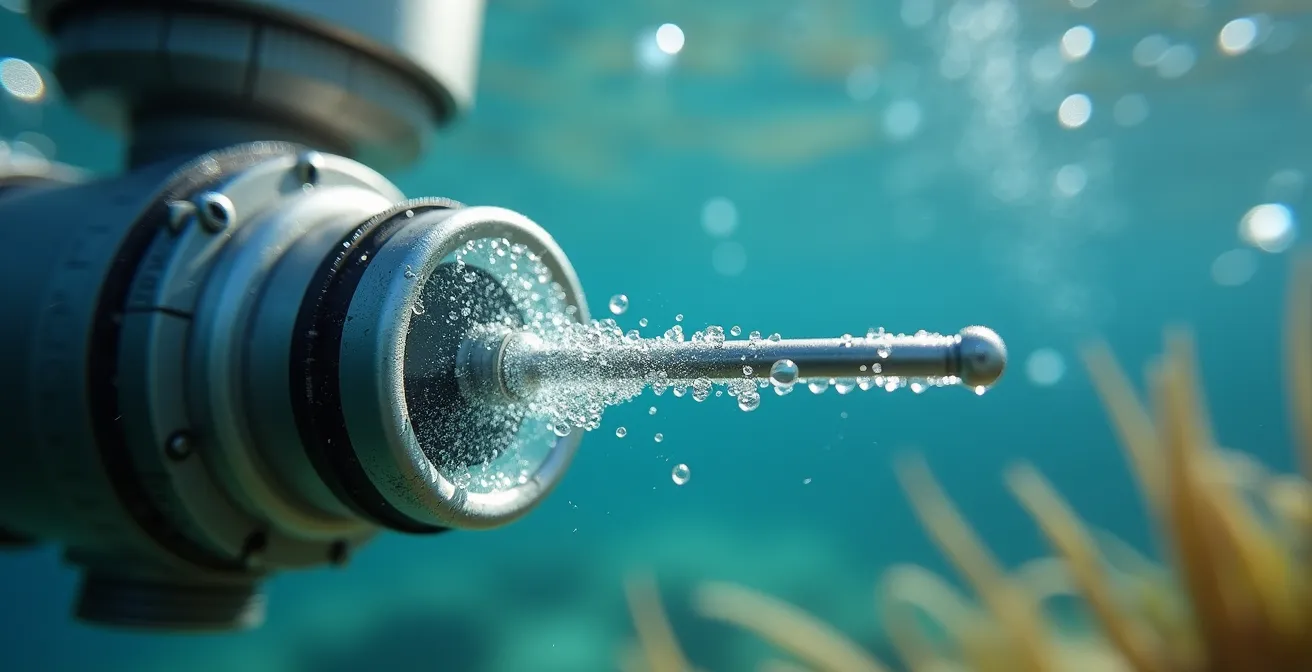
As the image shows, professional-grade equipment is essential for obtaining reliable data. These sensors are the front line in the effort to understand and adapt to the changing chemistry of our coastal waters, providing the critical information that underpins effective management strategies for vulnerable marine industries.
Acidification or Warming: Which Is the Immediate Killer for Coral Polyps?
Coral bleaching is often attributed to ocean acidification, but the primary and most immediate trigger is rising water temperature. However, acidification acts as a powerful and deadly accomplice. The two stressors attack corals through distinct physiological pathways, and their combined effect is far greater than the sum of their parts. Understanding this distinction is crucial for predicting and managing coral reef health.
Warming is the direct cause of bleaching. As described by Dr. Rachel Levin and colleagues, “Heat stress causes the symbiotic algae (zooxanthellae) to produce reactive oxygen species, forcing the coral to expel them and starve.” This expulsion of the algae, which provide the coral with most of its food and color, is what we see as bleaching. It is an acute response to thermal stress. Research has shown that even a small temperature change can be the tipping point. For instance, one study found that a 1°C temperature reduction in the bleaching threshold occurred when combined with deoxygenation, another common stressor.
Acidification, on the other hand, is a chronic stressor that kills more slowly through energetic exhaustion. As ambient pH drops, corals must expend a massive amount of energy to maintain a stable internal pH at their site of calcification. This process, as Dr. Levin’s research highlights, diverts energy away from essential functions like growth, reproduction, and tissue repair. A coral weakened by this constant energy drain is far more susceptible to bleaching from a thermal event and has a much lower chance of recovering. So, while warming pulls the trigger, acidification ensures the coral is too weak to survive the wound.
The Intake Pipe Mistake That Killed Millions of Oyster Larvae in Oregon
Perhaps no event has made the economic threat of ocean acidification more tangible than the crisis at the Whiskey Creek Shellfish Hatchery in Oregon. For managers in the aquaculture industry, it serves as a stark case study of how misunderstood water chemistry can lead to financial ruin. The hatchery, a key supplier for the Pacific Northwest’s oyster industry, experienced a sudden and catastrophic collapse of its larval production between 2007 and 2008.
Whiskey Creek Hatchery: The Mass Mortality Event
In 2007, the hatchery faced unprecedented larval mortality rates of 70-80%. As owner Mark Wiegardt recounted, “We came in here one day and we had billions of larvae that died overnight. Nothing in this facility was alive… mass mortality.” Initially, bacteria like Vibrio were suspected, but extensive research by Oregon State University scientists definitively linked the die-offs to ocean acidification. The crucial mistake was in the timing of water intake. The hatchery’s intake pipes were drawing in seawater that had been subject to coastal upwelling—a process that brings deep, cold, nutrient-rich, but also highly acidic and CO2-saturated, water to the surface. This naturally corrosive water was lethal to the oyster larvae, preventing them from forming their initial calcium carbonate shells. This discovery catalyzed a revolution in the industry, leading to the development and adoption of real-time water chemistry monitoring systems across the West Coast’s oyster industry, which generates significant economic activity.
The Whiskey Creek event was a wake-up call. It demonstrated that ocean acidification is not a distant, future threat but a present-day operational variable with devastating potential. It shifted the industry’s focus from simply breeding oysters to actively managing the chemistry of the water they are raised in. The lessons learned in Oregon have become the standard for hatcheries worldwide, proving that proactive monitoring and water treatment are essential components of risk management in a high-CO2 world.
When to Buffer Hatchery Water to Prevent Larval Shell Dissolution?
For a shellfish hatchery, preventing larval shell dissolution is a matter of maintaining the water’s chemical balance above a critical threshold. The key metric is not just pH, but the aragonite saturation state (Ωarag). Aragonite is the specific form of calcium carbonate that oyster larvae use to build their shells. When the aragonite saturation state is high (Ω > 1), shell formation can proceed. When it drops below 1, the water becomes corrosive, and shells will begin to dissolve. However, for larvae to thrive, not just survive, the threshold is significantly higher.
Decisive action is needed when monitoring shows the intake water is approaching or has fallen below this viability level. Buffering is the process of chemically treating the water to increase its alkalinity and raise the saturation state. This is typically done by adding carbonate-rich substances, like sodium carbonate, to the hatchery’s header tanks. The decision of when and how much to buffer is dictated entirely by real-time data from the water monitoring system. Without this data, any buffering effort is guesswork and can be wasteful or ineffective. The goal is to create a stable, favorable chemical environment during the first 48 hours of a larva’s life, the most critical window for shell development.
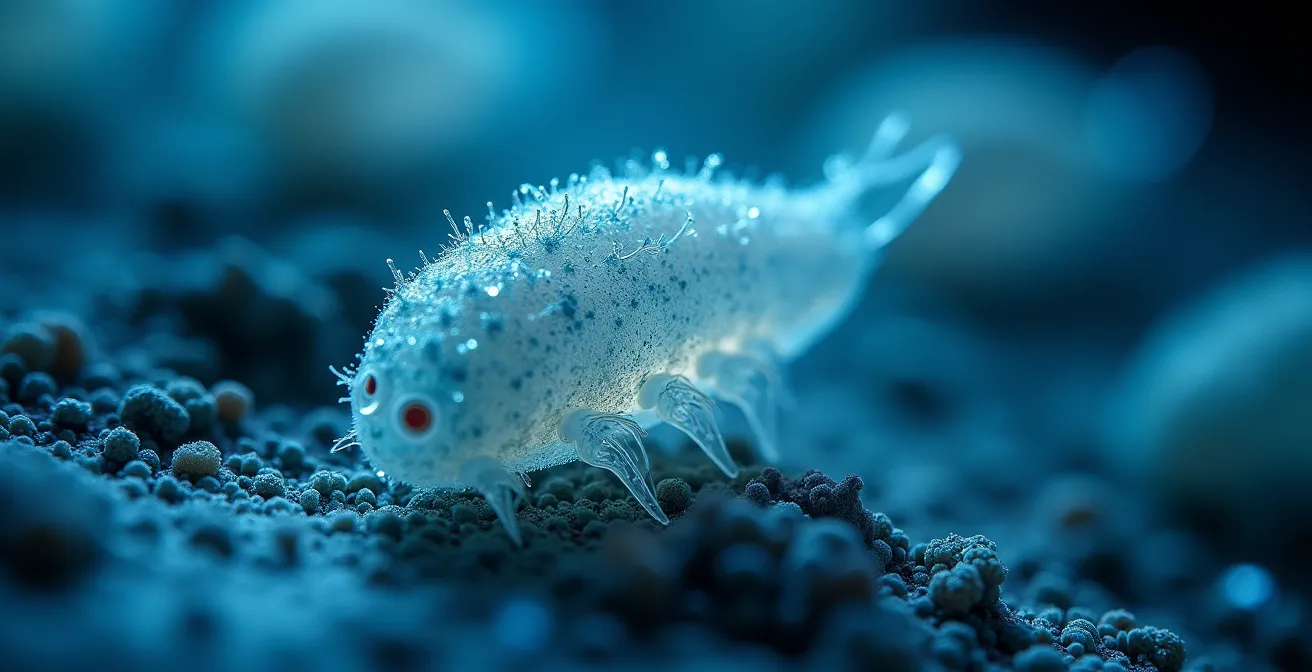
As seen in the microscopic view of an oyster larva, this initial shell is incredibly delicate. Industry experience and scientific monitoring have established a clear operational benchmark: successful larval development requires water where the aragonite saturation state is consistently above 2.0. When monitoring indicates that the incoming seawater’s Ωarag is below this level, buffering protocols must be initiated immediately to prevent mass mortality.
Action Plan: Safeguarding Your Hatchery from Acidification
- Establish a Monitoring Baseline: Deploy continuous sensors at your water intake to measure temperature, salinity, and pCO2. Collect data for at least one full tidal and seasonal cycle to understand your site’s specific diurnal and seasonal pH variations.
- Define Critical Thresholds: Set an alert system for when the calculated aragonite saturation state (Ωarag) drops below your target, which for most bivalve larvae should be a hard floor of Ωarag = 2.0.
- Implement a Buffering Protocol: Develop a standard operating procedure for adding sodium carbonate or other buffering agents. Base the dosage calculations on header tank volume and the real-time chemistry deficit reported by your sensors.
- Optimize Water Intake: Analyze your monitoring data to identify predictable periods of better water quality (e.g., late afternoons during low tide). Adjust your water intake schedule to draw water during these optimal windows whenever possible.
- Conduct Larval Bioassays: Regularly test the success of your water treatment by running small-scale larval cultures. Correlate larval survival and growth rates with your recorded water chemistry data to fine-tune your target thresholds.
Why Does rising Water Temperature Break the Symbiotic Bond in Corals?
The symbiotic relationship between coral polyps and the microscopic algae known as zooxanthellae is the cornerstone of reef ecosystems. This partnership is highly efficient but also fragile, particularly in the face of thermal stress. Rising water temperatures do not directly kill the coral; instead, they cause this essential symbiotic bond to break down, leading to a process known as coral bleaching. The mechanism behind this breakdown is rooted in the metabolic response of the algae to heat.
Under normal conditions, zooxanthellae photosynthesize and provide the coral host with up to 90% of its energy needs. When water temperatures exceed a certain threshold, typically just 1-2°C above the summer maximum, the metabolic machinery of the zooxanthellae goes into overdrive. This hyperactivity leads to the overproduction of Reactive Oxygen Species (ROS), which are highly toxic molecules. As explained in a compilation of research in Marine Biology Research, “Elevated temperatures accelerate zooxanthellae metabolism, leading to an overproduction of reactive oxygen species. This oxidative stress causes corals to expel their symbionts.”
The coral’s expulsion of the algae is a protective measure against this toxic oxidative stress. However, in doing so, the coral loses its primary food source and its color, revealing the white calcium carbonate skeleton beneath. If water temperatures return to normal quickly, the coral may be able to reacquire algae and recover. But if the thermal stress is prolonged, the coral will eventually starve to death. This process has led to mass mortality events on a global scale, fundamentally altering reef structures and the biodiversity they support.
Why Do Nitrates Trigger Deadly Algal Blooms in Nearby Lakes?
While ocean acidification is driven by atmospheric CO2, the health of coastal and freshwater ecosystems is also severely threatened by another form of pollution: nutrient runoff. Specifically, excess nitrates from agricultural fertilizers, wastewater, and urban runoff act as a powerful catalyst for explosive algal growth, a phenomenon known as eutrophication. Nitrates are a limiting nutrient in many aquatic systems, meaning their scarcity normally keeps algal populations in check. When they are introduced in large quantities, this natural limit is removed.
The process begins when heavy rainfall washes nitrates from land into nearby rivers, lakes, and estuaries. This sudden influx of food triggers a rapid, massive proliferation of algae and cyanobacteria, creating a dense “bloom” that can cover the water’s surface. This bloom blocks sunlight from reaching submerged aquatic plants, causing them to die and decompose. As the massive algal bloom itself eventually dies, it sinks to the bottom, providing a feast for aerobic bacteria. These bacteria consume enormous amounts of dissolved oxygen as they decompose the dead organic matter, leading to a condition known as hypoxia (low oxygen) or anoxia (no oxygen).
This severe oxygen depletion creates “dead zones” where fish, crabs, and other aquatic life cannot survive and either flee or suffocate. These events have devastating impacts on local fisheries and ecosystem health. The issue is a clear example of how terrestrial activities are directly linked to aquatic ecosystem collapse. While chemically distinct from the CO2-driven acidification of the open ocean, nutrient pollution and the resulting hypoxia are a major synergistic stressor in coastal zones, compounding the challenges faced by marine life already struggling with changing pH and temperature.
Key Takeaways
- Ocean acidification is a dual threat: it lowers pH and, more critically, depletes the carbonate ions necessary for shell and skeleton formation.
- For the shellfish industry, the aragonite saturation state (Ωarag) is the most important metric, with a level above 2.0 being the target for healthy larval development.
- Warming causes coral bleaching through oxidative stress (ROS production), while acidification weakens corals through chronic energetic exhaustion, making them more vulnerable.
Why Calcifying Organisms Are the First Casualties of a High-CO2 World?
In an ocean increasingly saturated with carbon dioxide, organisms that build shells or skeletons out of calcium carbonate—the calcifiers—are the first and most direct casualties. This group includes a vast and vital array of life, from microscopic pteropods at the base of the food web to oysters, clams, and the corals that build entire reef ecosystems. Their vulnerability stems from a simple, unavoidable metabolic cost imposed by the changing water chemistry.
As CO2 lowers both the pH and the availability of carbonate ions, these organisms must work harder to build and maintain their structures. They have to expend a significant amount of their metabolic energy on actively pumping protons (H+) out of their calcification sites to create an internal environment where calcium carbonate can precipitate. This biological cost is often referred to as an “energy tax.” Every unit of energy spent on maintaining this internal chemical balance is a unit of energy that cannot be used for other vital functions.
As Dr. Peter Harris and colleagues articulated, “Calcifiers are first because acidification imposes a direct, unavoidable energy tax on shell/skeleton construction and maintenance, leaving fewer resources for growth, reproduction, and defense against other stressors.” This explains why the effects of acidification are so pervasive. It results in slower growth rates, thinner and more brittle shells, reduced reproductive success, and a heightened susceptibility to disease and predation. They are the canaries in the coal mine, providing the clearest and earliest biological signal of a fundamental, system-wide chemical disruption.
Ultimately, the health of the marine food web and the industries that rely upon it is inextricably linked to ocean chemistry. Addressing this challenge requires a commitment to both global carbon reduction and the local, data-driven management and mitigation strategies that can provide a buffer against the ongoing changes. For marine resource managers and industry stakeholders, investing in robust monitoring technology is the first, most critical step toward navigating the corrosive tides of a high-CO2 world.