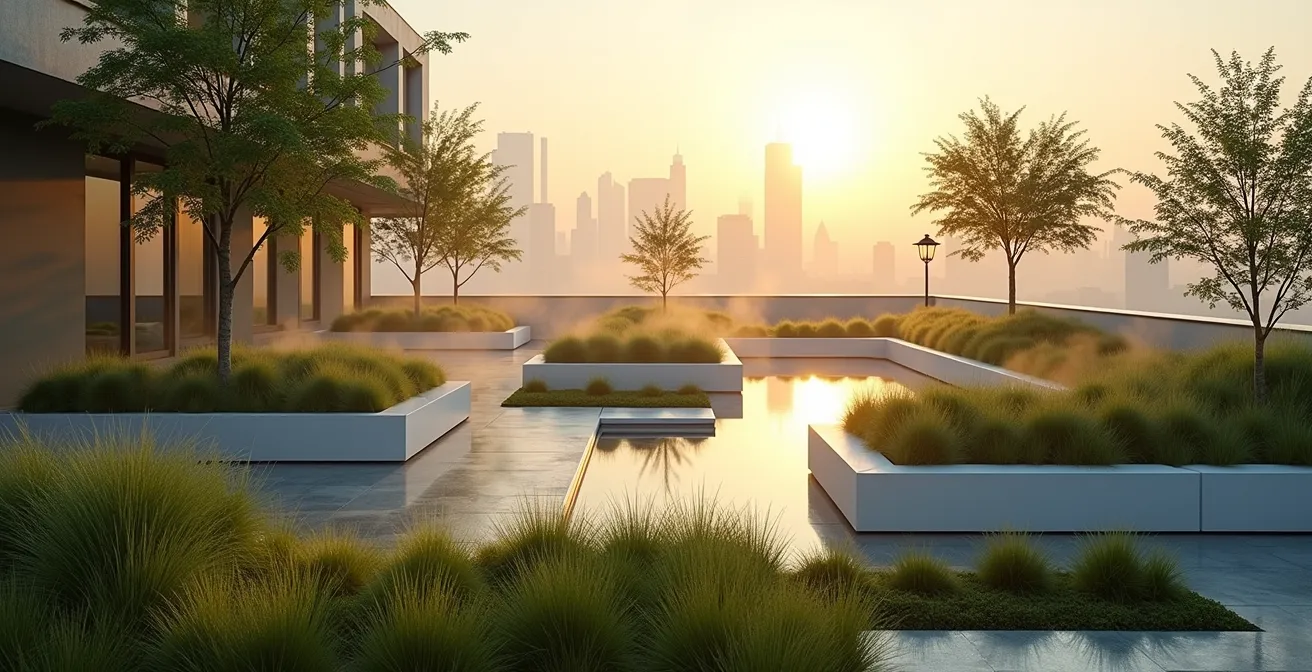
Escaping urban heat in your garden isn’t just about planting more trees. The most effective strategy is to treat your space as a small-scale thermodynamic system that you can actively engineer. By understanding and manipulating core principles like airflow, heat absorption (albedo), and thermal mass, you can move beyond generic tips and design a genuinely cool, resilient oasis, even during intense heatwaves.
The scorching summer sun turns your urban balcony or backyard into an oven. Your plants are wilting, the soil is cracked, and stepping outside feels like walking into a furnace. You’ve tried the common advice: watering more, adding mulch, and maybe even planting a small tree for shade. Yet, the oppressive heat persists, a constant reminder that cities are fundamentally hotter environments. This phenomenon, the Urban Heat Island effect, is the root cause of your gardening struggles, making standard horticultural advice feel inadequate.
Many guides focus on plant selection or simple water management, but they often miss the bigger picture. They treat the symptoms of heat stress without addressing the underlying physics of your garden’s environment. The real challenge isn’t just keeping plants alive; it’s about fundamentally altering the local climate on a micro-scale. What if the solution wasn’t just about *what* you plant, but *how* you shape the flow of energy and air through your space?
This is where a shift in perspective is needed. Instead of seeing yourself as just a gardener, think like a climate-adaptive landscape designer. The key to a cool, thriving urban garden lies not in fighting the heat, but in engineering a microclimate that works with natural forces. This article will guide you through the practical science of microclimate creation. We will deconstruct the forces that create urban heat and provide you with actionable strategies to manipulate airflow, manage solar radiation, and use vegetation as a powerful cooling tool. Prepare to transform your heat-stressed plot into a calculated, cool sanctuary.
To navigate this journey from problem to solution, we’ve structured this guide to build your expertise step-by-step. The following summary outlines the key environmental principles and design strategies we will explore to empower your urban gardening.
Summary: Engineering Climate-Resilient Urban Gardens
- Why Is Downtown 4°C Hotter Than the Suburbs at Night?
- How to Position Trees to Channel Cooling Breezes into Your Home?
- Green Roofs vs White Paint: Which Lowers Building Temperature More Effectively?
- The High-Rise Mistake That Traps Pollution at Street Level
- When to Plant Shade Trees to Maximize Summer Cooling for South-Facing Walls?
- How to Orient Windows to Capture Solar Radiation for Winter Heating?
- Native Grasses or Legumes: Which Functional Group Best Prevents Erosion on Slopes?
- Solar Radiation Management: The Last Resort to Cool the Planet?
Why Is Downtown 4°C Hotter Than the Suburbs at Night?
The core reason your urban garden bakes is the Urban Heat Island (UHI) effect. This phenomenon explains why city centers are significantly warmer than surrounding rural or suburban areas, especially after sunset. During the day, materials common in cities—asphalt, concrete, and dark roofing—absorb and store vast amounts of solar radiation. Unlike a natural landscape with soil and vegetation that uses this energy for evapotranspiration, these urban surfaces have a high thermal mass. They act like giant, slow-cooking bricks.
When night falls, the suburbs cool down relatively quickly as open ground and plants release their minimal stored heat. In contrast, the dense cluster of buildings and paved surfaces in a downtown core begins to radiate its massive heat load back into the atmosphere. This process keeps the ambient temperature elevated long into the night. Studies from California EPA’s Urban Heat Island Index show urban cores can be 4-9°F warmer than their greener counterparts. This relentless overnight heat prevents your plants from recovering, leading to chronic stress.
Furthermore, the lack of vegetation exacerbates the problem. Green spaces are nature’s air conditioners. A study on London’s UHI patterns found that increasing tree canopy cover to just 30% can lead to a noticeable city-wide cooling effect. The relative absence of trees and permeable surfaces in dense urban areas means less evaporative cooling and more heat retention, turning your garden into a hot spot. Understanding this principle is the first step toward reversing its effects on a micro-scale.
How to Position Trees to Channel Cooling Breezes into Your Home?
Once you understand that heat retention is the enemy, the next logical step is to improve air circulation. Strategic tree placement isn’t just about creating shade; it’s about airflow engineering. By arranging trees and shrubs correctly, you can create a ‘Venturi effect’—a principle of fluid dynamics where air speeds up as it passes through a constricted area. You can essentially build a natural funnel to direct cooling breezes toward your home or patio.
The goal is to create a corridor that captures prevailing summer winds and accelerates them. This involves placing taller trees and lower shrubs in a V-shape, with the narrowest point of the ‘V’ aimed at the area you want to cool, such as a window or seating area. This deliberate design doesn’t just move hot air away; it actively pulls in cooler air, creating a refreshing and dynamic microclimate.
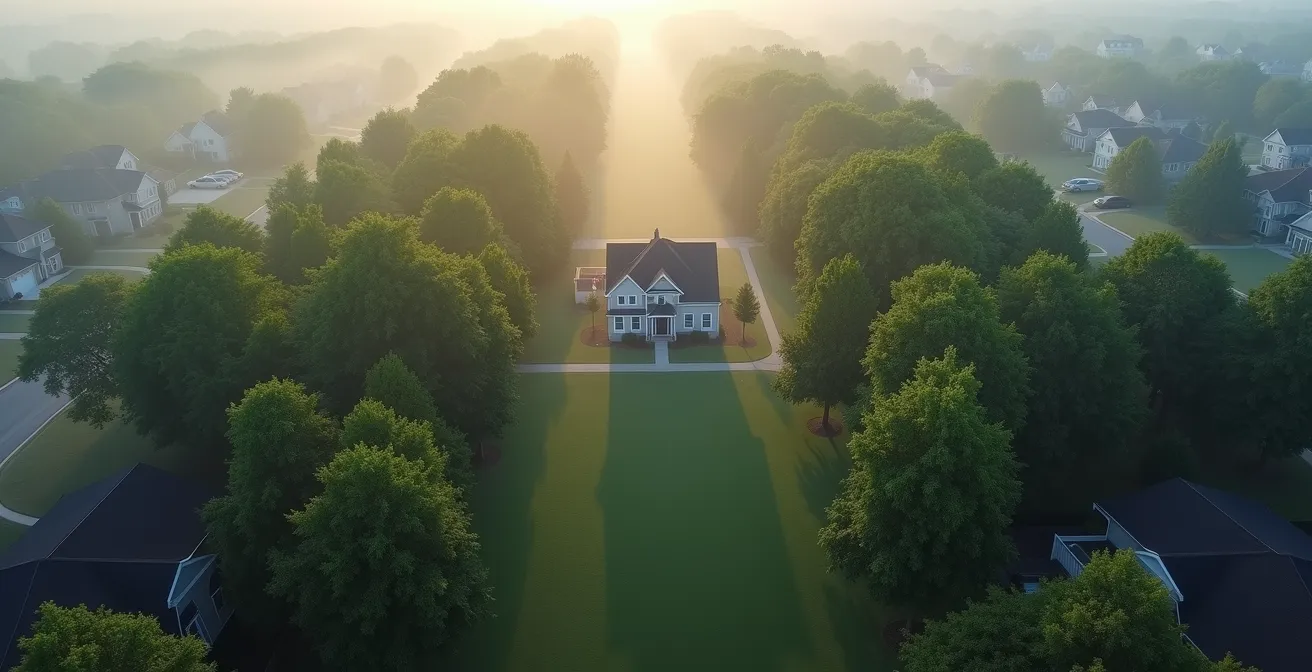
As shown in the visualization above, the specific arrangement of vegetation dictates the path of airflow. This isn’t random planting; it’s a calculated design. By varying canopy heights and creating defined channels, you can transform a stagnant, hot yard into a space with consistent, cooling air movement. This is a perfect example of treating your garden as a thermodynamic system that you can actively control.
Your Action Plan: Designing a Wind-Funnel Garden
- Identify Prevailing Winds: Determine the direction of your most common summer breezes using a local weather app or simple observation.
- Create the Funnel: Plant rows of taller trees (15-20 feet from the target) perpendicular to the wind, creating a wide opening that narrows toward your house or patio.
- Generate Thermal Siphoning: Place low shrubs beneath the trees to help generate turbulence and pull cooler, ground-level air into the main channel.
- Vary Canopy Heights: Use a mix of trees and shrubs with canopy heights between 6 and 30 feet to encourage air mixing and prevent a solid, wind-blocking wall.
- Optimize the Opening: Ensure the ‘mouth’ of your funnel is wide enough to capture a significant amount of air, guiding it effectively toward your target cooling zone.
Green Roofs vs White Paint: Which Lowers Building Temperature More Effectively?
After tackling airflow, the next frontier in microclimate engineering is managing surface heat absorption. Your roof is one of the largest surfaces exposed to direct solar radiation. The choice of what covers it has a dramatic impact on your building’s temperature and the microclimate around it. The two primary strategies are increasing reflectivity with white paint (an ‘albedo hack’) or using vegetation with a green roof. While both are effective, they work in fundamentally different ways.
Painting a roof white is a straightforward approach. It dramatically increases the surface’s albedo, or its ability to reflect sunlight. Less solar energy is absorbed, so less heat is transferred into the building and radiated into the surrounding air. It’s a passive, low-maintenance solution that provides an immediate cooling benefit.
Green roofs, however, offer a more complex and dynamic cooling mechanism. While the vegetation itself has a lower albedo than white paint, it cools through evapotranspiration. Plants absorb water from the soil and release it as vapor, a process that actively draws heat from the air. This ‘living air conditioner’ not only cools the building but also the ambient air around it. Furthermore, the soil layer of a green roof provides significant insulation. Groundbreaking research on future climate scenarios shows green roofs achieving up to a 65.51% HVAC reduction by 2100, showcasing their long-term, high-performance potential. While white paint is a powerful reflector, a green roof is an active cooling engine that also supports biodiversity and manages stormwater.
The High-Rise Mistake That Traps Pollution at Street Level
Just as you can engineer positive airflow, poor urban design can create the opposite effect, leading to stagnant, polluted air. The classic high-rise mistake is the creation of ‘urban canyons’—relatively narrow streets flanked by tall, continuous buildings. These canyons disrupt natural wind patterns and can trap heat and pollutants at street level, directly impacting the health of your garden and yourself.
Instead of allowing air to flow freely, the canyon-like structure induces a vortex. Wind blowing over the top of the buildings creates a slow-rotating pocket of air within the street below. This circulation is often too weak to flush out vehicle emissions, particulate matter, and other pollutants. The air becomes trapped, stale, and increasingly concentrated with harmful substances. The BelowClouds Research Team succinctly explains this architectural flaw:
Narrow streets lined with tall buildings, known as urban canyons, tend to trap heat and reduce wind velocity.
– BelowClouds Research Team, How Urban Areas Create Microclimates
This trapped air also heats up faster due to solar radiation being absorbed and re-radiated by the building facades and pavement. The result is a toxic, sweltering microclimate that is hostile to both people and plants.

This illustrates why principles of airflow are so critical in urban design. While you may not be able to redesign your street, you can apply these lessons to your own property. Avoid creating dense, solid walls of hedges or fences that mimic an urban canyon, and instead opt for permeable structures and varied vegetation heights to encourage air to move through your space, carrying heat and pollutants away.
When to Plant Shade Trees to Maximize Summer Cooling for South-Facing Walls?
Planting a tree for shade is the oldest trick in the book, but ‘strategic shading’ elevates this idea into a science. The goal isn’t just to block the sun, but to block it at the right place and the right time. For south-facing walls, which receive the most intense solar radiation during summer, the timing and placement of shade trees are critical to maximizing their cooling effect. A well-placed tree can act as a natural shield, preventing your home’s exterior from becoming a massive heat sink.
The cooling power of shade is immense; measurements show that shade from mature trees can achieve a 20-45°F surface cooling effect on materials like asphalt or dark walls. To harness this power, you must consider the sun’s angle. During the summer solstice, the sun is at its highest point in the sky. To effectively shade a south-facing wall during the hottest part of the day, a tree needs to be planted at a specific distance from the house—not too close and not too far. A good rule of thumb is to plant the tree at a distance of about 70% of its mature height from the wall.
The choice of tree is equally important. A deciduous species, like a maple or an oak, is ideal. Its dense summer canopy provides maximum shade when you need it most, but it drops its leaves in the fall, allowing the low-angled winter sun to warm the same wall—a key principle of passive solar design. Planting should occur in early spring to give the tree time to establish its root system before the stress of summer heat. By combining the right species with the right placement, your tree becomes a dynamic, seasonal climate controller.
How to Orient Windows to Capture Solar Radiation for Winter Heating?
The same principles used to cool your home in summer can be inverted to heat it in winter. This is the essence of passive solar design: using your home’s orientation and features to manage the sun’s energy across seasons. While south-facing windows can be a source of unwanted heat in July, they are a valuable source of free warmth in January when the sun is lower in the sky. The key is controlling that radiation.
Properly oriented windows act as solar collectors. By ensuring your primary, large windows face south, you can maximize ‘solar gain’ during the winter months. The low-angled sunlight penetrates deep into the house, warming floors and walls (thermal mass), which then slowly radiate that heat back into the room as temperatures drop in the evening. This can significantly reduce heating costs and create a more comfortable indoor environment.
This principle extends directly into the garden, allowing you to create warm microclimates for extending the growing season. A south-facing wall or fence can become a powerful tool for any gardener dealing with cool nights or shorter seasons, as demonstrated by practical applications in community gardens.
Case Study: Passive Solar Design in Denver Gardens
In climates with cool nighttime temperatures, gardeners can leverage passive solar principles to their advantage. A south-facing wall or fence absorbs significant heat during the day and radiates it back out at night, creating a warmer microclimate in its immediate vicinity. This protected zone can be used to successfully grow heat-loving plants such as tomatoes, peppers, and eggplants, which would otherwise struggle to produce fruit in a climate with large day-night temperature swings.
By understanding how solar radiation interacts with your home and garden throughout the year, you can make strategic choices that provide cooling in the summer and essential warmth in the winter, all by working with nature’s cycles.
Native Grasses or Legumes: Which Functional Group Best Prevents Erosion on Slopes?
Microclimate engineering isn’t just about managing air and sun; it’s also about what’s happening at ground level. Your choice of groundcover has a profound impact on soil temperature, water retention, and stability. On sloped areas, preventing soil erosion is paramount, and the root structure of your chosen plants is the single most important factor. Here, a combination of native grasses and legumes provides the most robust solution.
Native grasses, like switchgrass or little bluestem, are champions of erosion control because they develop deep, fibrous root systems. These dense, net-like roots bind the soil particles together, creating a stable mat that is highly resistant to being washed away by heavy rain. Legumes, such as clover or native vetch, offer a complementary benefit. They typically have a main ‘taproot’ that grows deep into the soil, breaking up compacted layers and creating channels for water infiltration. This taproot acts as an anchor, further stabilizing the slope.
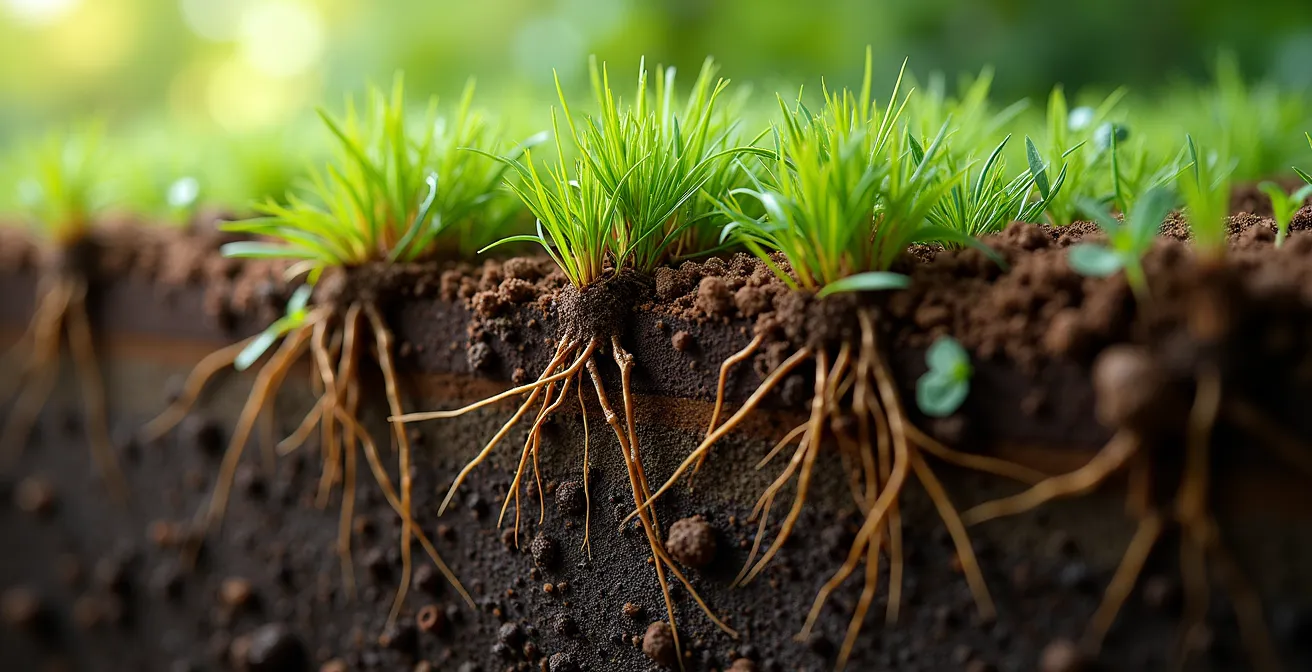
When planted together, these two functional groups create a powerful, synergistic system. The fibrous grass roots secure the topsoil, while the legume taproots anchor the deeper soil layers and improve soil health through nitrogen fixation. This combination is far superior to a shallow-rooted monoculture like a traditional turf lawn. Moreover, these dense plantings create their own cooling microclimate. Studies show that high-density native plantings can create surface temperatures up to 9°F cooler than a conventional lawn, thanks to increased shading and evapotranspiration at the ground level.
Key Takeaways
- The Urban Heat Island (UHI) effect, caused by heat-absorbing materials, is the primary reason city gardens are hotter than suburban ones.
- Strategic placement of trees can engineer airflow, creating a Venturi effect that channels cooling breezes toward your home.
- Surface treatments matter: white paint reflects heat (albedo), while green roofs actively cool through evapotranspiration, offering broader ecological benefits.
Solar Radiation Management: The Last Resort to Cool the Planet?
As we’ve explored, you hold considerable power to manage solar radiation on a micro-scale. From painting a roof white to planting a deciduous tree, each action is a form of local climate engineering. When you scale these ideas up from a single garden to a global level, you enter the complex and controversial world of Solar Radiation Management (SRM). SRM refers to large-scale geoengineering technologies proposed to reflect a small fraction of sunlight back into space to counteract global warming.
The techniques discussed in this article are, in essence, personal-scale versions of SRM’s core principle. The BelowClouds Research Team notes that simple choices can have a significant impact: using lighter-colored roofing materials, installing green roofs, or using permeable pavements all help mitigate heat absorption by increasing reflectivity and evapotranspiration. These actions, when adopted by many individuals and municipalities, contribute to a collective cooling effect that can reduce the intensity of urban heat islands.
While global SRM strategies like stratospheric aerosol injection remain a “last resort” with unknown ecological side effects, the principles behind them are sound and can be applied safely and effectively in your own backyard. Every choice you make—from the color of your patio stones to the type of groundcover you plant—is an opportunity to manage solar radiation. By consciously designing your space to reflect unwanted summer sun and absorb welcome winter warmth, you are not just creating a more comfortable garden; you are participating in a grassroots climate adaptation movement. You are proving that thoughtful, science-based design can build resilience in the face of a warming world.
Start today by evaluating your own space as a thermodynamic system. Identify your hottest surfaces, map your prevailing breezes, and begin designing small interventions—like a strategically placed shrub or a light-colored container—to engineer a cooler, more resilient urban garden.