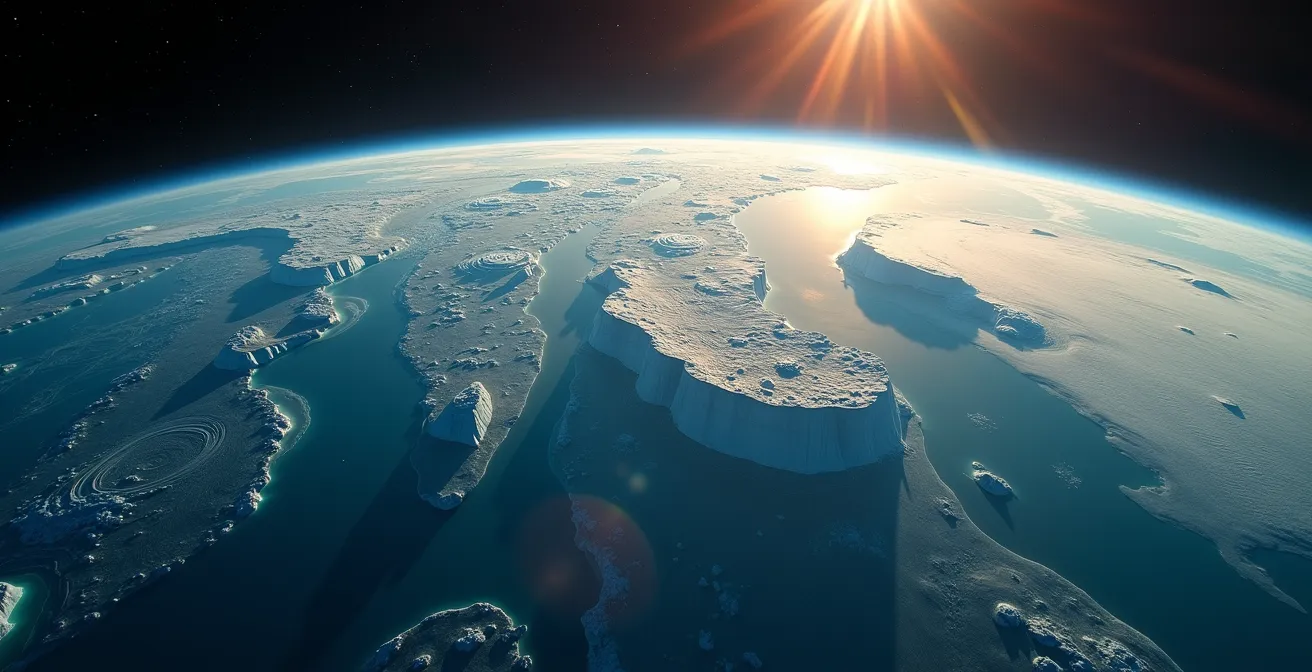
The current climate crisis is not merely about warming, but a fundamental state transition from the stable Holocene to a volatile new planetary equilibrium.
- The predictable environment that enabled civilization was a historical anomaly that is now ending.
- Key signals of this shift include accelerating ice loss, cascading tipping points, and unprecedented extinction rates.
Recommendation: Monitoring these interconnected system failures, not just isolated metrics, is essential to grasp the full scale of the Anthropocene’s arrival.
For geologists and earth system scientists, the contemporary narrative often centers on rising temperatures and atmospheric CO2 concentrations. While accurate, this focus can obscure a more profound reality: we are not merely witnessing climate change, but the initial phases of a planetary state transition. The Earth system is shifting from the remarkably stable and predictable conditions of the Holocene—the geological epoch of the last 11,700 years—to the volatile and uncertain dynamics of the Anthropocene. This is not a linear adjustment but a fundamental change in the planet’s operating system.
The familiar equilibrium that allowed agriculture, cities, and complex societies to flourish was a rare gift of geological chance. Today, the signals of this era’s end are accumulating in the geological and biological record. These indicators go far beyond a simple warming trend. They manifest as a systemic breakdown of the planet’s self-regulating mechanisms, a process that threatens the very foundations of the world we have built.
The core challenge, therefore, is to learn how to read these signals. It requires moving past isolated symptoms and adopting a systemic perspective that recognizes the interconnectedness of the cryosphere, biosphere, oceans, and atmosphere. This analysis is not an academic exercise; it is the essential diagnostic work for understanding the stability of our planetary habitat. Instead of asking “How much warmer will it get?”, the more critical question is “Is the Earth system tipping into a new, fundamentally different state?”
This article provides a framework for identifying these signals. It explores the key diagnostics of the planetary state shift, moving from the stable Holocene baseline to the cascading instabilities that now define our epoch. By examining these indicators, we can better comprehend the magnitude of the transition underway.
Summary: Recognizing the Planetary State Shift from Holocene to Anthropocene
- Why Did Human Civilization Flourish During the Last 10,000 Years of Stability?
- How to Measure the Rate of Ice Shelf Collapse Using Satellite Radar?
- Hothouse vs Icehouse: Which State Is Earth Heading Toward Rapidly?
- The Domino Error: Assuming Tipping Points Are Isolated Events
- How to Deploy Ocean Sensors to Fill Gaps in Global Climate Data?
- Holocene vs Anthropocene: Which Era Had Higher Species Extinction Rates?
- How to Calculate How Many Earths Your Lifestyle Requires?
- Why Crossing 6 of 9 Planetary Boundaries Threatens Global Economic Stability?
Why Did Human Civilization Flourish During the Last 10,000 Years of Stability?
The emergence of complex human civilization was not an inevitability. It was contingent upon a period of extraordinary climatic stability known as the Holocene. Before this epoch, the Earth system was characterized by wild oscillations, with global temperatures swinging dramatically between glacial and interglacial conditions. However, starting around 11,700 years ago, the planet entered a prolonged phase of relative calm. This stability was the essential cradle for human development, providing the predictable seasonal patterns necessary for the agricultural revolution, the establishment of permanent settlements, and the rise of global civilizations.
The contrast with the preceding period is stark. According to the Intergovernmental Panel on Climate Change (IPCC), the Holocene saw global temperature variations of less than 1°C over millennia. This is a dramatic departure from the wild swings of 4-7°C that characterized the last glacial period. In fact, paleoclimatic data reveals that temperature variability during the Holocene was 8 times lower than during that preceding era. This remarkable consistency was not a given; it was, as some scientists note, a fortunate coincidence of Earth’s orbital parameters that created an unusually long and stable interglacial period.
This environmental predictability removed a significant element of risk and uncertainty. It allowed for long-term planning, reliable crop yields, and the accumulation of surplus resources—the very building blocks of societal complexity. The Holocene was, in essence, a uniquely benign state for the Earth system, one in which the planet’s regulatory feedbacks maintained a dynamic but bounded equilibrium. Understanding this Holocene baseline is not just a historical exercise; it is the critical reference point against which the unprecedented changes of the Anthropocene must be measured. We are now leaving this geological “Garden of Eden” and entering uncharted territory.
How to Measure the Rate of Ice Shelf Collapse Using Satellite Radar?
One of the most potent signals of the planetary state shift is the rapid destabilization of the cryosphere, particularly the great ice sheets of Greenland and Antarctica. These colossal bodies of ice are not merely passive indicators of temperature; they are active components of the Earth’s regulatory system, influencing global sea levels, ocean circulation, and planetary albedo. Measuring their rate of collapse is therefore a primary diagnostic for assessing the speed of the state transition. Satellite radar technology has become the principal tool for this crucial task.
Missions like the European Space Agency’s CryoSat and Copernicus Sentinel-1 satellites employ techniques such as radar altimetry and interferometry (InSAR). Radar altimeters precisely measure the height of the ice surface, allowing scientists to calculate changes in ice volume over time. InSAR, on the other hand, compares radar images taken at different times to create detailed maps of ice velocity and grounding line retreat—the critical point where a glacier loses contact with the seabed and begins to float. These methods provide unambiguous evidence of acceleration in ice loss, an early warning signal of irreversible collapse.
The data from these systems is stark. For example, NASA satellite measurements show Greenland is losing an average of 270 billion tons of ice annually. This is not a slow, linear melt but an accelerating process driven by complex feedback loops. Warm ocean water melts ice shelves from below, reducing their buttressing effect and allowing land-based glaciers to flow faster into the sea. The visual evidence from satellite interferograms of key glaciers, like Antarctica’s Thwaites, shows extensive fracturing and rifting, the physical manifestations of a system under immense stress.
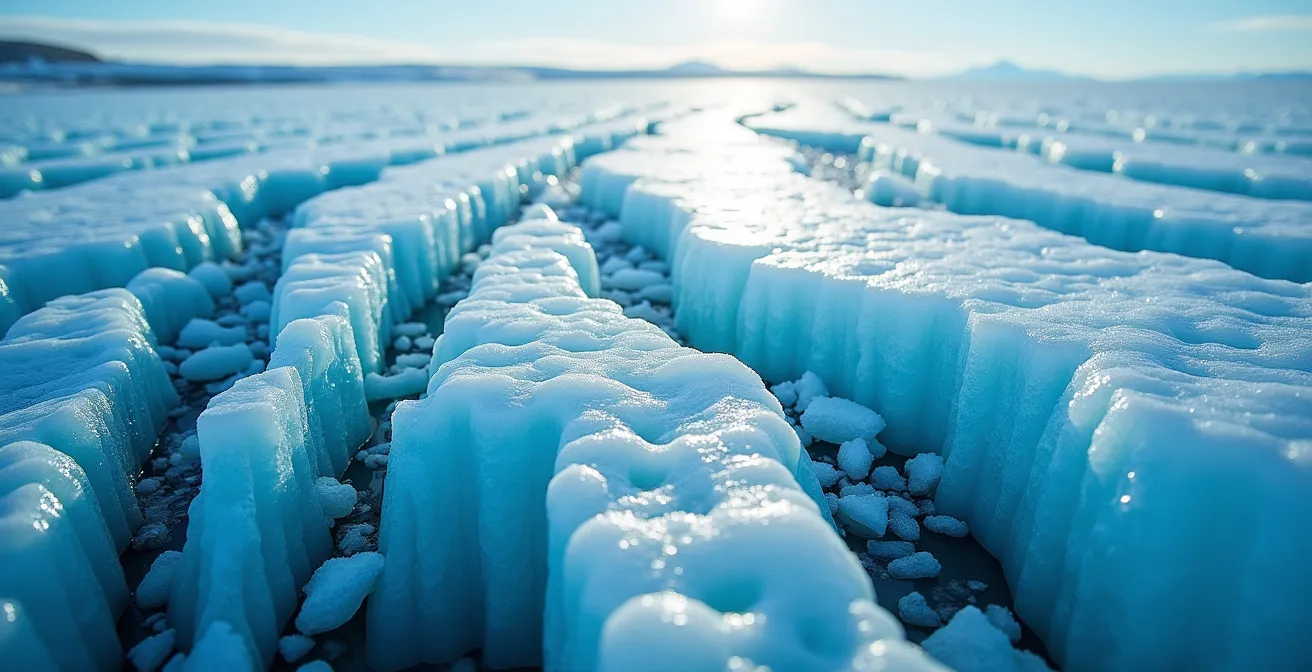
This monitoring reveals that ice sheets are not just melting; their fundamental structural integrity is being compromised. The speed of this process provides a direct measure of our trajectory away from Holocene stability. It is a powerful signal of systemic volatility, written in the language of ice and gravity.
Hothouse vs Icehouse: Which State Is Earth Heading Toward Rapidly?
Throughout its deep history, Earth’s climate has oscillated between two primary states: “Icehouse,” characterized by significant polar ice caps, and “Hothouse,” a largely ice-free world. The Holocene was a warm phase within the current Icehouse state. The critical question now is whether anthropogenic pressures are pushing the entire Earth system over a threshold and into a long-term Hothouse state, from which a return would be geologically difficult, if not impossible on human timescales.
The concept of a state transition is central here. As explained by Professor Tim Lenton of the University of Exeter, the Earth system can be visualized as a ball in a landscape of valleys. The Holocene was a stable valley. He notes that “Human emissions are pushing the Earth ‘ball’ over the hill that separates the Interglacial and Hothouse valleys, after which it will naturally roll into the Hothouse state.” This metaphor powerfully illustrates that beyond a certain point, planetary feedback loops (like reduced ice albedo and permafrost thaw) become self-sustaining, driving the system toward a new, much warmer equilibrium regardless of subsequent human emissions.
Current data suggests we are well on our way to crossing that hill. Even with the current pledges under the Paris Agreement, the trajectory is not toward Holocene-like stability. Instead, current climate commitments put us on track for a 2.5-2.9°C warming above pre-industrial levels. This level of warming is widely considered sufficient to trigger several major tipping points, locking the planet into a Hothouse pathway. The signals are not pointing to a warmer version of our current world, but to a world with a fundamentally different operating logic—one with higher sea levels, radically different weather patterns, and a reconfigured biosphere.
Recognizing the shift is about understanding this trajectory. It involves looking beyond short-term temperature fluctuations and identifying the activation of the positive feedbacks that define the slide into a Hothouse Earth state. The speed of cryosphere collapse and the weakening of ocean carbon sinks are not just symptoms of warming; they are the mechanics of the state shift in action.
The Domino Error: Assuming Tipping Points Are Isolated Events
A common but dangerous misconception in assessing planetary change is to view climate tipping points as discrete, isolated events. This “domino error” fails to recognize the deeply interconnected nature of the Earth system. The reality is that tipping one element can increase the likelihood of tipping another, creating a cascade of failures that can accelerate the overall state shift. This concept of tipping cascades is fundamental to understanding the non-linear dynamics of the Anthropocene.
A well-studied potential cascade demonstrates this principle. Accelerated warming in the Arctic leads to a massive influx of freshwater from the melting Greenland ice sheet. This freshwater influx can slow or even shut down the Atlantic Meridional Overturning Circulation (AMOC), a critical ocean current system that transports heat. A weakened AMOC would then dramatically alter global weather patterns, shifting tropical rain belts southward. This, in turn, could destabilize the West African monsoon and push vast swathes of the Amazon rainforest past a tipping point toward a drier, savanna-like state. Here, the failure of one system (Arctic ice) triggers a domino effect across oceans and continents.
The risk is not theoretical. Recent analysis from the Stockholm Resilience Centre has identified 16 major climate tipping elements, and the data is alarming. This recent research identifies that as many as five of these tipping points may be triggered even at today’s levels of global warming. These include the collapse of the Greenland and West Antarctic ice sheets, widespread permafrost thaw, the death of warm-water coral reefs, and the shutdown of the AMOC.

Recognizing the planetary shift requires looking for these correlations and feedback loops. The signal is not just that a single domino is wobbling; it’s that the entire line is becoming unstable. This systemic volatility is a core feature of the Anthropocene and a stark departure from the buffered, resilient dynamics of the Holocene.
How to Deploy Ocean Sensors to Fill Gaps in Global Climate Data?
The world’s oceans are the planet’s primary heat and carbon buffer, having absorbed the vast majority of the excess energy from anthropogenic warming. This buffering capacity, however, is finite and showing signs of strain. Understanding the health of this critical regulatory system is paramount, yet vast regions of the ocean remain dangerously under-monitored. Deploying advanced ocean sensor networks is therefore essential to fill these data gaps and get a true reading on the planetary state.
The scale of the ocean’s role is immense; scientific measurements confirm that over 90% of the heat from human-induced climate change has been absorbed by the oceans. This has profound consequences, including thermal expansion driving sea-level rise, increased stratification that limits nutrient mixing, and growing deoxygenation. Traditional monitoring via ships and fixed buoys provides an incomplete picture of these three-dimensional, dynamic processes.
To address this, programs like the Biogeochemical-Argo (BGC-Argo) network represent a paradigm shift in ocean observation. The program deploys fleets of autonomous, free-drifting floats that profile the water column, descending to depths of 2,000 meters and returning to the surface to transmit data via satellite. Crucially, these BGC floats are equipped not just with temperature and salinity sensors, but with a suite of biogeochemical sensors. They measure pH, oxygen levels, nitrate concentrations, and chlorophyll, providing an unprecedented, near-real-time view of the ocean’s carbon cycle and biological productivity.
Case Study: The BGC-Argo Program
The BGC-Argo program has deployed over 500 of these advanced autonomous floats across the global ocean. By collecting high-resolution data on key chemical and biological variables, the network is directly measuring the ocean’s declining ability to absorb CO2 and support marine life. This data is critical for validating climate models and detecting early warning signs of tipping points in marine ecosystems and the global carbon cycle, filling a critical gap in our planetary monitoring infrastructure.
Closing these observational gaps is not just about refining models. It is about detecting the signals of regulatory breakdown in the planet’s largest and most important climate regulator. The data from these sensor networks provides a direct diagnostic of the Earth system’s trajectory away from the stable Holocene state.
Holocene vs Anthropocene: Which Era Had Higher Species Extinction Rates?
The biosphere is not a passenger on a changing planet; it is an integral part of the Earth’s regulatory system. The current mass extinction event is therefore not just a tragic consequence of human activity, but a primary signal of a fundamental state shift. When comparing the Holocene to the Anthropocene, the most dramatic and unambiguous difference lies in the rate of species extinction. The placid background rate of the former has been replaced by a crisis of unprecedented speed and scale.
During the Holocene, species appeared and disappeared at a natural “background” rate, a slow and steady turnover that is part of evolutionary history. In the Anthropocene, this has been utterly eclipsed. According to multiple scientific bodies, the current extinction rate is estimated to be 100 to 1,000 times higher than natural background rates. This is a velocity of loss so extreme that it is already being inscribed in the fossil record as a geological signature, comparable to the “great dying” events of Earth’s deep past.
As author Elizabeth Kolbert notes in her seminal work, this event is unique. She writes, “The Anthropocene extinction is unique because it’s the first global extinction event driven by a single species, affecting all taxonomic groups indiscriminately.” This is not a selective process but a systemic unraveling of the web of life.
Furthermore, current extinction numbers may be a significant underestimate of the true scale of the crisis. The concept of “extinction debt” reveals a grim reality. Analysis of fragmented habitats shows that many species still alive today are functionally extinct or “committed to extinction” because their remaining habitats are too small or isolated to support viable long-term populations. Their eventual disappearance is a lagged signal of damage that has already been done, a debt that will come due in the coming decades. This demonstrates a critical breakdown in the “biosphere integrity” planetary boundary, a core component of Earth’s life-support system.
How to Calculate How Many Earths Your Lifestyle Requires?
While the planetary state shift is driven by large-scale systemic forces, it is ultimately fueled by the cumulative resource consumption of human society. Translating this vast, abstract process into a more tangible metric can be a powerful tool for understanding our collective impact. One of the most established methods for this is the Ecological Footprint, which calculates human demand on nature and compares it to the planet’s biocapacity—its ability to regenerate resources and absorb waste.
The calculation essentially quantifies how much of the planet’s biological capacity is required by a given population or individual. This is measured in “global hectares”—a standardized unit of biologically productive land and sea area. By comparing a person’s or nation’s footprint to the available biocapacity per person on Earth, one can determine how many “Earths” would be needed if everyone on the planet lived that same lifestyle. Currently, humanity as a whole uses the equivalent of about 1.7 Earths, meaning we are using resources faster than they can be replenished.
Calculating a personal footprint provides a direct, albeit simplified, signal of one’s contribution to the pressures driving the Anthropocene. It connects abstract consumption patterns to a concrete physical limit. The process involves auditing key areas of consumption and land use, from the carbon emitted by travel and energy use to the land required to produce food and forest products. This exercise makes the concept of planetary boundaries tangible on an individual scale.
Your Action Plan: Calculate Your Ecological Footprint
- Assess Carbon Output: Calculate your carbon footprint from home energy use, transportation patterns (driving, flying), and overall consumption habits.
- Evaluate Land Use: Assess your land-use footprint, which includes the cropland, grazing land, and fishing grounds required to produce the food you consume, as well as the built environment you inhabit.
- Measure Resource Consumption: Quantify your water footprint and your consumption of forest products, including paper and timber.
- Compare to Global Biocapacity: Compare your total footprint (in global hectares) to the Earth’s available biocapacity per person, which is approximately 1.6 global hectares.
- Determine Your “Earths”: Divide your personal footprint by the available global biocapacity per person to determine how many planets would be required if everyone lived your lifestyle.
While individual action alone cannot reverse a planetary state shift, understanding the scale of our demand on the Earth’s systems is a fundamental step in recognizing the drivers of this profound transition.
Key Takeaways
- The Holocene’s 10,000-year stability was an exceptional period that allowed human civilization to thrive, a state we are now rapidly exiting.
- The planetary shift is evident in cascading tipping points, where the failure of one system (like Arctic ice) triggers failures in others (like ocean currents and rainforests).
- Crossing planetary boundaries, such as biosphere integrity, has direct and destabilizing consequences for global systems, including the economy and food security.
Why Crossing 6 of 9 Planetary Boundaries Threatens Global Economic Stability?
The shift out of the Holocene state is not merely an environmental issue; it is a fundamental threat to the stability of the global economic system. The modern economy was built on the assumptions of Holocene predictability: stable coastlines, reliable agricultural seasons, and abundant natural resources. As the Earth system transitions into the volatile Anthropocene, these assumptions are becoming invalid, creating systemic risks that cascade through financial, insurance, and supply chain sectors.
The Planetary Boundaries framework, developed by a group of leading earth system scientists, identifies nine critical processes that regulate the stability of the planet. Recent assessments show we have already transgressed six of these boundaries, including climate change, biosphere integrity, land-system change, and novel entities (e.g., plastic pollution). Crossing these boundaries is not a future risk; it is actively transmitting shocks into the global economy today. Each transgression erodes the safe operating space for humanity and, by extension, its economic activities.
A clear example of this is the breach of the biosphere integrity boundary. The widespread decline of pollinator populations, driven by habitat loss and pesticide use, directly impacts agriculture. This creates increased volatility in crop yields for many of the world’s most important food crops, leading to unpredictable food price shocks. These shocks don’t remain in the agricultural sector; they ripple through global commodity markets, affect the profitability of food companies, and increase the risk exposure for the insurance industry that underwrites agricultural production. This is a direct transmission line from an ecological tipping point to economic instability.
Ultimately, a destabilized planet cannot support a stable economy. The costs of extreme weather events, disruptions to global supply chains, resource scarcity, and forced migrations are already mounting. Recognizing the signals of the planetary state shift is therefore synonymous with identifying the primary sources of long-term systemic risk to global economic and social stability. The economy is a wholly-owned subsidiary of the environment, and its parent company is showing clear signs of insolvency.
To accurately model our planet’s future, the essential next step is to integrate these cascading systemic feedbacks and boundary transgressions into global climate and economic projections, moving beyond linear assumptions and embracing the non-linear reality of the Anthropocene.