
The key to sustainable agriculture isn’t just reducing waste; it’s engineering a circular nutrient economy where “waste” becomes a more valuable asset than the raw materials it replaces.
- Linear “take-make-waste” models are financially unsustainable due to volatile raw material costs and hidden disposal fees.
- Biological machinery like mycorrhizal fungi and Black Soldier Fly Larvae (BSFL) are hyper-efficient processors for recovering critical nutrients like phosphorus and nitrogen.
Recommendation: Shift focus from waste management to designing integrated nutrient recovery systems that create new revenue streams and build long-term soil fertility.
For decades, the dominant agricultural model has operated on a linear path: take nutrients from the earth, use them to grow food, and dispose of the organic “waste” in landfills. This system is not just inefficient; it’s a slow-motion ecological and economic bankruptcy. We see the symptoms in depleted soils, polluted waterways, and ever-rising fertilizer costs. The conventional conversation often revolves around simply reducing waste or using less fertilizer, but these are incremental fixes to a fundamentally broken design.
The solution lies not in tweaking the old system, but in replacing it entirely. What if we stopped seeing organic matter as waste and started treating it as a valuable, misallocated asset? Nature doesn’t have a landfill. Every fallen leaf, every dead organism, is meticulously broken down and re-integrated into a continuous, self-sustaining loop. Replicating this isn’t a romantic return to the past; it’s a sophisticated act of system design, building a resilient nutrient infrastructure that powers our farms and communities.
This approach moves beyond simple composting. It involves creating a cascade of processes—from fungal networks mining phosphorus in the soil to municipal facilities converting food scraps into high-value protein. It’s about understanding and deploying an army of microscopic and macroscopic biological machines to do the work for us, more efficiently and profitably than any industrial process. This article will guide you through the principles and practical designs for building this circular nutrient economy, transforming your farm or community from a consumer of resources into a regenerative engine of fertility and value.
To fully grasp how to construct this regenerative model, we will explore the core biological mechanisms, the critical mistakes to avoid, and the economic frameworks that make this transition not just possible, but profitable. This guide breaks down the essential components for designing a truly circular system.
Summary: Building a Regenerative Nutrient Economy in Agriculture
- Why Are Fungi Essential for Closing the Phosphorus Cycle in Forests?
- How to Design a Municipal Composting System That Reduces Landfill Waste by 30%?
- Mineral Fertilizer vs Green Manure: Which Builds Long-Term Soil Fertility?
- The Soil Depletion Mistake That Leads to Desertification in 20 Years
- When to Apply Cover Crops to Prevent Nitrogen Leaching in Winter
- Downcycling vs Closed Loop: Which Recovery Method Saves More Money?
- Why Does Sending Waste to Landfill Cost You Double in Lost Material Value?
- Why the “Take-Make-Waste” Model Is Bankrupting Manufacturers via Raw Material Costs?
Why Are Fungi Essential for Closing the Phosphorus Cycle in Forests?
In nature’s blueprint, nothing is wasted, and the phosphorus (P) cycle is a masterclass in efficiency, largely orchestrated by an unseen workforce: mycorrhizal fungi. These fungi form a symbiotic relationship with plant roots, creating a vast underground web that acts as a highly efficient nutrient infrastructure. While plants have limited ability to access phosphorus bound in soil, fungi act as biological miners. They excrete enzymes that unlock unavailable P and transport it directly to the plant in exchange for carbon. This biological machinery is not a minor enhancement; it is the primary engine of phosphorus availability in healthy ecosystems.
The effectiveness of this system is staggering. Research demonstrates that mycorrhizal fungi can increase P incorporation into phospholipids by 30-45% in soils where phosphorus is scarce. They don’t just find more P; they fundamentally change the plant’s ability to use it. This creates a closed-loop system where phosphorus is constantly recycled and kept within the local biome, rather than being leached away or locked into inaccessible mineral forms. Ignoring this fungal network is like trying to run a city without a power grid—it’s fundamentally inefficient.
Case Study: The Phosphorus Regulators of Norway Spruce Forests
A 2023 study in Norway spruce forests provided a clear demonstration of fungi as active managers of the nutrient economy. Researchers observed that the production of ectomycorrhizal fungi (EMF) biomass was directly regulated by phosphorus availability. In P-limited forest plots, these fungi accounted for up to 50% of the total belowground carbon allocation, building a massive biological network to mine for the scarce nutrient. When phosphorus fertilizer was applied, EMF production increased, showing their ability to dynamically respond to the environment and maximize nutrient capture. This proves fungi don’t just exist in the soil; they actively engineer it for maximum resource efficiency.
For any farmer or land manager seeking self-sufficiency, cultivating this fungal partnership is non-negotiable. It means shifting practices away from fungicides and excessive tillage, which destroy this delicate web, and toward methods that feed it: using woody mulch, maintaining living roots, and reducing soil disturbance. By fostering this natural infrastructure, we can dramatically reduce our dependence on finite, externally-sourced phosphorus and build a truly resilient fertility system from the ground up.
How to Design a Municipal Composting System That Reduces Landfill Waste by 30%?
Transitioning a community’s organic waste from a liability into an asset requires more than just backyard compost bins; it demands a consciously designed, multi-stage “Nutrient Recovery Facility.” The goal isn’t merely to divert waste from landfills but to create a cascade system where each output becomes a valuable input for the next process, maximizing both ecological and economic returns. A well-designed system can easily achieve a 30% reduction in total municipal solid waste, while generating revenue and high-quality agricultural inputs.
The first step is source segregation. Not all organic “waste” is created equal. Clean streams like coffee grounds can be diverted to high-value processes like gourmet mushroom cultivation, while general food scraps are perfect feedstock for other biological machinery. This strategic sorting allows for the most efficient processing pathway for each material type. The system integrates different technologies, from anaerobic digestion creating biogas from wet waste to vermicomposting systems that turn digestate into premium soil amendments. This is not composting; it is biological manufacturing.
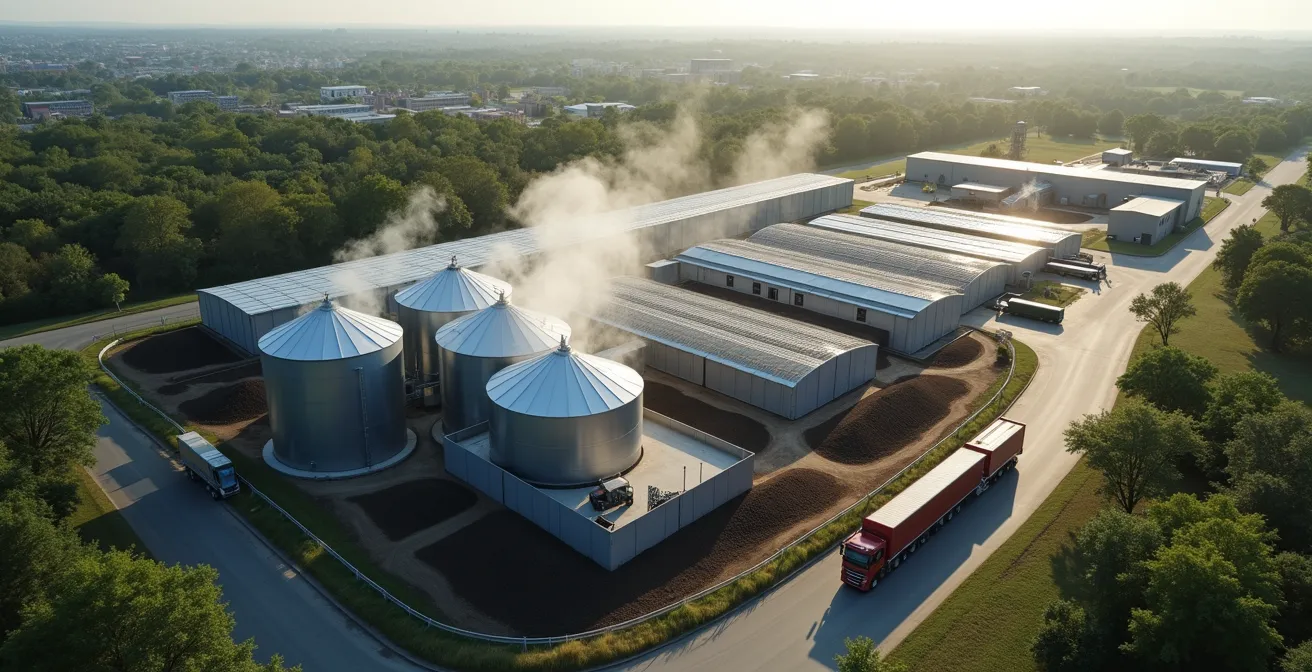
This aerial view shows how a modern facility is laid out in distinct zones for maximum efficiency. It’s a physical manifestation of a circular economy, with clear pathways for receiving, processing, and distributing recovered nutrients. The choice between a large, centralized facility and smaller, decentralized hubs depends entirely on the community’s context, balancing transport costs against economies of scale.
The following checklist outlines the core components needed to engineer such a facility, shifting the paradigm from waste disposal to resource creation.
Action Plan: 5 Key Components of a Municipal Nutrient Recovery Facility
- Implement source segregation for organic waste streams: Establish separate collection for distinct materials, such as coffee grounds for mushroom cultivation and general food scraps for Black Soldier Fly Larvae (BSFL) processing.
- Install anaerobic digestion units: Use these to process high-moisture organic waste, capturing biogas for on-site energy production or sale to the grid.
- Establish Black Soldier Fly Larvae facilities: Deploy this biological machinery to convert post-consumer food waste into high-value animal feed protein with up to 42% conversion efficiency.
- Create vermicomposting systems: Process the outputs from digestion (digestate) and BSFL (frass) through worm farms to create a premium, microbially-rich soil amendment.
- Design reverse logistics collection routes: Optimize collection schedules and routes based on detailed analysis of population density and waste generation patterns to minimize transport costs and emissions.
Mineral Fertilizer vs Green Manure: Which Builds Long-Term Soil Fertility?
The debate between mineral fertilizers and green manures is often framed as an all-or-nothing choice, but this misses the strategic reality of transitioning a farm. Mineral fertilizers offer a potent, immediate dose of soluble nutrients, leading to predictable yield boosts. However, they are a short-term fix that does little to build the underlying soil organic matter (SOM), the true foundation of long-term fertility. They are like a hit of caffeine, providing energy without building reserves. Over-reliance can even damage the soil’s natural biological machinery through salt accumulation and pH changes.
Green manures, on the other hand, are an investment in the soil’s capital. These cover crops, grown specifically to be incorporated into the soil, are a slow-release-and-build mechanism. As they decompose, they not only provide nutrients but, more importantly, they feed the entire soil food web. This process builds stable organic matter, which improves soil structure, water retention, and the capacity to hold and exchange nutrients (cation exchange capacity or CEC). Research confirms that a consistent program of green manure can improve soil organic matter by 1.5-2% over just 3-5 years, increasing the crucial CEC by 25-40%.

The most pragmatic and visionary approach, especially during a transition, is not to choose one but to integrate them intelligently. A complete and sudden withdrawal from mineral fertilizers on depleted soil can lead to significant yield drops, making the transition economically unviable. A smarter strategy uses low-dose mineral fertilizers as a crutch while the green manure program rebuilds the soil’s inherent biological fertility.
The integration of low-dose mineral fertilizers with green manure during the transition period creates a synergistic effect, reducing yield loss risk by 60% while allowing soil biology to rebuild over 3-4 seasons.
– Dr. Christine Baum, Journal of Plant Nutrition, Forest Soil Management Study
This hybrid approach de-risks the transition. It provides the necessary nutrients for the cash crop in the short term, while the green manure works in the background, building the natural infrastructure that will eventually make the synthetic inputs obsolete. The goal is to wean the farm off its dependency, not to force it into withdrawal.
The Soil Depletion Mistake That Leads to Desertification in 20 Years
The path to desertification often begins not with a lack of water, but with a catastrophic failure of the soil’s internal nutrient infrastructure. The most common and devastating mistake is focusing solely on the “big three” macronutrients (NPK) while systematically ignoring the micronutrients. This oversight doesn’t just lead to minor deficiencies; it triggers a complete breakdown of the symbiotic relationships that underpin a healthy soil ecosystem. When key micronutrients like zinc and boron are depleted, the biological machinery collapses.
This is because the vast majority of plants cannot access nutrients on their own. Ohio State University Extension research shows that 80-90% of plants depend on mycorrhizal fungi for micronutrient uptake, and that a deficiency in zinc and boron can reduce this critical symbiosis by as much as 65%. Without these trace elements, the fungal network dies back, leaving plant roots isolated and unable to forage effectively. The soil becomes biologically inert, a mere physical substrate rather than a living ecosystem. This is the first step toward irreversible degradation.
The second critical mistake is physical. Aggressive tillage, particularly inversion plowing, pulverizes soil aggregates. These aggregates, held together by fungal hyphae and bacterial glues, are what create the pore spaces for air and water. Destroying them leads to surface crusting and severe compaction, which in turn obliterates the soil’s ability to absorb rainfall.
Case Study: The Tillage-Induced Drought
Long-term monitoring in degraded agricultural lands paints a stark picture of this process. Studies revealed that aggressive plowing practices reduced water infiltration rates by 75% over a 15-year period. As the soil lost its structure, rainfall could no longer penetrate. Runoff increased from a normal 15% to a catastrophic 60%, effectively creating drought conditions even in regions with adequate rainfall. The water simply couldn’t get into the soil profile where it was needed. The good news is that this is reversible: strategic, one-time subsoiling to break the deep compaction layer was shown to restore infiltration rates by 40% within just two seasons, proving that healing the soil’s physical structure is paramount.
The combination of biological starvation (micronutrient depletion) and physical destruction (tillage) is a fatal one-two punch. It creates a feedback loop where reduced biological activity leads to poorer soil structure, which leads to less water infiltration, which further kills off soil life. Within two decades, a once-fertile landscape can become a hard, compacted, and lifeless pan on its way to becoming desert.
When to Apply Cover Crops to Prevent Nitrogen Leaching in Winter
One of the biggest leaks in the agricultural nutrient cycle is the loss of nitrogen during the fallow winter months. After the cash crop is harvested, residual nitrogen in the soil is highly vulnerable to being leached away by winter rains, polluting groundwater and representing a significant economic loss. Cover crops are the solution, acting as a living, biological sponge to capture and hold this valuable nutrient. However, their effectiveness hinges almost entirely on one critical factor: timing. Planting too late is nearly as ineffective as not planting at all.
The key to successful nitrogen scavenging is ensuring the cover crop has enough time to establish a robust root system before the soil gets too cold and microbial activity ceases. The metric for this is Growing Degree Days (GDD), which measures heat accumulation. Research from ATTRA’s sustainable agriculture program indicates that cover crops planted to accumulate 200-250 GDD before the first frost can achieve up to 85% nitrogen scavenging efficiency. This is the sweet spot that maximizes nutrient capture. Waiting until after the cash crop is fully harvested is often too late, especially in northern climates.
This means planning must happen proactively. A visionary farmer monitors soil temperatures and GDD accumulation from the moment the cash crop begins to senesce, ready to interseed the cover crop at the optimal moment. The choice of cover crop species is also strategic. In a short planting window (less than 30 days before frost), fast-growing grasses like annual ryegrass or oats are ideal for their rapid establishment and immediate N uptake. With a longer window (over 45 days), a legume-grass mix provides the dual benefit of scavenging existing nitrogen and fixing new atmospheric nitrogen for the following season. The goal is to have a green, living carpet protecting the soil through winter.
Termination timing in the spring is just as important. Terminating the cover crop early (e.g., in March) helps conserve soil moisture for the subsequent cash crop, which is crucial in drier climates. Allowing it to grow longer (e.g., into May) maximizes biomass production, contributing more organic matter to the soil but at the cost of using more water. This is a calculated decision, balancing the farm’s specific goals for fertility and water management.
Downcycling vs Closed Loop: Which Recovery Method Saves More Money?
When dealing with organic “waste,” not all recovery methods are created equal. The distinction between downcycling and creating a closed loop is the difference between marginal improvement and transformative economic gain. Downcycling, such as creating simple, low-grade compost from mixed organic waste, is a step up from the landfill. However, it often involves significant nutrient loss and results in a low-value end product. It’s a slightly better version of a linear model. A true closed-loop system, by contrast, is a circular model designed to capture and upgrade the value of the nutrient stream at every step.
A perfect example of a closed-loop technology is the use of Black Soldier Fly Larvae (BSFL). These remarkable insects can convert food waste into high-quality protein for animal feed with incredible efficiency. This process not only preserves a far higher percentage of the essential nutrients (like Nitrogen, Phosphorus, and Potassium) but also creates two high-value product streams: the larvae themselves (a protein source) and their frass (a potent solid fertilizer). This is not waste management; it is bioconversion.
A direct financial comparison makes the strategic choice obvious. While downcycling through conventional composting has moderate processing costs, the low value of the final product often results in a net financial loss over time. A closed-loop BSFL system may have similar or even lower processing costs due to its speed and efficiency, but the end products are orders of magnitude more valuable.
The following table provides a clear financial analysis, comparing the two approaches. The metrics reveal that while composting is better than a landfill, it remains an economic drag, whereas a closed-loop system is a powerful profit center.
| Metric | Downcycling (Compost) | Closed Loop (BSFL) |
|---|---|---|
| Processing Cost/ton | $35-45 | $25-30 |
| End Product Value/ton | $15-25 | $450-600 |
| Energy Input (kWh/ton) | 120 | 45 |
| ROI (5-year) | -15% | +240% |
| NPK Preservation | 40-50% | 85-95% |
The 240% 5-year ROI for a closed-loop system versus a -15% for downcycling is a clear indicator. The goal for any forward-thinking permaculture designer or farmer is to move beyond mere waste diversion and engineer systems that actively create and capture maximum value from nutrient streams.
Why Does Sending Waste to Landfill Cost You Double in Lost Material Value?
The cost of sending organic waste to a landfill is deceptively simple. Most businesses or municipalities only see one figure on their bill: the disposal or “tipping” fee. This direct cost, however, is just the tip of the iceberg. The true cost of this linear action is at least double what appears on the invoice, because it represents both a direct expense and a massive opportunity cost in the form of lost resources. Every ton of food scraps or agricultural residue that goes to a landfill is a ton of valuable nutrients being thrown away.
This represents a double loss. First, you pay a fee to get rid of it. Second, you lose the inherent value of the nitrogen, phosphorus, and organic matter contained within it, which you will then have to re-purchase in the form of synthetic fertilizers or soil amendments. According to calculations by the Noble Research Institute, each ton of organic waste sent to landfill costs approximately $85 in disposal fees *plus* an additional $120 in lost nutrient value. This immediately brings the real cost to over $200 per ton.
But even this calculation is incomplete. It fails to account for the long-term, externalized costs associated with landfills. As organic matter decomposes anaerobically in a landfill, it produces methane, a potent greenhouse gas. Furthermore, as rainwater percolates through the waste, it creates a toxic liquid called leachate, which can contaminate groundwater and requires expensive treatment. These future liabilities are rarely factored into today’s disposal decisions, but they are real.
When we factor in future carbon tax liabilities at $50/ton CO2e from methane emissions and water treatment costs from nutrient runoff, the true cost of landfilling organic waste approaches $280 per ton.
– Environmental Protection Agency Economic Analysis Division, EPA Waste Management Economics Report 2024
Thinking like a permaculture designer means seeing the whole system, including the hidden costs and lost opportunities. Landfilling is not a neutral act of disposal; it is an active financial drain. It forces you to pay to discard a valuable asset, only to pay again to buy back a synthetic, and often inferior, version of that same asset. Breaking this cycle is the first step toward building a solvent and self-sufficient nutrient economy.
Key Takeaways
- The linear ‘take-make-waste’ model is becoming financially obsolete due to rising raw material costs and hidden disposal fees.
- True sustainability lies in engineering circular systems where ‘waste’ is a high-value asset, processed by biological machinery like fungi and insects.
- A successful transition requires a systems design approach, integrating methods like cover cropping, composting cascades, and closed-loop bioconversion to build long-term fertility and profitability.
Why the “Take-Make-Waste” Model Is Bankrupting Manufacturers via Raw Material Costs?
The “take-make-waste” industrial model, long the engine of global production, is showing fatal signs of decay. Its fundamental premise—a reliance on a cheap, endless supply of raw materials and a convenient, out-of-sight place to discard waste—is collapsing. This is most starkly visible in the agricultural sector, where dependence on finite resources like mined phosphorus has created extreme vulnerability. When supply chains are disrupted, the financial consequences are immediate and severe, exposing the model’s inherent fragility.
The recent past provides a powerful lesson. NC State University research highlights that phosphorus fertilizer prices increased a staggering 300% between 2020 and 2023, driven by geopolitical events and supply disruptions. For manufacturers and large-scale farms tethered to this linear model, such volatility is catastrophic. It transforms a predictable operational cost into a wildly unpredictable financial risk, making long-term planning impossible and threatening the very viability of their business. This isn’t just an environmental problem; it’s a critical business continuity failure.
Visionary companies are recognizing this existential threat and are pivoting away from the linear model toward a circular one, not just for ethical reasons, but for pure economic survival. They are re-engineering their processes to treat their own “waste” streams as their most reliable and cost-effective source of raw materials. This creates a resilient, internal supply chain immune to external market shocks.
Case Study: A Food Manufacturer’s Circular Revolution
A major food manufacturer, facing extreme price volatility, implemented a comprehensive circular nutrient recovery system. Instead of landfilling their organic processing waste, they partnered with local farms to build an integrated system using anaerobic digestion and BSFL cultivation. This move not only slashed their raw material and disposal costs by 35% but also created three new, independent revenue streams: selling biogas to the grid ($2M/year), producing high-value animal feed protein ($5M/year), and marketing premium organic fertilizer ($1.5M/year). This transition from a linear to a circular model also significantly improved their ESG ratings, unlocking access to an additional $50M in green financing.
This case study is not an outlier; it is the blueprint for the future. The take-make-waste model is financially bankrupting those who cling to it. By contrast, designing a closed-loop, circular system that mimics nature’s nutrient cycle is proving to be the most resilient, profitable, and intelligent business strategy for the 21st century.
Start today by auditing your own agricultural or manufacturing process. Identify your largest organic waste stream and begin researching the most appropriate biological machinery—be it composting, vermicomposting, or BSFL bioconversion—to transform that liability into a valuable asset.