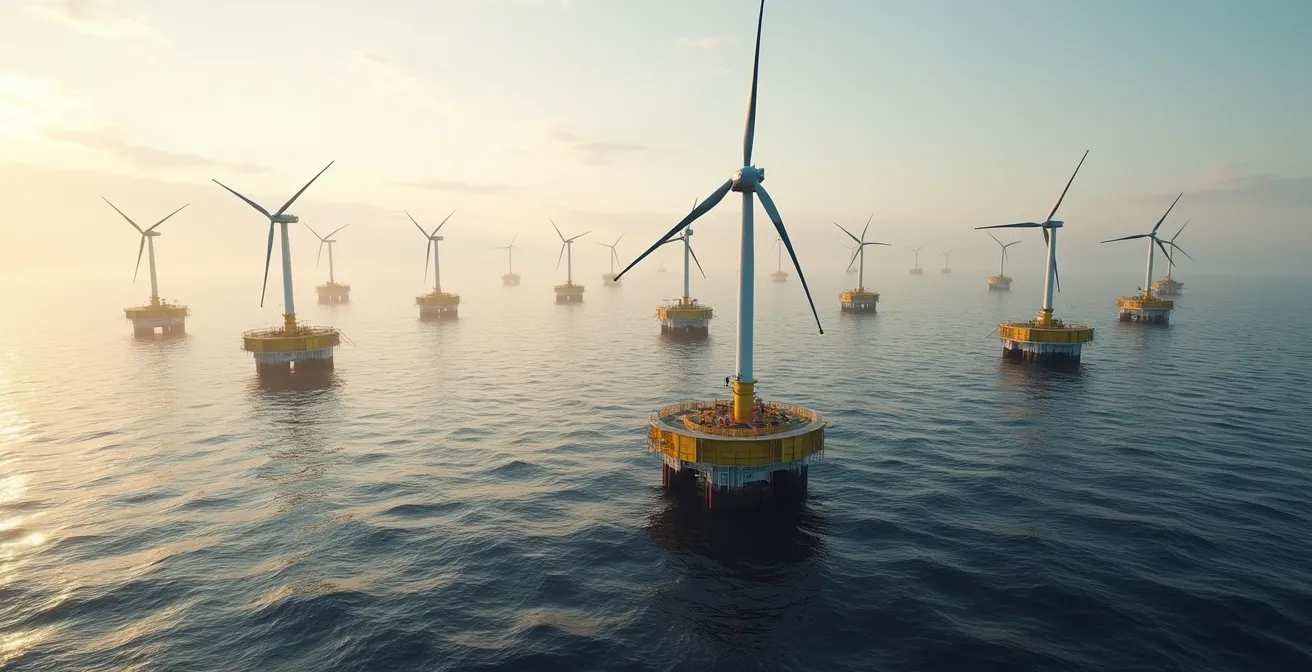
Solving offshore wind intermittency is fundamentally a systems engineering challenge, won by integrating resilient technologies from the turbine to the grid, not by simply adding storage as an afterthought.
- Stable power generation is achieved by accessing superior, consistent winds in deep waters using advanced floating platforms.
- Operational uptime is maximized and costs are controlled through predictive maintenance powered by digital twins and intelligent transmission choices like HVDC.
Recommendation: Shift design focus from pure Levelized Cost of Energy (LCOE) to maximizing system uptime and grid service value as primary performance indicators.
The core challenge for scaling renewable energy has always been intermittency. For offshore wind, the conventional wisdom often points to massive battery storage systems as the inevitable, costly solution to smooth out production peaks and troughs. While energy storage is a critical grid asset, this view overlooks a more fundamental truth: the battle against intermittency is won or lost long before the electrons reach the shore. It is a systems engineering problem that can be proactively addressed through intelligent design at every stage of an offshore wind project.
This approach moves beyond treating the wind farm as a simple power source and instead views it as an integrated, resilient system. By making strategic choices in turbine placement, foundation technology, operational logistics, and power transmission, we can fundamentally “flatten” the production curve at its source. This guide delves into the specific technologies and strategies that transform a collection of turbines into a predictable and highly reliable power plant. We will explore how accessing deeper waters, implementing predictive digital twins, and choosing the right transmission backbone are not isolated decisions, but interconnected parts of a cohesive strategy to achieve near-constant power generation and unprecedented uptime.
This article provides a technical roadmap for energy grid planners and marine engineers. We will analyze the critical engineering trade-offs and operational strategies that enable offshore wind to overcome its primary obstacle and become a cornerstone of our future energy grid.
Summary: A Systems Engineering Approach to Offshore Wind Reliability
- Why Are Offshore Winds More Consistent Than Onshore Winds?
- How to Anchor Turbines in Deep Water Using Floating Platforms?
- Monopiles vs Semi-Submersibles: Which Is More Cost-Effective Beyond 50m Depth?
- The Logistics Error That Doubles O&M Costs for Offshore Farms
- When to Use HVDC Cables Instead of HVAC for Long-Distance Transmission?
- How to Read Atmospheric Pressure Charts to Predict Local Storms?
- How to Mix Solar and Wind Capacities to Flatten the Production Curve?
- Achieving 99.9% Uptime: The Challenge of Integrating Renewables into Legacy Grids
Why Are Offshore Winds More Consistent Than Onshore Winds?
The primary reason offshore wind is a more reliable power source lies in a simple aerodynamic principle: friction. On land, wind must travel over varied terrain, including hills, forests, and buildings. This creates turbulence and a phenomenon known as wind shear, where wind speed is significantly reduced closer to the ground. The ocean, by contrast, presents a vast, flat, and relatively smooth surface. This lack of obstruction allows wind to maintain higher and more uniform speeds over great distances. Consequently, the energy available to a turbine is not only greater but also far more predictable.
This difference is quantifiable. The capacity factor—a measure of how much electricity a turbine produces relative to its maximum potential—is consistently higher for offshore installations. For example, recent industry data shows a 41% average global offshore capacity factor compared to just 36% for onshore wind in 2023. This 5-point difference represents a massive increase in energy generation and revenue over a project’s lifetime. Furthermore, the diurnal wind cycle at sea is often more complementary to energy demand, with wind speeds frequently picking up in the late afternoon and evening as land cools faster than water, a time when solar production wanes.
Harnessing this superior resource is the first step in designing for high uptime. By moving further from shore, farms can escape the turbulent “wind shadow” of the coastline and tap into these more powerful and stable atmospheric flows. This unlocks the potential for higher, flatter production curves, but it also introduces significant engineering challenges for deep-water deployment. The fundamental consistency of the resource, however, makes solving these challenges a worthwhile endeavor.
How to Anchor Turbines in Deep Water Using Floating Platforms?
Accessing the most consistent winds requires moving into water depths greater than 60 meters, where traditional fixed-bottom foundations become technically and economically unfeasible. This is the domain of floating offshore wind turbines. Instead of being fixed to the seabed, the turbine is mounted on a floating platform, which is then secured in place by a complex mooring system. This technology decouples the turbine from water depth, opening up vast new areas of the ocean for energy development.
The stability of the entire system depends on the synergy between the floating platform and its anchoring. There are three primary mooring configurations used in the industry: catenary, taut-leg, and tension-leg systems. Catenary systems use heavy chains that lie on the seabed, relying on their weight and long scope to provide restoring force. Taut-leg systems use lighter synthetic ropes under tension at a steeper angle, reducing the seabed footprint. Tension-leg platforms (TLPs) use vertical tethers under high tension, virtually eliminating vertical motion but requiring more complex installation. The choice depends on water depth, soil conditions, and the platform type (spar, semi-submersible, or barge).
The engineering of these mooring systems is a critical factor in both performance and cost. Each line must be designed to withstand millions of load cycles from waves, currents, and wind, all while maintaining the platform’s position within a strict watch circle to protect power cables.
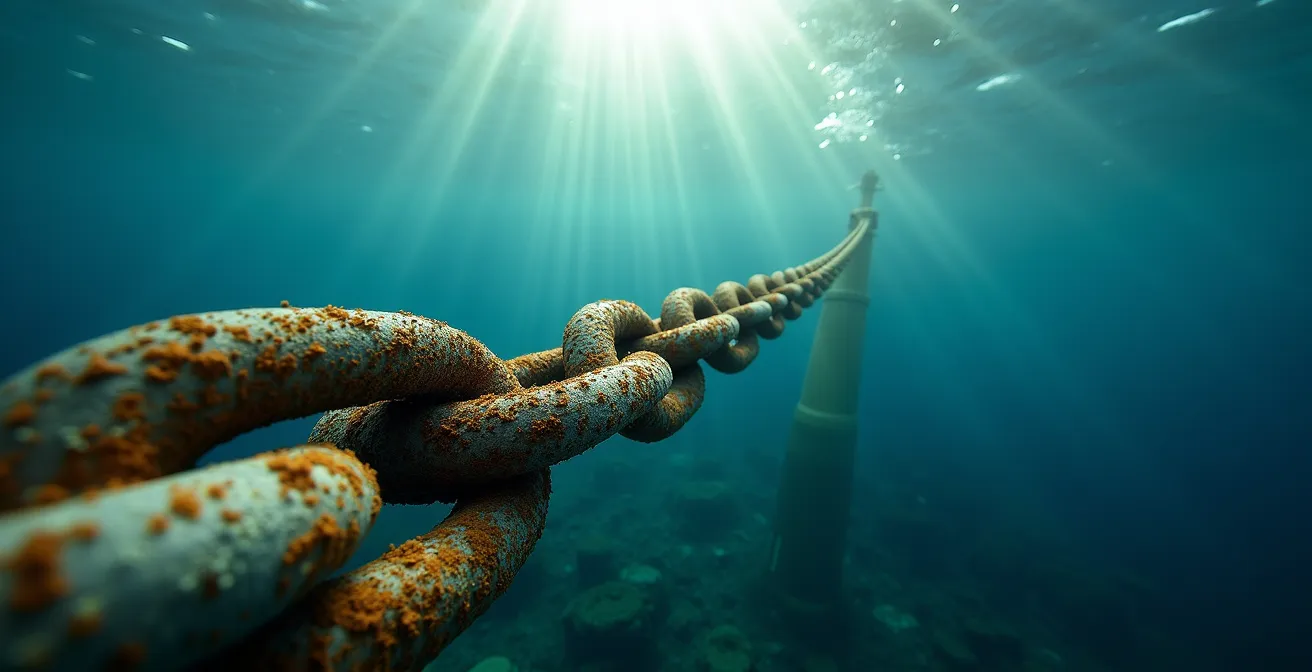
As the illustration highlights, the complexity lies in the details—the connections, materials, and their interaction with the harsh marine environment. Innovation is driving down costs in this area. As pointed out by SINTEF Ocean researchers, new strategies are emerging to optimize these systems. They note:
Shared mooring lines suspended between two floaters in a farm can reduce overall construction costs for large-scale floating wind farms
– SINTEF Ocean researchers, SINTEF Blog on Floating Wind Mooring Systems
This system-level thinking, where components serve multiple turbines, is key to making deep-water wind economically viable and unlocking the best wind resources on the planet.
Monopiles vs Semi-Submersibles: Which Is More Cost-Effective Beyond 50m Depth?
The choice of foundation technology is one of the most significant cost drivers in an offshore wind project, representing up to 30% of total capital expenditure. The decision is dictated almost entirely by water depth. For projects in shallower waters (0-50 meters), the monopile has been the undisputed king. A monopile is a simple, large-diameter steel tube driven directly into the seabed, offering a robust and cost-effective solution that has benefited from decades of manufacturing and installation experience.
However, as projects move beyond the 50-meter depth contour, the physics and economics of monopiles break down. The required diameter and wall thickness of the steel tube increase exponentially to handle the bending moments, making them prohibitively heavy and expensive to fabricate and install. This is where floating foundations, such as semi-submersibles, become the more logical and cost-effective choice. A semi-submersible is a buoyant structure with multiple columns that provides stability through its large waterplane area and is held in place by mooring lines.
While the upfront fabrication of a semi-submersible platform is complex, it offers key advantages. The entire turbine and platform assembly can often be done onshore in a controlled port environment, eliminating risky and weather-dependent heavy lifts at sea. Furthermore, the cost of the mooring system for a floating platform scales more favorably with depth than the steel mass of a fixed-bottom foundation. The following table breaks down the optimal depth ranges and key cost drivers for major foundation types, illustrating the clear transition point where floating technology takes over.
| Foundation Type | Optimal Depth Range | Key Cost Factor | Market Status |
|---|---|---|---|
| Monopiles | 0-50m | Installation vessels | Mature technology |
| Jackets | 40-60m | Fabrication complexity | Established |
| Floating Semi-Sub | 50-200m+ | Mooring systems | Emerging commercial |
| Floating Spar | 80-800m | Deep draft requirements | Demonstration phase |
As this comparative analysis of foundation technologies shows, there is a clear economic and technical hand-off around the 50-60 meter mark. For grid planners and developers targeting the superior wind resources of deeper waters, embracing semi-submersible and other floating solutions is not just an option; it is a necessity for project viability.
The Logistics Error That Doubles O&M Costs for Offshore Farms
Once a wind farm is operational, Operations and Maintenance (O&M) become the largest recurring cost. A single, seemingly minor logistics error can have a cascading effect, leading to extended downtime and skyrocketing expenses. The most common and costly mistake is relying on a reactive maintenance strategy—waiting for a component to fail before dispatching a crew. In an offshore environment, this is a recipe for disaster. A simple gearbox sensor failure can ground a multi-megawatt turbine for weeks if a suitable vessel, trained crew, and the correct spare part are not immediately available, all while waiting for a safe weather window.
This logistical inefficiency is what can double O&M costs compared to a proactive, data-driven approach. The solution is the implementation of a digital twin. A digital twin is a virtual, real-time replica of the physical wind farm. Fed by a constant stream of data from IoT sensors on every critical component—from blade bearings to converter electronics—the digital twin uses predictive analytics to forecast potential failures weeks or even months in advance. This transforms O&M from a reactive fire-fight into a planned, optimized logistical operation. Maintenance can be scheduled during periods of low wind, crews can be dispatched with the correct parts to service multiple turbines in a single trip, and vessel routes can be optimized based on weather forecasts and inventory levels.
For example, modern farms in the North Sea already use automated systems that shut down turbines in extreme weather, but the next evolution is using predictive data to perform pre-storm adjustments and schedule post-storm inspections with autonomous drones, minimizing human intervention and maximizing uptime. Implementing such a system requires a structured approach.
Action Plan: Digital Twin Implementation for O&M Optimization
- Deploy IoT sensors across all critical turbine components for comprehensive, real-time data collection on temperature, vibration, and performance.
- Integrate live weather forecasting data with maintenance scheduling algorithms to optimize vessel dispatch and ensure crew safety.
- Implement machine learning models and predictive analytics to detect anomalies and forecast component failures before they occur.
- Coordinate Crew Transfer Vessel (CTV) routes with spare parts inventory management to ensure parts and people arrive together.
- Deploy autonomous inspection drones and Remotely Operated Vehicles (ROVs) for routine and post-storm checks, reducing reliance on human intervention.
By shifting the O&M paradigm from reaction to prediction, operators can cut downtime, reduce vessel chartering costs, and ensure the farm is generating revenue as close to 24/7 as possible.
When to Use HVDC Cables Instead of HVAC for Long-Distance Transmission?
Once power is generated, it must be transmitted to shore with minimal loss. For offshore wind farms, this choice comes down to two technologies: High-Voltage Alternating Current (HVAC) and High-Voltage Direct Current (HVDC). HVAC is the standard for most land-based grids and is cost-effective for shorter distances. However, for the large-scale offshore farms being built further from shore, HVAC has a significant drawback: reactive power loss. The long submarine cables act like giant capacitors, leading to substantial energy losses that increase with distance.
This is where HVDC becomes the superior solution. HVDC transmission suffers from much lower energy losses over long distances, making it ideal for far-from-shore projects. The trade-off is the high cost of the converter stations required at both ends of the cable to change AC to DC and back again. Therefore, there is an economic break-even point where the higher upfront cost of HVDC converters is offset by the long-term savings from lower energy losses. According to technical analysis, this cost break-even point is typically around 120 km. For any farm located beyond this distance, HVDC is the clear economic choice.
The image below shows the scale of an offshore HVDC converter platform, a massive piece of infrastructure that acts as the collection hub for the entire wind farm before sending the power to shore.
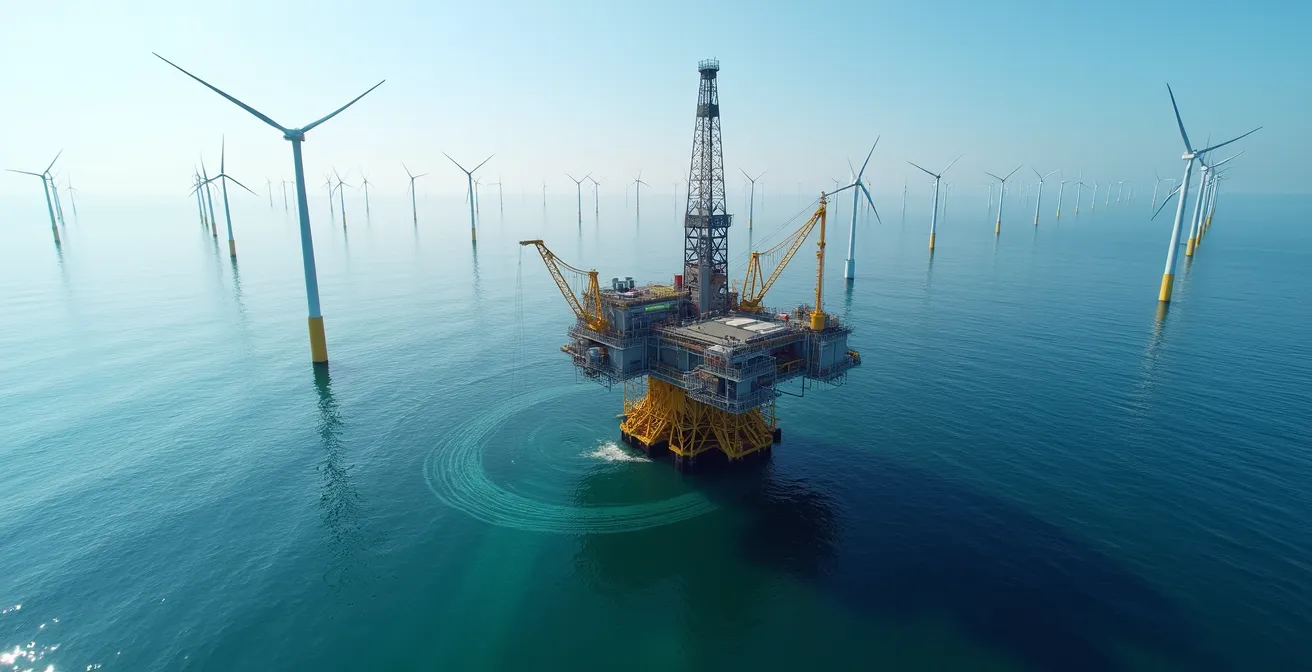
However, the decision to use HVDC is not purely based on distance and cost. It is also a strategic choice for grid stability. As grid integration engineers from NREL highlight, the value of HVDC extends far beyond simple transmission efficiency.
HVDC’s advanced controllability provides valuable grid services that HVAC cannot, making it strategic, not just technical
– Grid Integration Engineers, NREL Grid Integration of Offshore Wind Power Study 2024
These “grid services” include the ability to precisely control power flow, manage voltage, and improve the stability of the onshore grid. In an energy system with high penetration of renewables, this level of control is invaluable, making HVDC a critical enabler of a stable, decarbonized grid.
How to Read Atmospheric Pressure Charts to Predict Local Storms?
For an offshore wind farm, weather is not just a power source; it is the single biggest operational risk. The ability to accurately predict the arrival of storms is paramount for protecting multi-billion-dollar assets and ensuring personnel safety. While turbines are incredibly robust, operational safety protocols require an automatic shutdown when sustained wind speeds exceed a threshold, typically around 25 m/s (90 km/h). Predicting these events in advance allows for a controlled, orderly shutdown and proactive inspections, rather than a sudden, emergency stop.
The cornerstone of marine weather forecasting is the atmospheric pressure chart. These charts display isobars—lines of equal atmospheric pressure. The key to predicting storms is analyzing the pressure gradient. Tightly packed isobars indicate a steep pressure gradient, which drives very strong winds. A rapidly deepening low-pressure system, identifiable by concentric isobars with decreasing pressure towards the center, is the classic signature of an approaching storm. By tracking the movement and intensification of these systems, operators can forecast the timing and intensity of high-wind events 24 to 72 hours in advance.
However, modern forecasting goes beyond pressure charts. It integrates multiple data sources for a more complete picture. LIDAR (Light Detection and Ranging) systems, both on the turbines and on buoys, provide real-time, high-resolution wind speed and direction data up to several kilometers away. This data is fed into numerical weather models, which combine it with pressure chart analysis to produce highly accurate 72-hour forecasts. This allows O&M planners to identify safe “weather windows” for sending out maintenance crews, defined by specific thresholds like significant wave heights of less than 2 meters. By implementing pre-storm turbine control adjustments and scheduling post-storm drone inspections based on these forecasts, the farm’s resilience and availability are dramatically increased.
How to Mix Solar and Wind Capacities to Flatten the Production Curve?
While optimizing a single offshore wind farm is crucial, the true path to a stable renewable grid lies in portfolio diversification. No single renewable source can provide constant power, but by combining different sources with complementary generation profiles, we can create a much flatter and more predictable aggregate production curve. The most powerful pairing for offshore wind is utility-scale solar photovoltaics (PV).
The generation profiles of wind and solar are often naturally anti-correlated. Solar power production peaks midday, directly aligning with high commercial and industrial demand. Wind energy, particularly offshore, often exhibits a different pattern. It can be strong overnight as temperature differences between land and sea create pressure gradients, and it frequently peaks in the morning and evening, precisely when solar generation is ramping up or down. This “shoulder-of-the-day” production from wind is incredibly valuable for bridging the gap between solar’s peak and evening demand spikes.
A grid planner using a systems approach would co-locate or strategically deploy these assets to smooth out aggregate supply. During a calm, sunny day, the grid relies on solar. As a weather front moves in, bringing clouds and wind, solar output drops, but wind production surges to compensate. This symbiotic relationship reduces the need for steep ramping from fossil-fuel peaker plants and lessens the required capacity of short-duration energy storage. With latest industry reports confirming over 83 GW of total installed offshore wind capacity globally, the scale is now large enough for this portfolio effect to have a meaningful impact on grid stability. The key is no longer just building maximum gigawatts, but building the *right mix* of gigawatts.
Key Takeaways
- Solving intermittency is a systems design challenge, not just a storage problem; high uptime is built-in, not bolted on.
- Floating platforms are essential for unlocking the most consistent and powerful wind resources in deep waters, representing the next frontier of offshore energy.
- A proactive O&M strategy using digital twins and predictive analytics is non-negotiable for controlling costs and maximizing revenue.
Achieving 99.9% Uptime: The Challenge of Integrating Renewables into Legacy Grids
The ultimate goal of these advanced technologies and systems-level strategies is to deliver clean, reliable power to consumers. This means successfully integrating massive amounts of variable offshore wind energy into legacy grids that were designed for centralized, dispatchable fossil-fuel plants. Achieving the “five nines” (99.999%) of reliability that modern society expects is the final and greatest challenge. It requires the grid itself to become as smart and dynamic as the renewable assets connected to it.
Integrating a multi-gigawatt offshore farm is not as simple as plugging in a new power plant. The grid operator must manage the inherent variability, even after all on-site optimizations. This is where the grid services provided by technologies like HVDC become critical. The ability to precisely control voltage and power flow helps stabilize the grid in real-time. Furthermore, advanced forecasting, powered by the same data used for O&M, gives grid operators hours or days of notice to prepare for shifts in wind production, allowing them to schedule other generation or demand-response resources accordingly.
The economic imperative for solving this challenge is clear. As Girish Tanti, a leader in the wind industry, noted, “Wind is among the cheapest sources of energy and one of two sources making up 95% of global renewable capacity growth.” The downward cost trend is unstoppable, making wind a cornerstone of future energy systems. The technical challenge is now a grid integration challenge. The DNV energy transition outlook predicts that wind capacity will reach 9.9 TW by 2060, providing nearly a third of all global electricity. To accommodate this scale, our grids must evolve. This involves deploying more grid-forming inverters, expanding transmission capacity, and using sophisticated energy management software to orchestrate a complex dance between generation, storage, and demand.
The next logical step is to integrate these systems engineering principles into your next project’s feasibility and design phases. By designing for uptime and grid stability from day one, you build a more resilient, reliable, and profitable renewable energy asset for the future.