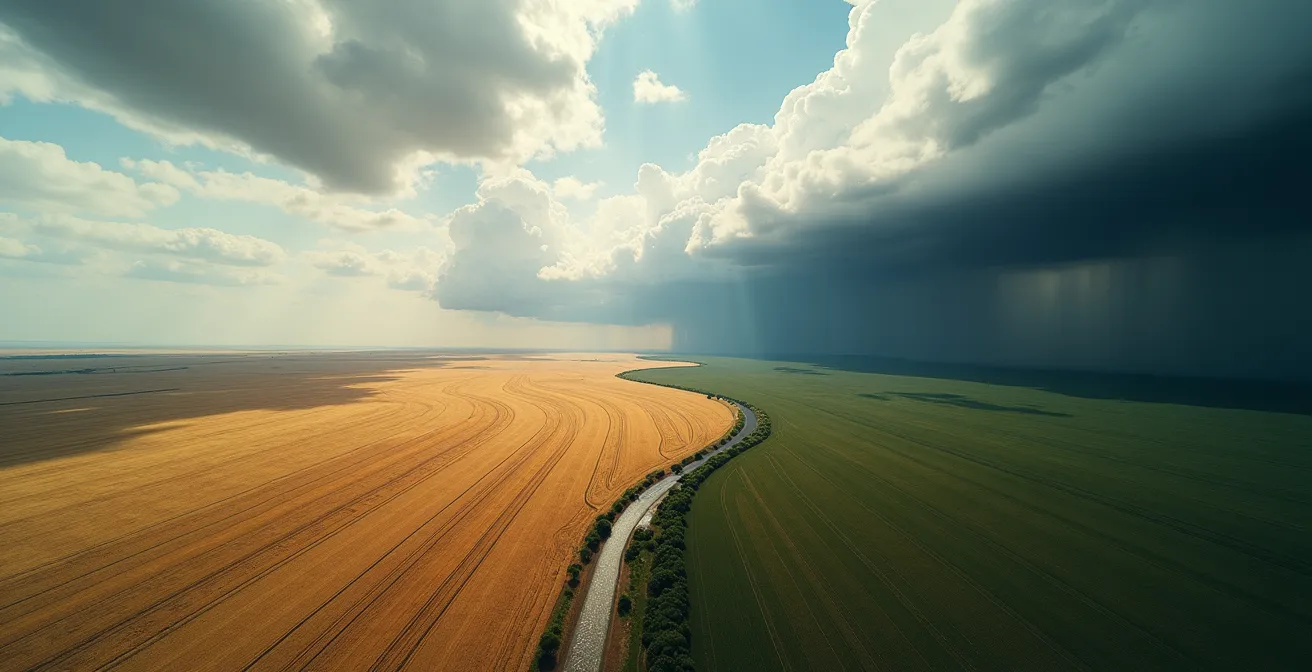
Stuck weather isn’t random; it’s a predictable failure cascade within Earth’s interconnected atmospheric systems.
- Arctic warming is collapsing the critical temperature gradient that powers the jet stream, causing it to meander and stall.
- This leads to more frequent and intense “blocking patterns” that lock in weather for weeks, directly increasing risks in sectors from agriculture to aviation.
Recommendation: Focus on adapting to this new reality of prolonged weather events rather than expecting a return to past seasonal norms.
The feeling is becoming increasingly familiar: a heatwave that won’t break, a drought that lingers for weeks, or a period of relentless rain that leads to flooding. It often seems as if the weather gets “stuck.” For meteorology enthusiasts and farmers alike, this erosion of seasonal predictability is more than an inconvenience; it represents a fundamental shift in the planet’s behavior. While many discussions point to a “wavy jet stream” as the culprit, this is merely a symptom of a much deeper issue. The traditional, reliable rhythm of our atmosphere is being disrupted.
The common understanding blames climate change in a general sense, often focusing on Arctic warming. However, this explanation misses the crucial mechanical details. The Earth’s climate is not a single entity but a series of massive, interconnected atmospheric gears—the Hadley, Ferrel, and Polar cells—all driven by the temperature difference between the equator and the poles. What we are now witnessing is not just one gear malfunctioning, but a systemic cascade where a weakness in one part of the system reverberates through all the others, from the high stratosphere down to the soil on a farm.
This article moves beyond the platitude of a “wavy jet stream.” We will dissect the underlying physics of this atmospheric slowdown. The true key is understanding the collapse of the global temperature gradient and how this loss of energy is causing our weather systems to lose momentum and develop a kind of positional inertia. By examining this process, we can better grasp why cold snaps are becoming more severe, why turbulence is a growing threat, and what it means for practical decisions like when to plant crops. This is a guide to the mechanics of our stalling global weather engine.
To fully grasp this complex phenomenon, this article breaks down the issue into its core components. The following sections will explore the causes, the observable effects, and the practical consequences of these shifting atmospheric dynamics.
Summary: How Atmospheric Circulation Is Creating Stuck Weather Patterns
- Why Is a Wavy Jet Stream Causing More Extreme Winter Cold Snaps?
- How to Read Atmospheric Pressure Charts to Predict Local Storms?
- Tropical vs Mid-Latitude Cells: Which Impacts Desert Formation More?
- The Turbulence Risk That Is Increasing Due to Changed Air Currents
- When to Shift Planting Dates Based on New Atmospheric Moisture Patterns?
- Why Does Melting Arctic Ice Accelerate Global Warming by 25%?
- Why Are Offshore Winds More Consistent Than Onshore Winds?
- Why the Loss of Arctic Sea Ice Accelerates Global Warming by 30%?
Why Is a Wavy Jet Stream Causing More Extreme Winter Cold Snaps?
One of the most dramatic consequences of a changing jet stream is the intensification of winter cold snaps. These are not simply colder-than-average days but prolonged invasions of Arctic air plunging deep into mid-latitudes. The mechanism responsible involves a process called stratospheric coupling, where disturbances high in the atmosphere directly influence our surface weather. The key player is the polar vortex, a large area of low pressure and cold air surrounding the Earth’s poles. When stable, it acts like a spinning top, keeping the coldest air contained. However, a wavier, weaker jet stream can disrupt this stability, effectively knocking the vortex off-balance.
This disruption often manifests as a “Sudden Stratospheric Warming” (SSW) event. During an SSW, the stratosphere above the pole can warm by tens of degrees Celsius in just a few days. This warming reverses the vortex’s winds, causing it to weaken, split, or be displaced southward. Recent studies highlight a growing link between ocean conditions and these events; research from 2024 shows that 65% of weak polar vortex events are preceded by specific ocean warming patterns. The early 2024 winter saw a prime example, where a major SSW event occurred, briefly reaching the threshold before the vortex winds recovered, demonstrating how volatile these systems have become.
This process of wave breaking in the jet stream is what allows frigid Arctic air masses to spill out of their usual containment. The visualization below helps conceptualize this intrusion.

As the image illustrates, the once-zonal (west-to-east) flow of the jet stream develops deep troughs and ridges. It’s within these deep troughs that the dense, cold Arctic air is channeled southward, leading to the extreme and persistent cold snaps that have impacted regions like North America and Europe with increasing frequency. It’s not that the planet is getting colder, but that the atmospheric barriers that once separated climate zones are becoming more permeable.
How to Read Atmospheric Pressure Charts to Predict Local Storms?
For meteorology enthusiasts, predicting local weather in this new era of “stuck” patterns requires moving beyond simple forecasts and learning to identify the signatures of atmospheric blocking on pressure charts. These blocking patterns are the direct cause of prolonged weather events. They are essentially stationary domes of high pressure that divert the jet stream and, with it, the path of storm systems. The most common tool for spotting them is the 500 millibar (hPa) height chart, which shows the state of the atmosphere at roughly 5,500 meters (18,000 feet).
On these charts, the jet stream appears as a river of fast-moving air. A blocking pattern is visible when this river deviates significantly from its typical west-to-east flow and forms a persistent, amplified wave. Instead of storms moving progressively across a region, they are either steered around the block or stall along its edges, leading to days of monotonous weather—either clear and dry under the high-pressure dome or persistently wet and stormy on its periphery. Recognizing these formations is key to anticipating weather that will last for days or even weeks, rather than hours.
Several distinct types of blocking patterns exist, each with a unique shape and impact on local weather. The following table, based on common meteorological classifications, outlines the primary types you might encounter on a weather chart.
| Pattern Type | Shape | Weather Impact | Duration |
|---|---|---|---|
| Omega Block | Greek letter Ω shape | Dry center, wet flanks | Several days to weeks |
| Rex Block | High north of low | Reversed flow patterns | Days to weeks |
| Cut-off Low | Isolated low pressure | Persistent storms | 3-10 days |
| Split Flow | Bifurcated jet stream | Stable between streams | Variable |
The most infamous of these is the Omega Block, named for its resemblance to the Greek letter. When an Omega Block sets up over a region, the areas on its eastern and western flanks can be trapped in a corridor of relentless storms, while the area directly underneath the high pressure experiences an extended period of dry, stable conditions. Learning to spot the formation of these patterns is the first step toward forecasting the duration and intensity of local weather events.
Tropical vs Mid-Latitude Cells: Which Impacts Desert Formation More?
While the jet stream dominates mid-latitude weather, the planet’s most fundamental climatic zones, including its great deserts, are sculpted by much larger atmospheric “gears”: the global circulation cells. There are three such cells in each hemisphere: the Hadley, Ferrel, and Polar cells. Of these, the Hadley Cell is the most powerful and has the most direct and profound impact on desert formation. It is a massive convection loop that rises near the equator and descends in the subtropics, around 30 degrees north and south latitude.
The process begins at the equator, where intense solar radiation heats the moist surface air, causing it to rise and cool. As it cools, the moisture condenses and falls as heavy rain, which is why tropical rainforests are found here. This now-dry air is then pushed poleward at high altitudes. Around 30 degrees latitude, the air has cooled enough to become dense and begins to sink back toward the surface. This sinking motion creates a belt of high atmospheric pressure known as the subtropical ridge.
As this column of air descends, it warms and its relative humidity plummets. This extremely dry air reaches the ground and spreads out, absorbing any available moisture from the land. This constant process of subsidence and moisture absorption is the primary reason the world’s largest hot deserts, such as the Sahara, the Arabian, and the Australian deserts, are located along this 30-degree latitude belt. The Ferrel Cell, which operates in the mid-latitudes, is a much weaker, thermally indirect circulation that is largely driven by the motion of the Hadley and Polar cells. It does not have the same powerful, desert-forming subsidence mechanism. Therefore, the Hadley Cell is the dominant engine of large-scale desertification.
The Turbulence Risk That Is Increasing Due to Changed Air Currents
The same atmospheric destabilization that causes stuck weather patterns on the ground is creating a significant and growing risk in the sky: clear-air turbulence (CAT). This is turbulence that occurs in cloudless skies, making it invisible to pilots and on-board radar. It is generated by wind shear—abrupt changes in wind speed or direction over a short distance—which is becoming more common as the jet stream becomes more erratic. The increased temperature difference vertically and horizontally is intensifying this shear, particularly at cruising altitudes of 30,000-40,000 feet.
Research has now definitively linked this increase to climate change. The changing temperature structure of the atmosphere is feeding more energy into the jet stream, making it more unstable. A landmark study from the University of Reading quantified this alarming trend, finding a 55% increase in severe turbulence over the North Atlantic between 1979 and 2020. This is not a future projection but a measured historical change. The implications for aviation safety and passenger comfort are significant, as airlines must now contend with a more hazardous atmospheric environment.
Experts in the field warn that this is just the beginning. The physical mechanisms causing this increase are directly tied to ongoing atmospheric warming. As Paul Williams, a leading scientist in this area, has stated, the problem is set to worsen considerably.
By 2050, the rate of injuries will have almost tripled. Air turbulence is increasing across the globe, in all seasons and at multiple cruising altitudes. This problem is only going to worsen as the climate continues to change.
– Paul Williams, Professor of Atmospheric Science, University of Reading
Further analysis projects that this is a global phenomenon. While the North Atlantic is a hotspot, other major flight routes are expected to see dramatic increases in severe turbulence, with projected rises of 60% over South America and 50% over Australia and Africa. This systemic increase in CAT represents a direct, tangible consequence of altered atmospheric circulation, forcing the aviation industry to adapt its routing and operational procedures.
When to Shift Planting Dates Based on New Atmospheric Moisture Patterns?
For farmers, the rise of stuck weather patterns translates directly into existential threats like “flash droughts” and “false springs.” A blocking high can stall over an agricultural region for weeks, cutting off rainfall and rapidly depleting soil moisture just as crops are germinating. Conversely, an unusually early warm spell can trick plants into budding prematurely, only for a subsequent cold snap to destroy the nascent crops. Adapting to this new volatility is no longer optional; it requires a data-driven approach to deciding when—and if—to plant.
Relying on traditional planting calendars based on historical averages is now a high-risk gamble. The key is to shift from a calendar-based mindset to one based on real-time environmental monitoring. This involves tracking not just precipitation but also soil moisture levels and evapotranspiration rates—the amount of water lost from the soil and plants to the atmosphere. An extended forecast of an Omega Block, for example, should be a major red flag, potentially signaling a need to delay planting until the pattern breaks, even if the calendar date seems right.
This challenge is particularly acute during critical growth stages like germination, where a few weeks of unexpected drought can wipe out an entire season’s potential. The appearance of dry, cracked soil is a lagging indicator; by the time it’s visible, the damage is already done.

To navigate this uncertainty, farmers must become proactive risk managers, integrating new data sources and technologies. This means moving beyond anecdote and tradition to build a resilient agricultural strategy. The following checklist outlines a framework for auditing a farm’s readiness for these new moisture patterns.
Action Plan: Auditing Farm Readiness for New Moisture Patterns
- Indicators to Monitor: List all channels where climate signals are monitored, including long-range forecasts (beyond 10 days), soil moisture sensors, and satellite evapotranspiration data.
- Data Collection: Inventory existing on-farm data (historical yields, soil types, water usage) to establish a baseline for comparison against new patterns.
- Strategic Coherence: Compare long-range forecasts for blocking patterns against traditional planting windows to identify potential high-risk conflicts.
- Pattern Recognition: Analyze soil moisture data to identify the unique signature of a “flash drought” versus a normal dry spell, noting the rate of moisture depletion.
- Adaptive Integration: Develop a flexible action plan with clear triggers for delaying planting, choosing more cold-tolerant cultivars, or deploying irrigation resources based on forecast data.
Why Does Melting Arctic Ice Accelerate Global Warming by 25%?
The engine driving the destabilization of our atmospheric gears is located at the top of the world: the Arctic. This region is warming at an alarming rate, a phenomenon known as Arctic Amplification. While the title notes a 25% acceleration, many scientific bodies report even higher figures. The MIT Climate Portal explains that the Arctic is warming two to four times faster than the global average. This disproportionate heating is not just a side effect of global warming; it is a powerful accelerator of it, driven by a series of self-reinforcing feedback loops.
The most significant of these is the ice-albedo feedback. Albedo is a measure of how much solar radiation a surface reflects. Bright white sea ice has a high albedo, reflecting up to 85% of incoming sunlight back into space. In contrast, the dark open ocean that replaces it has a very low albedo, absorbing over 90% of that same energy. As the ice melts, more dark ocean is exposed, which absorbs more heat, which in turn melts more ice. This vicious cycle is the primary reason the Arctic is warming so rapidly.
But the albedo effect is not the only mechanism at play. The Arctic’s vast stretches of permafrost—permanently frozen ground—contain enormous amounts of trapped organic carbon. As the region warms, this permafrost thaws, allowing microbes to decompose the organic matter and release potent greenhouse gases like methane (CH4) and carbon dioxide (CO2) into the atmosphere. This adds yet more fuel to the warming fire, further accelerating the thaw in another dangerous feedback loop.
This intense warming directly reduces the temperature gradient between the pole and the equator. This gradient is the power source for the jet stream. As the temperature difference shrinks, the jet stream weakens, slows down, and begins to meander—the very waviness that causes blocking patterns and stuck weather. Therefore, the melting Arctic is not just a symbol of climate change; it is the primary driver of the atmospheric instability we are now experiencing globally.
Why Are Offshore Winds More Consistent Than Onshore Winds?
Offshore winds are generally prized for their consistency, a key factor for the wind energy industry. The primary reason for this is the significant difference in surface friction between land and sea. Onshore, the wind’s flow is constantly disrupted by topography (hills, mountains), vegetation (forests), and man-made structures (buildings). This creates turbulence and causes the wind to be gusty and variable in both speed and direction. In contrast, the open ocean presents a vast, relatively smooth surface with minimal friction. This allows wind to flow unimpeded, resulting in a more stable and consistent velocity.
Furthermore, the thermal properties of land and water contribute to this difference. Land heats up and cools down much faster than the ocean. This creates daily cycles of land and sea breezes near the coast, which add another layer of variability to onshore winds. The ocean’s massive thermal inertia means its surface temperature is much more stable, leading to more predictable and less diurnally-variable wind patterns farther offshore. This combination of low friction and thermal stability is why offshore wind farms can generate power more reliably than their onshore counterparts.
However, this traditional consistency is now being challenged by the very same phenomenon of atmospheric blocking. While daily variability is low, large-scale blocking patterns can impact wind resources for weeks at a time. A persistent high-pressure dome over a region can lead to a “wind drought,” drastically reducing power generation. Historical events demonstrate this vulnerability; blocked weather was a key driver of the UK’s 1976 summer drought and has been linked to periods of low wind. The increasing frequency of blocking patterns over areas like Greenland represents a new, long-term risk to the perceived consistency of offshore wind resources.
Key Takeaways
- Stuck weather is caused by a weakened jet stream, which is a direct result of the shrinking temperature difference between the warming Arctic and the equator.
- This “temperature gradient collapse” leads to persistent blocking patterns (like Omega Blocks) that lock in weather conditions for weeks.
- The consequences are systemic, increasing risks of extreme cold snaps, severe aviation turbulence, and agricultural disruption from flash droughts.
Why the Loss of Arctic Sea Ice Accelerates Global Warming by 30%?
The loss of Arctic sea ice acts as a powerful accelerator for global warming, with some models suggesting it’s responsible for as much as 30% of the warming from CO2. This figure goes beyond the 25% mentioned earlier by incorporating the broader, systemic impacts on global weather. The core of the issue is that by removing the planet’s primary northern reflector (the sea ice), we are fundamentally altering the Earth’s energy balance. This change isn’t just warming the Arctic; it is directly energizing the mechanisms that lead to more frequent and intense extreme weather events globally.
The critical link is the quantified increase in jet stream waviness. As the Arctic warms and the temperature gradient collapses, the energy that once drove a strong, zonal jet stream is now being expressed as amplified, meandering Rossby waves. This isn’t theoretical; it’s a measured change. For instance, 2018 research projects a 50% increase in the annual number of these quasi-resonant amplification events, from an average of 7.5 to 11 per year. Each of these events represents a period of stuck, extreme weather somewhere in the Northern Hemisphere.
This provides a direct, physical link between the melting ice cap and the heatwave in your city or the drought on a farm thousands of miles away. The connection is no longer a matter of correlation but of causation, as leading climate scientists have affirmed.
We came as close as one can to demonstrating a direct link between climate change and a large family of extreme recent weather events.
– Michael Mann, 2017 Study on Jet Stream and Climate Change
Therefore, the 30% acceleration figure encapsulates not just the direct warming from the ice-albedo effect but also the cascading impacts of a destabilized atmosphere. The loss of Arctic sea ice has effectively “unlocked” a more chaotic and extreme weather regime. It represents a tipping point that has been crossed, shifting the global climate system into a new state characterized by the positional inertia of these slow-moving, high-impact weather patterns. This understanding transforms the narrative from one of future risk to one of present-day adaptation to a fundamentally altered climate system.
Frequently Asked Questions on Atmospheric Circulation and Climate
What is the ice-albedo feedback effect?
Sea ice reflects up to 85% of solar radiation while dark ocean water absorbs over 90%, creating a self-reinforcing warming cycle. As ice melts, more dark water is exposed, which absorbs more heat and melts more ice.
How does Arctic ice loss affect the polar vortex?
A warmer Arctic weakens the temperature gradient between the pole and the mid-latitudes. This temperature difference is what powers the jet stream and contains the polar vortex. A weaker gradient makes the vortex more prone to disruption and breaking apart.
What role does permafrost play in Arctic amplification?
Thawing permafrost releases large quantities of trapped methane and CO2, which are potent greenhouse gases. This release adds more warming agents to the atmosphere, which in turn accelerates the thawing of more permafrost in a dangerous feedback loop.