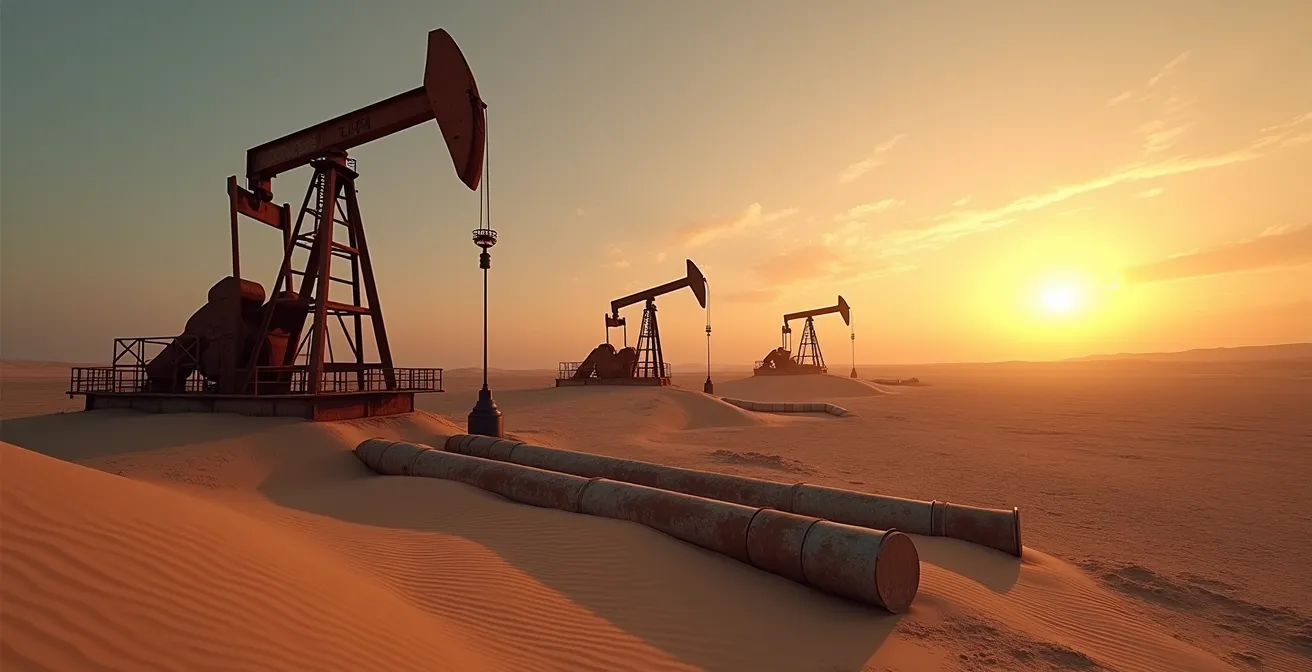
The true stranded asset risk in fossil fuels lies not in policy alone, but in the deteriorating biophysical economics of extraction, a factor financial models often overlook.
- Energy Return on Investment (EROI) for key fossil fuels is in a state of terminal decline, making them less profitable from a pure energy perspective.
- Infrastructure for “bridge fuels” like natural gas risks becoming obsolete long before its planned 20-year payback period, creating a significant liability.
Recommendation: Investors must integrate EROI analysis and asset retirement obligations (AROs) into their valuation models to accurately price risk and time divestment before market consensus forms.
For pension fund managers and institutional investors, the term “stranded assets” has become a persistent concern. The common narrative focuses on regulatory risk: future carbon taxes or emissions caps rendering fossil fuel reserves worthless. Consequently, the standard advice is to monitor policy and diversify into renewables. While sound, this perspective misses a more fundamental, quantifiable, and immediate threat brewing beneath the surface of financial statements and policy debates. It overlooks the hard physics of energy production.
The market often sends misleading signals, focusing on short-term commodity prices while ignoring the long-term viability of the energy source itself. The conversation about risk is incomplete without discussing the declining energy profitability of these assets. What if the most reliable predictor of an asset becoming stranded isn’t a future law, but a present-day calculation of its net energy output?
The true key to managing this transition risk is not to predict politics, but to understand biophysical economics. The central argument of this analysis is that the Energy Return on Investment (EROI) is the most critical leading indicator of stranding risk. An asset that requires almost as much energy to extract as it ultimately produces is already economically unviable, regardless of prevailing market prices or government subsidies. Ignoring this metric is akin to assessing a company’s health by looking only at its revenue, not its profit margin.
This article provides a framework for integrating this biophysical lens into your investment strategy. We will dissect the EROI of different fossil fuels, challenge the “bridge fuel” narrative, and outline concrete triggers for deciding when to divest, retrofit, or decommission. The goal is to equip you with a more robust methodology for protecting your portfolio from the inevitable re-pricing of carbon-intensive assets.
To navigate this complex landscape, this guide breaks down the core components of biophysical risk analysis, from the fundamentals of energy density to the final strategic decision of asset disposal. Explore the sections below to build a comprehensive understanding.
Summary: A Deeper Look at Stranded Asset Risk
- Why Is Replicating the Energy Density of Oil So Difficult for Batteries?
- How to Calculate Energy Return on Investment for Oil Sands Projects?
- Bridge Fuel or Dead End: Is Natural Gas Infrastructure Worth the 20-Year Investment?
- The Policy Mistake of Subsidizing Consumption Instead of Transition
- When to Sell Fossil Fuel Stocks: Before or After Peak Demand?
- The Natural Gas Leakage Mistake That Negates the Benefits of “Bridge Fuels”
- When to Decommission an Asset to Maximize Scrap Value vs Operational Revenue?
- Retrofit or Demolish: What to Do With Carbon-Intensive Plants in a Net-Zero World?
Why Is Replicating the Energy Density of Oil So Difficult for Batteries?
The fundamental challenge of the energy transition begins with physics. Oil and its derivatives possess an extraordinary energy density, a quality that batteries, despite rapid advances, struggle to match. This physical reality explains why liquid fuels have dominated transportation for over a century. However, for an investor, the critical metric is not just the energy stored, but the net energy gained from its extraction. This is where the concept of Energy Return on Investment (EROI) becomes paramount.
EROI measures how many units of energy are produced for every one unit of energy invested in extraction, processing, and transportation. A high EROI signifies an efficient, highly profitable energy source. A low EROI signals a system in decline. Historically, conventional oil fields boasted EROIs of 100:1 or more. Today, the picture is vastly different, especially for unconventional sources that now dominate new production.
For example, recent analysis shows that unconventional oil extraction methods, such as shale oil, can have an EROEI as low as 1-2:1, while oil sands hover between 3.5-5.4:1. At these levels, a vast amount of energy is consumed simply to produce more energy, eroding the very foundation of the asset’s economic purpose. This biophysical deficit is a clear leading indicator of stranding risk, as these assets are the first to become unviable when energy input costs rise or output prices fall.
Case Study: The Disconnect in Canadian Oil Sands
An extensive analysis of Canadian oil sands operations between 1997 and 2016 revealed a startling conclusion: there was no discernible correlation between the declining EROI of the projects and their financial performance indicators. This suggests that market prices and financial metrics were operating in a separate reality from the underlying biophysical efficiency. Investors relying solely on financial reports would have missed the deteriorating energy profitability of the core asset, exposing them to a sudden correction once market sentiment caught up with physical reality.
How to Calculate Energy Return on Investment for Oil Sands Projects?
Calculating EROI is a complex exercise in energy accounting, but the principle is straightforward for an investor: it is the primary measure of an energy asset’s quality. The formula, EROI = (Energy Output) / (Energy Input), requires a comprehensive assessment of all energy consumed throughout the asset’s lifecycle. For an oil sands project, this includes the energy used for extraction (often steam injection), upgrading bitumen into synthetic crude, transportation, and even the embodied energy in the machinery and infrastructure itself.
The historical trend is a stark warning. According to some models, the EROI of global oil production is roughly 17 and declining. For the USA, it is closer to 11, and for capital-intensive projects like ultra-deep-water drilling and oil sands, the figure drops below 10. This is a dramatic fall from the EROI of over 40:1 seen in the mid-20th century. As the “easy oil” is depleted, companies must invest significantly more energy to extract lower-quality resources, leading to a permanent decline in net energy profitability.
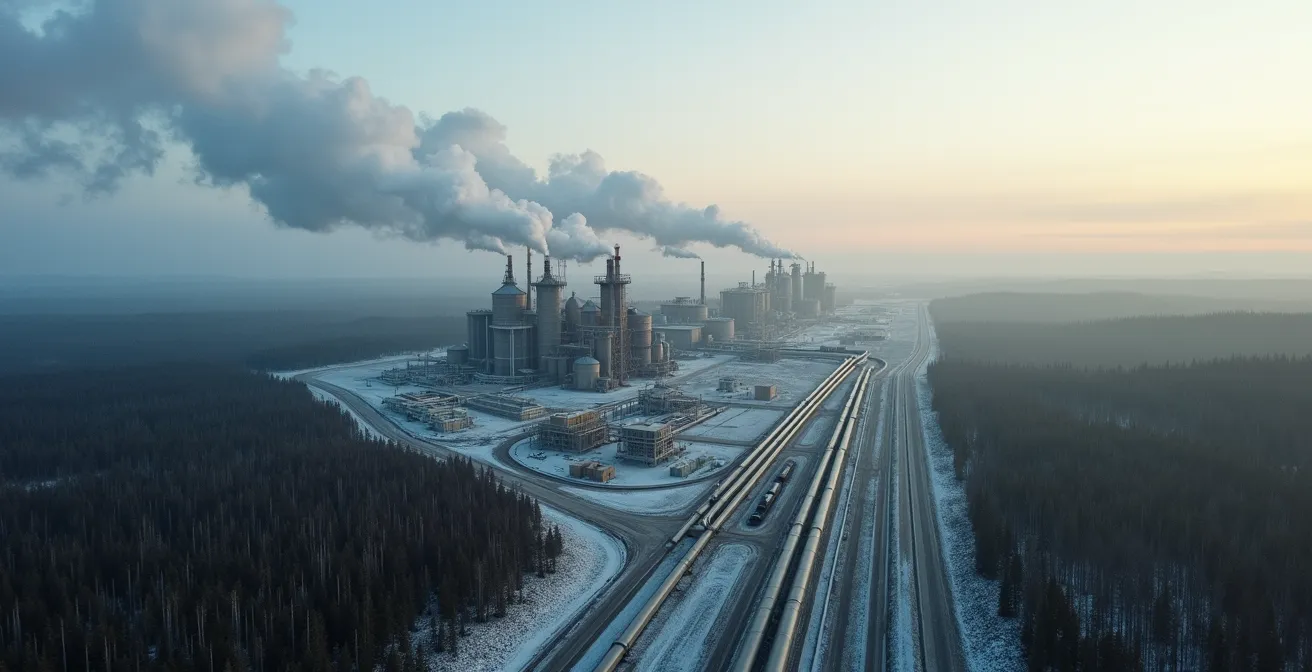
The image of an oil sands facility visualizes this energy intensity. The sprawling infrastructure of steam pipes, processing plants, and heavy machinery represents massive upfront and ongoing energy inputs. For investors, a declining EROI trend within a portfolio is a red flag indicating that the assets are working harder for diminishing returns. This biophysical inefficiency will eventually manifest as financial distress, often abruptly. A prudent risk management strategy must therefore involve tracking the EROI of underlying assets, not just their reported financial earnings, to anticipate this tipping point.
The EROI of global oil production is roughly 17 and declining, while that for the USA is 11 and declining; the EROI of ultra-deep-water oil and oil sands is below 10.
– Royal Society Publishing, Philosophical Transactions of the Royal Society A
Bridge Fuel or Dead End: Is Natural Gas Infrastructure Worth the 20-Year Investment?
Natural gas has long been promoted as a “bridge fuel”—a cleaner alternative to coal that can support the transition to a fully renewable grid. This narrative has justified massive capital expenditure in pipelines, LNG terminals, and gas-fired power plants, assets with typical lifespans of 20 to 40 years. For an investor, the critical question is whether this bridge leads to a sustainable future or is simply a pier to nowhere, creating a new wave of stranded assets.
From a biophysical perspective, the case is weakening. While historically boasting a very high EROI, natural gas extraction is also facing declining returns as conventional reserves are depleted. More importantly, the financial logic of these long-term investments is clashing with the accelerating pace of the energy transition. The payback period for a new gas pipeline often extends 20 years or more, yet climate targets and the falling cost of renewables plus storage could make that same pipeline obsolete in just 10-15 years. This is a classic case of infrastructure lock-in, where capital is tied up in assets whose economic life is cut short by technological and policy shifts.
The risk is not uniform across the fossil fuel complex, but natural gas infrastructure carries a unique vulnerability due to its long-term, inflexible nature. Unlike an oil field, whose production can be throttled, a pipeline represents a fixed, multi-decade bet on sustained demand.
The following table from Carbon Tracker provides a stark comparison of stranding risk across different fossil fuel assets, highlighting the medium-to-high risk facing natural gas infrastructure. For investors, this data challenges the prevailing “bridge fuel” story and underscores the need for a more skeptical assessment of long-duration carbon assets.
| Asset Type | Risk Level | Transition Timeline | Investment Implications |
|---|---|---|---|
| Coal Power Plants | Highest | 10-30 years early retirement | Most exposed to stranding |
| Natural Gas Infrastructure | Medium-High | 20-year payback at risk | Bridge fuel narrative questioned |
| Oil Refineries | Medium | Gradual decline post-2030 | $30 trillion fixed assets at risk |
This comparative framework, derived from analysis by Carbon Tracker, should be a cornerstone of any energy portfolio review, forcing a re-evaluation of assets previously considered safe “transition” plays.
The Policy Mistake of Subsidizing Consumption Instead of Transition
A significant factor distorting the energy market and masking true stranded asset risk is the pervasive use of government subsidies. Globally, these supports artificially inflate the profitability of fossil fuels, encouraging continued investment in assets that are fundamentally uneconomic from both a biophysical and climate perspective. The International Monetary Fund estimates global fossil fuel subsidies reached trillions of dollars, effectively creating a massive, publicly funded barrier to the energy transition.
For investors, these subsidies represent a dangerous illusion of stability. They are politically volatile and can be withdrawn with little notice, causing a sudden and severe re-pricing of the underlying assets. Worse, the vast majority of these funds subsidize consumption (e.g., by keeping fuel prices artificially low) rather than financing a strategic transition. This approach fails to build future capacity and instead doubles down on a system with declining EROI and rising external costs.
A prudent investor must look past the temporary cushion provided by subsidies and assess the asset’s viability in a non-subsidized, carbon-constrained world. The capital currently used to prop up failing business models could be redirected to de-risk the transition and create long-term value. Instead of subsidizing fuel consumption, governments and private capital could fund mechanisms that provide price stability for renewables or finance retraining programs for workers in legacy energy sectors. This strategic redirection of capital is not only more economically sound but also aligns with the fiduciary duty to manage long-term risk.
Action Plan: Shifting Capital from Subsidies to Strategic Transition
- Analyze Subsidy Exposure: Identify and quantify the reliance of portfolio assets on direct and indirect government subsidies to understand vulnerability to policy shifts.
- Advocate for Carbon Contracts for Difference (CCfDs): Support policies that de-risk renewable investments by guaranteeing a stable price, making them more attractive for institutional capital.
- Allocate to Just Transition Funds: Redirect capital toward initiatives that support worker retraining and community investment in regions moving away from fossil fuel extraction.
- Model Early Retirement Scenarios: Develop financial models that incorporate the costs and benefits of early retirement schemes for the most at-risk fossil fuel assets.
- Demand Transparent Disclosure: Push for mandatory corporate disclosure of stranded asset risks and the financial impact of subsidy removal.
When to Sell Fossil Fuel Stocks: Before or After Peak Demand?
The central timing question for any investor is when to divest. The conventional wisdom is to sell before “peak demand” for a commodity is reached. However, in the context of the energy transition, this approach may be too slow. Financial markets are forward-looking, and asset values will likely begin to erode well before global oil consumption actually peaks and begins to decline. The risk is not just a gradual price fall but a sudden, sharp de-rating as a new consensus forms around the terminal value of these assets.
The moment investors collectively realize that a significant portion of a company’s booked reserves will never be profitably extracted, the stock price will collapse. Waiting for official demand figures to confirm the peak means you are already too late. The prudent strategy is to identify and act on leading indicators—such as declining EROI, rising extraction costs, and the increasing economic competitiveness of alternatives. Selling *after* these indicators are clear but *before* the market fully prices them in is the key to preserving capital.

This decision is particularly acute for pension funds and individual investors who are heavily exposed. As highlighted in a landmark study in *Nature Climate Change*, the financial implications are enormous, with research calculating that global stranded assets exceed US$1 trillion under plausible climate policy scenarios. The time to act is when the risk is quantifiable, not when it has already materialized in the share price.
Most of the market risk falls on private investors, overwhelmingly in OECD countries, including substantial exposure through pension funds and financial markets.
– Semieniuk et al., Nature Climate Change
The Natural Gas Leakage Mistake That Negates the Benefits of “Bridge Fuels”
The “bridge fuel” narrative for natural gas rests on a key assumption: that it is significantly cleaner than coal. While it’s true that burning natural gas produces about half the CO2 of coal per unit of energy, this calculation omits a critical and often underestimated factor: methane leakage. Methane, the primary component of natural gas, is a potent greenhouse gas with a warming potential over 80 times that of CO2 over a 20-year period. Even a small leakage rate across the supply chain—from the wellhead to the power plant—can completely negate the supposed climate benefit of switching from coal to gas.
This “leakage mistake” transforms the risk profile of natural gas assets. What was sold as a climate-friendly transition investment is revealed to be a significant climate liability. For investors, this introduces a new layer of regulatory and reputational risk. As monitoring technology improves and public pressure mounts, companies with high leakage rates will face stringent regulations, potential fines, and shareholder backlash. An asset’s value could be impaired not by a carbon tax, but by a “methane fee” or mandatory infrastructure upgrades.
This hidden risk can also lead to perverse outcomes. The pressure to secure returns before an asset is stranded can create incentives to maximize short-term output at the expense of long-term maintenance and environmental integrity.
Case Study: The Paradox of Accelerated Emissions
Research published in Nature Communications examining power plants from 2009-2018 uncovered a counter-intuitive effect. In countries with high stranded asset risk, power plants actually increased their CO2 emissions. Operators, anticipating future devaluation, appeared to be running their plants harder to extract value while they still could. This behavior, driven by stranded asset risk itself, could lead the U.S. and Russia to burn through 16% and 12% of their respective carbon budgets in just ten years, paradoxically accelerating climate change and undermining the very transition investors are trying to navigate.
When to Decommission an Asset to Maximize Scrap Value vs Operational Revenue?
As the energy transition accelerates, asset owners face a critical decision: continue operating a carbon-intensive asset for diminishing returns, or decommission it to capture its scrap value and avoid future liabilities? This calculation is complicated by a unique feature of the oil and gas industry: the legal requirement to safely dismantle facilities at the end of their life. These non-negotiable costs are known as Asset Retirement Obligations (AROs) and represent a significant, often underestimated, liability on a company’s balance sheet.
The timing of decommissioning becomes a strategic play. Delaying the process allows the operator to eke out a few more years of operational revenue, but it also risks facing higher ARO costs in the future due to stricter environmental regulations or inflation. Furthermore, delaying the broader energy transition dramatically increases the total capital at risk. Research warns that delaying a global transition from 2020 to 2030 could inflate the value of stranded capital from $117 trillion to a staggering $557 trillion.
The optimal strategy involves a careful balancing act. The investor must model the net present value of future operational cash flows against the immediate proceeds from scrap metal and other materials, minus the looming ARO liability. In many cases, especially for older, less efficient plants with low EROI, early decommissioning may be the most financially prudent path. It allows the company to crystallize a known value, extinguish a growing liability, and redirect capital towards more productive, future-proof investments. Holding on too long in a declining market is a recipe for maximizing losses.
Unlike most sectors, oil and gas companies are legally obligated to decommission their assets in accordance with environmental standards at the end of their productive lives, and accountants call these liabilities ‘asset retirement obligations’ (AROs).
– Carbon Tracker Initiative, The Flip Side: Stranded Assets and Stranded Liabilities
Key Takeaways
- EROI Is a Primary Risk Indicator: The declining Energy Return on Investment (EROI) of fossil fuels is a more reliable leading indicator of stranding risk than short-term market prices or policy forecasts.
- The “Bridge Fuel” Is a Risky Bet: Long-lifespan natural gas infrastructure faces significant risk of becoming obsolete well before its payback period due to infrastructure lock-in and the hidden costs of methane leakage.
- Timing Divestment Is Proactive: The optimal time to sell fossil fuel assets is before market consensus forms, based on leading indicators like declining EROI, not after peak demand has already passed.
Retrofit or Demolish: What to Do With Carbon-Intensive Plants in a Net-Zero World?
For the owners of existing carbon-intensive assets, such as coal-fired power plants or oil refineries, the ultimate strategic question is whether to retrofit or demolish. A retrofit—for example, by adding carbon capture and storage (CCS) technology—is a capital-intensive bet on the asset’s extended life in a net-zero world. Demolition, or early retirement, is an admission that the asset’s economic life is over, crystallizing its terminal value and avoiding further operational losses and liabilities.
The decision hinges on a brutal economic calculation. As an MIT study found, the global net present value of untapped fossil fuel output that may have to remain in the ground ranges from $21.5 trillion to $30.6 trillion. This represents a colossal loss of potential value for asset owners. The temptation is to invest in life-extension technologies like CCS to try and capture some of that value. However, retrofitting is often prohibitively expensive and may itself have a poor EROI, potentially turning one stranded asset into an even larger one.
Coal-fired power plants are at the sharpest end of this dilemma. To meet climate targets, they would need to retire 10 to 30 years earlier than historical averages. This accelerated timeline makes the economics of a costly retrofit highly questionable. In many cases, the most prudent financial decision is to accept the sunk cost and proceed with a structured demolition and decommissioning plan. This strategy frees up capital, eliminates ongoing ARO liabilities, and allows the organization to focus its resources on business models aligned with the future energy economy.
The framework presented—prioritizing biophysical metrics like EROI and accounting for structural risks like infrastructure lock-in and AROs—provides a more robust foundation for navigating the energy transition. By moving beyond a reactive, policy-focused approach, investors can make proactive, data-driven decisions that protect long-term capital. The next logical step is to apply this lens to your own portfolio. A thorough review of your energy holdings based on these principles is no longer just prudent; it is an essential fiduciary duty.