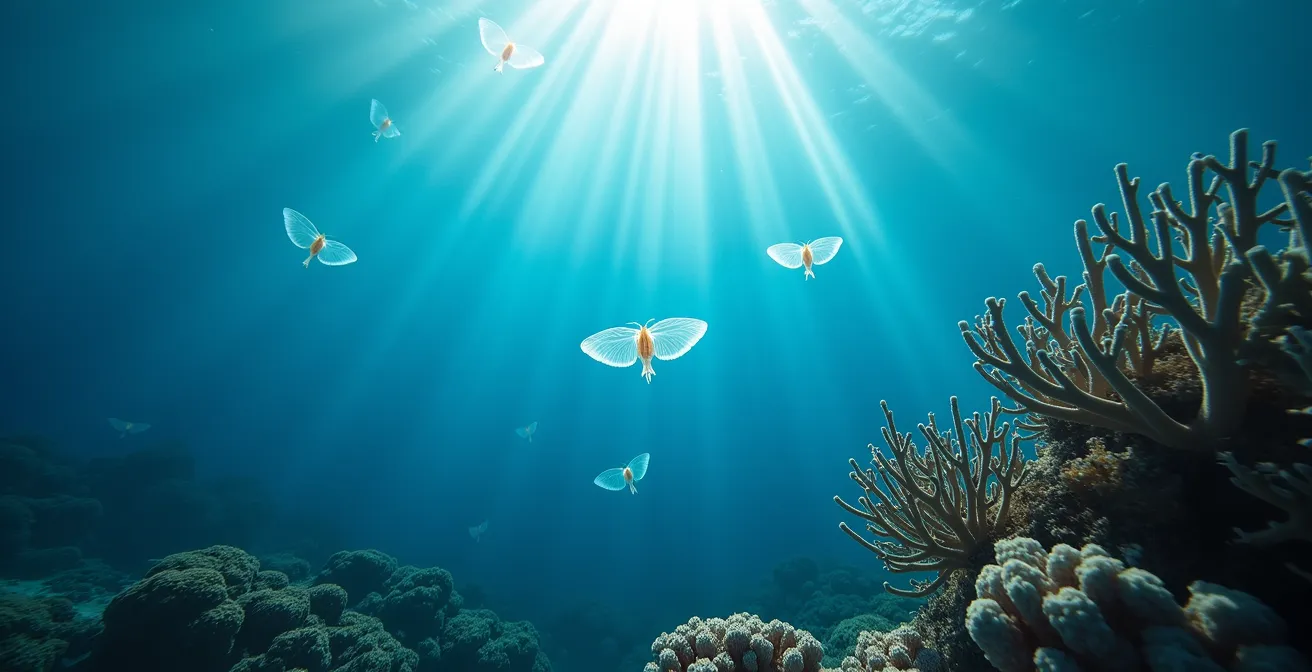
The escalating CO2 crisis is not just dissolving shells; it’s systematically dismantling the ocean’s food web by exploiting the hidden vulnerabilities of specific calcium carbonate structures.
- Aragonite-based lifeforms, which are significantly more soluble than calcite forms, are disproportionately at risk, creating a critical weak link in marine ecosystems.
- The collapse of foundational species like pteropods triggers a devastating domino effect, directly impacting the health and viability of commercial fisheries that depend on them.
Recommendation: Focus conservation efforts not just on iconic species, but on protecting the structural and ecological integrity of their entire habitat, from deep-sea coral mounds to coastal nurseries.
As a marine biodiversity expert, I am frequently confronted with the visible symptoms of a sick ocean: bleached corals, thinning mussel beds, and struggling oyster farms. The common narrative correctly identifies the culprit—ocean acidification driven by atmospheric carbon dioxide—but it often misses the insidious and far more dangerous reality. The issue is not merely that shells are dissolving. The true crisis lies in a fundamental, structural flaw being exploited by our changing ocean chemistry, leading to a silent, cascading trophic failure that threatens to unravel the entire marine food web from the bottom up.
We’ve moved beyond the simple equation of CO2 plus water equals carbonic acid. We must now analyze the crisis through the lens of differential vulnerability. It’s about understanding why some organisms are buckling under pressure while others temporarily hold on. It involves appreciating the immense bio-energetic cost that shell-building animals pay just to maintain their structural integrity, diverting precious energy from growth and reproduction. This is not a uniform, slow-motion disaster; it is a targeted dismantling of the ocean’s most critical pillars.
This article will deconstruct that process. We will move past the surface-level chemistry to explore the specific vulnerabilities of different shell structures. We will follow the chain of devastation from microscopic plankton to commercially vital fish populations, and connect the health of deep-sea ecosystems to the coastal nurseries that sustain our global fishing industry. The goal is to shift our perspective from simply saving species to protecting the fundamental ecological mechanics that allow them to exist in the first place.
To fully grasp the scale of this ecological challenge, it is essential to explore its distinct facets. The following sections break down the core chemical processes, the specific biological impacts on key species and ecosystems, and the critical link between these natural habitats and the global economy. This structured approach will provide a comprehensive understanding of why calcifying organisms are the unfortunate sentinels of a high-CO2 world.
Summary: The Unseen Collapse: Why Calcifiers Are the Ocean’s Canaries
- Why Does Absorbing CO2 Lower Ocean pH and Deplete Carbonate Ions?
- Aragonite or Calcite: Which Shell Structure Dissolves Faster in Acidic Water?
- How to Identify Shell Dissolution Signs in Juvenile Mussels?
- Why Are “Sea Butterflies” Essential for Feeding Salmon Populations?
- The Deep-Sea Risk: Why Cold Water Corals Are More Vulnerable Than Tropical Ones
- Why Do 75% of Commercial Fish Species Spend Their Youth in Estuaries?
- Why Protecting Mangrove Nurseries Is Critical for the Global Fishing Industry?
- How to Select Oyster Strains Resistant to Lower pH Levels?
Why Does Absorbing CO2 Lower Ocean pH and Deplete Carbonate Ions?
The fundamental chemistry driving ocean acidification is a direct consequence of the ocean’s role as a massive carbon sink. Since the Industrial Revolution, the ocean has been a steadfast ally in mitigating climate change, but this service comes at a steep price. According to NOAA, the ocean absorbs about 30 percent of atmospheric CO2 released by human activities. When CO2 dissolves in seawater, it undergoes a series of chemical reactions. The first product is carbonic acid (H2CO3), a weak acid that is inherently unstable. It quickly dissociates, releasing hydrogen ions (H+).
An increase in hydrogen ions is the very definition of increased acidity, which is measured by a decrease in pH. As NOAA experts explain, this is a logarithmic scale, meaning small numerical changes represent massive shifts in chemistry. The seemingly minor drop of 0.1 pH units observed so far is significant, as noted in their educational materials.
The pH scale is logarithmic, so this change represents approximately a 30 percent increase in acidity
– NOAA, Ocean Acidification Facts
This initial reaction is only half of the problem. These newly freed hydrogen ions have a strong affinity for carbonate ions (CO3²⁻), which are the essential building blocks for calcifying organisms. The hydrogen ions effectively “steal” the carbonate, bonding with it to form bicarbonate (HCO3⁻). While bicarbonate is plentiful, it is not the form that corals, mussels, or plankton can use to build their shells and skeletons. Therefore, as CO2 levels rise, not only does the water become more corrosive due to increased H+ ions, but the raw material for shell construction—carbonate ions—becomes increasingly scarce. This dual-pronged attack starves calcifiers of their building materials while actively dissolving their existing structures.
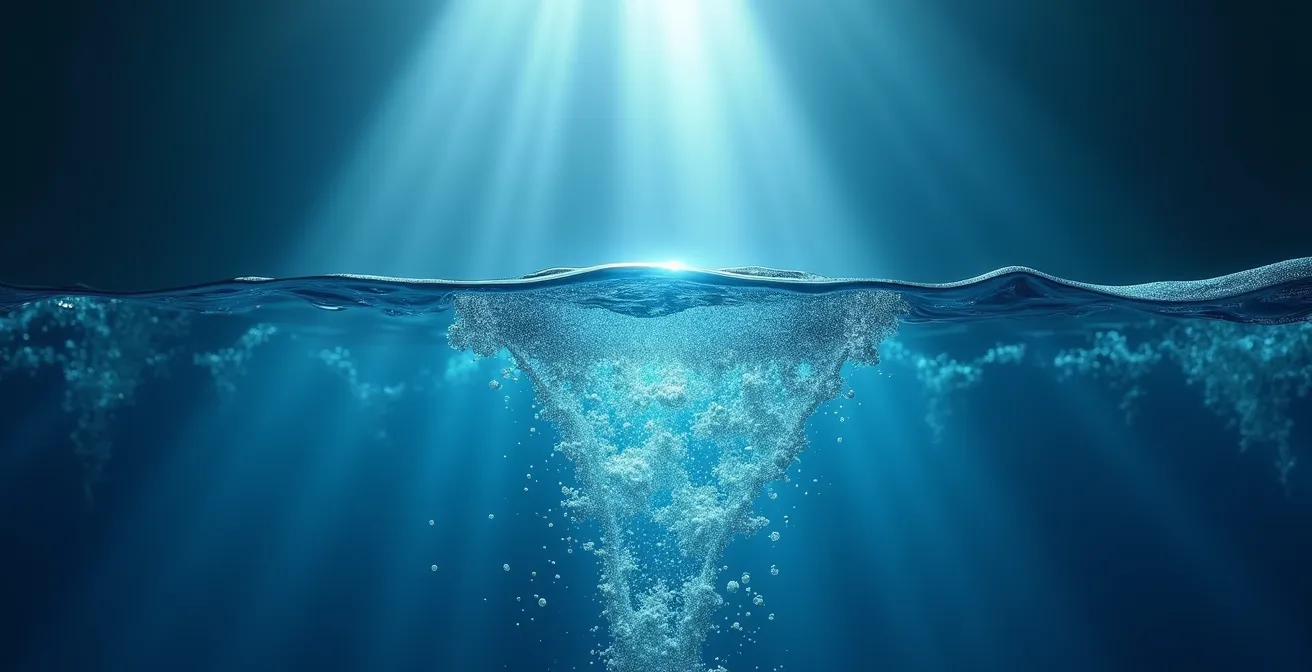
This visualization helps conceptualize the process: as CO2 enters the water, the available carbonate ions, essential for marine life, are chemically converted and locked away. This depletion creates what are known as “undersaturated” conditions, where there are not enough free carbonate ions to support shell growth, forcing organisms to expend more energy to calcify—if they can at all. For many, it’s a losing battle against fundamental chemistry.
Aragonite or Calcite: Which Shell Structure Dissolves Faster in Acidic Water?
Not all calcium carbonate is created equal. This is a critical distinction that explains the differential vulnerability we observe among marine species. Organisms build their shells and skeletons using one of two main crystalline forms of calcium carbonate: calcite or aragonite. While chemically identical (CaCO3), their crystal structures differ, which profoundly impacts their stability in acidic water. Aragonite possesses a less stable crystal lattice, making it significantly more susceptible to dissolution. According to the Smithsonian Ocean Portal, aragonite is 50 percent more soluble than calcite.
This single fact has monumental implications for marine biodiversity. Many of the ocean’s most ecologically critical organisms rely on aragonite. For example, the delicate, wing-like shells of pteropods (“sea butterflies”) are made of aragonite. The intricate, branching structures of most reef-building corals, both tropical and cold-water, are also aragonite-based. These organisms form the foundation of vast ecosystems, and their structural integrity is directly tied to this less stable form of calcium carbonate. As the ocean’s pH drops, the water becomes undersaturated with respect to aragonite first, meaning aragonite-shelled organisms are the first to struggle to build and maintain their structures.
Conversely, some organisms like coccolithophores (a type of phytoplankton) and foraminifera use the more stable calcite form. While they are still vulnerable to acidification, they have a higher tolerance threshold. The situation is further complicated by the presence of magnesium in the calcite, as some organisms incorporate it into their shells. High-magnesium calcite, often found in coralline algae, can be even more soluble than aragonite, adding another layer of complexity to predicting species’ fates. This concept of structural integrity is paramount; the specific material an organism uses is a primary determinant of its survival in a high-CO2 world.
How to Identify Shell Dissolution Signs in Juvenile Mussels?
The impact of ocean acidification is not always a dramatic, instantaneous crumbling of shells. More often, it is a slow, insidious process of erosion that weakens the organism over time, and these effects are most pronounced in the earliest life stages. Juvenile mussels are particularly vulnerable because they must allocate a tremendous amount of energy to building their initial shell. In a low-pH environment, this process becomes a costly uphill battle. Identifying the signs of dissolution requires looking closely, often at a microscopic level.
On the surface, a juvenile mussel under stress may appear smaller or have a thinner, more translucent shell. However, the true damage is revealed under magnification. Instead of a smooth, uniform surface, the shell will exhibit pitting and etching. These are areas where the acidic water has begun to dissolve the calcium carbonate crystals. The periostracum, a protective organic outer layer, may also appear frayed or peeled back, exposing the vulnerable mineral layers underneath. In severe cases, the shell’s prismatic layer, which provides its strength, becomes chalky and brittle. This is a clear sign that the bio-energetic cost of maintaining the shell is exceeding the organism’s capacity.
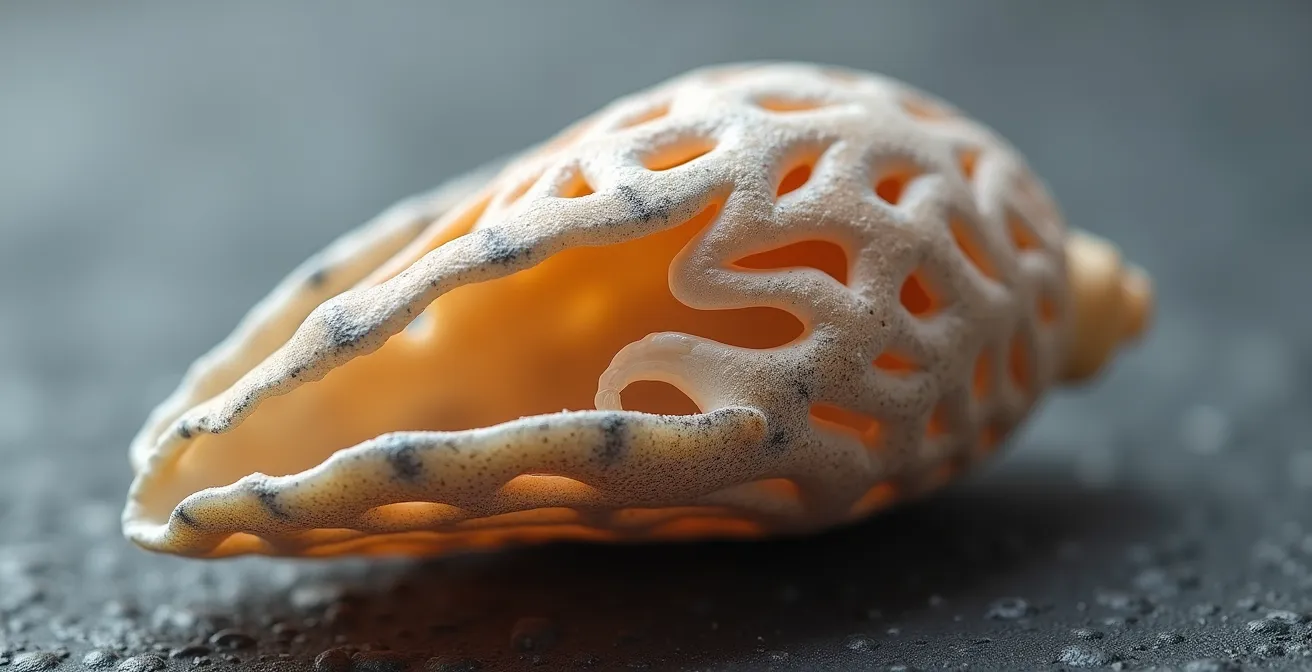
As this magnified image of a juvenile mussel shell shows, the dissolution patterns are not uniform. They appear as microscopic pits and fractures that compromise the shell’s structural integrity long before it collapses entirely. This damage forces the mussel to divert energy from growth and reproduction simply to conduct repairs. This trade-off is a death sentence by a thousand cuts: the organism may survive for a time, but it will be smaller, weaker, and less likely to reproduce, leading to population decline. For marine biologists and aquaculturists, monitoring for these subtle signs of pitting and delamination in juvenile populations is a critical early warning system for a habitat in distress.
Why Are “Sea Butterflies” Essential for Feeding Salmon Populations?
The term “sea butterfly” is a delicate name for a group of free-swimming snails known as pteropods, but their role in the marine food web is anything but fragile. These tiny creatures are a cornerstone species, particularly in the cold, nutrient-rich waters of the North Pacific. They are a primary food source for a variety of commercially and ecologically important animals, most notably juvenile salmon. For some salmon populations, pteropods are not just a snack; they are the main course. Research has shown that pteropods can constitute up to 60 percent of the diet of juvenile pink salmon.
This heavy reliance creates a terrifyingly direct link between ocean acidification and the health of the entire North Pacific fishing industry. Pteropods, with their delicate aragonite shells, are among the most vulnerable organisms to falling pH levels. As their shells begin to dissolve in more corrosive waters, their populations plummet. This is not a future problem; scientists are already observing widespread dissolution in pteropod populations in the wild. For the salmon that depend on them, this is a nutritional catastrophe. The result is a classic example of a cascading trophic failure, where the collapse of a foundational species triggers a crisis further up the food chain.
Case Study: The Direct Link Between Pteropod Decline and Salmon Health
The connection between these two species is not theoretical. A 2009 study from the University of Alaska Fairbanks modeled the devastating impact of pteropod loss on pink salmon. The research projected that a mere 10 percent decline in the availability of pteropods would lead to a staggering 20 percent decline in the body weight of juvenile pink salmon. This highlights the critical nutritional dependency. Smaller, weaker salmon are less likely to survive their journey to the open ocean, evade predators, and eventually return to spawn. This demonstrates how a chemical problem—ocean acidification—translates directly into a biological and economic crisis, threatening one of the world’s most valuable fisheries.
Protecting salmon, therefore, is not just about managing fishing quotas or preserving their spawning rivers. It now fundamentally requires protecting their food source from chemical annihilation. The fate of the mighty salmon is inextricably tied to the survival of the fragile sea butterfly.
The Deep-Sea Risk: Why Cold Water Corals Are More Vulnerable Than Tropical Ones
When we think of corals, we often picture the sun-drenched tropical reefs. However, some of the world’s most ancient and diverse coral ecosystems exist in the cold, dark depths of the ocean. These deep-sea corals are architects of essential fish habitat, creating complex structures that shelter countless species. Paradoxically, these cold-water ecosystems are at even greater risk from ocean acidification than their tropical counterparts. The reason is twofold: chemistry and biology. CO2 is more soluble in cold water, meaning the effects of acidification are more pronounced at depth and in colder regions. This creates a more corrosive environment from the outset.
Furthermore, the waters in the deep sea are naturally less saturated with the aragonite that these corals need to build their skeletons. The “aragonite saturation horizon”—the depth below which aragonite naturally dissolves—is rising towards the surface at an alarming rate. This means many deep-sea coral habitats will soon be in water that is chemically incapable of supporting their growth. Projections from organizations like Oceana are stark, suggesting that even a modest 20 percent increase above current CO2 levels could significantly reduce coral calcification rates, stunting their growth and making them more brittle.
This chemical threat is magnified by their life history. Unlike fast-growing tropical corals, deep-sea corals are defined by their extreme longevity and slow growth. This makes their recovery from any damage painstakingly slow, a fact highlighted by deep-sea research.
Case Study: The Irreversible Timescale of Deep-Sea Coral Loss
Research published in Frontiers in Marine Science emphasizes the unique vulnerability of deep-sea coral populations. Many of these corals live for centuries, with some species of black coral (Antipatharians) documented to be thousands of years old. Their growth is incredibly slow, and their reproductive turnover rates are minimal. This means that once a deep-sea coral garden is damaged or destroyed—whether by bottom trawling or the corrosive effects of acidification—its recovery is not measured in years or decades, but in centuries or millennia. This makes the threat of ocean acidification a potentially permanent one for these ancient habitats, erasing millennia of biological history on a human timescale.
The combination of more aggressive water chemistry and extremely slow biological recovery places these vital deep-sea ecosystems on the front line of the acidification crisis. Their loss represents an irreversible blow to marine biodiversity.
Why Do 75% of Commercial Fish Species Spend Their Youth in Estuaries?
Estuaries—the brackish-water zones where rivers meet the sea—are the unsung heroes of our oceans. These habitats are often referred to as “nurseries of the sea,” and for good reason. They provide a unique combination of benefits that make them ideal for the juvenile stages of many marine species, including the majority of commercially important fish and shellfish. The number of species that rely on these nurseries is astonishing; in the United States, for example, NOAA Fisheries data shows that estuaries provide habitat for 68 percent of U.S. commercial fish catch by value.
So, what makes these habitats so critical? First, they offer protection from predators. The shallow waters, complex root systems of mangroves, and dense seagrass beds provide abundant hiding places for small, vulnerable fish that would be easily preyed upon in the open ocean. Second, estuaries are incredibly rich in nutrients. The mixing of freshwater and saltwater, combined with nutrient runoff from land, fuels high levels of primary productivity, creating a veritable buffet of plankton and small invertebrates for young fish to feed on. This allows for rapid growth during their most critical life stage.
Finally, the variable salinity of estuaries provides a unique environment that many open-ocean predators cannot tolerate, further enhancing their function as a safe haven. Species like shrimp, flounder, menhaden, and blue crabs all spend crucial parts of their life cycle in these nursery sanctuaries. However, because they are at the interface of land and sea, estuaries are also on the front lines of anthropogenic stress, including pollution, coastal development, and, critically, ocean acidification, which threatens the very shellfish and other calcifiers that form the base of the estuarine food web.
Key takeaways
- Ocean acidification is a dual threat, making water corrosive while also depleting the essential carbonate ions needed for shell-building.
- Organisms using aragonite (like corals and pteropods) are the most vulnerable due to its higher solubility, making them the first casualties.
- The collapse of foundational species like pteropods triggers a trophic cascade, directly impacting the health and size of commercial fish like salmon.
Why Protecting Mangrove Nurseries Is Critical for the Global Fishing Industry?
Mangrove forests, which fringe the coastlines of tropical and subtropical estuaries, represent one of the most critical components of these “nursery of the sea” ecosystems. Their tangled, submerged root systems create a complex, three-dimensional habitat that is a perfect sanctuary for juvenile fish, crustaceans, and mollusks. These mangroves are not just passive shelters; they are productive ecosystems that directly fuel the global fishing industry. By providing both food and refuge, they dramatically increase the survival rates of young marine life, effectively serving as the recruitment engine for many offshore commercial and recreational fisheries.
The economic value tied to these nurseries is immense. A healthy mangrove ecosystem supports an entire chain of economic activity, from local artisanal fishers to large-scale commercial operations. The degradation of these habitats has immediate and severe consequences. When mangroves are cleared for coastal development or aquaculture, the nursery function is lost. Juvenile fish populations crash, and the ripple effect is felt by fishing fleets miles offshore. This makes the protection of mangrove nurseries not an act of environmental charity, but a matter of profound economic prudence. The link between habitat health and economic output is direct, as demonstrated by the economic activity generated in healthy estuarine regions, which, according to Fly Life Magazine, can be substantial, with visitors alone generating billions in revenue.
Case Study: The Multiplier Effect of Wetland Restoration
The economic benefits of protecting these nursery habitats are not just theoretical. A NOAA-led wetlands restoration project in California provides a powerful example of the return on investment. The project, which cost $3.5 million to restore a crucial estuarine wetland, resulted in an estimated increase of $36.3 million in local residential property values. While this metric measures property value, it serves as a proxy for the broader economic uplift associated with a healthy, functional, and aesthetically pleasing coastal environment, which includes robust fisheries, tourism, and recreation. It proves that investing in the ecological infrastructure of our oceans provides returns that far exceed the initial cost, reinforcing the argument that habitat protection is a cornerstone of a sustainable blue economy.
Ultimately, the stability of a significant portion of the global fishing industry depends on the health of a few square miles of coastal mangrove forest. Protecting these nursery sanctuaries is one of the most effective long-term strategies for ensuring sustainable fisheries for generations to come.
How to Select Oyster Strains Resistant to Lower pH Levels?
While the broader picture of ocean acidification is grim, the field of marine science is actively pursuing strategies for mitigation and adaptation. For the aquaculture industry, particularly oyster farming which has been devastated by acidification events, one of the most promising avenues is selective breeding. Not all oysters are equally susceptible to low-pH conditions. Natural genetic variation within populations means that some individuals and family lines exhibit higher resilience. The challenge lies in identifying and propagating these robust strains to build a more climate-ready aquaculture stock.
This selection process is a highly scientific endeavor, not simply a matter of picking the survivors of an acidification event. It involves controlled laboratory experiments to systematically assess the performance of different oyster strains under various pH levels. Scientists measure key traits such as larval survival, calcification rates, and growth speed to identify the most resilient genetic lines. The goal is to find oysters that can thrive, not just survive, in the more acidic waters of the future. It’s a proactive approach that accepts the reality of changing ocean chemistry and seeks to work within it.
This process, however, is complex and requires careful consideration of potential trade-offs. For instance, a strain that shows high tolerance to low pH might have a slower growth rate or be more susceptible to disease. A holistic approach is necessary to ensure that the selected strains are not only resilient but also commercially viable. The following plan outlines the key scientific steps involved in this critical selection process.
Your Action Plan: Key Selection Criteria for pH-Resistant Oyster Strains
- Measure Sensitivity Thresholds: Begin by establishing baseline sensitivity. Use logistic regression to measure species-specific median effective concentrations (pH50, the pH at which 50% of the population is affected) for key life stages like reproduction and growth.
- Assess Species Fraction: Develop species sensitivity distributions (SSDs). This allows you to estimate the potentially affected fraction (PAF) of species in a given community at different pH levels, providing a broader risk assessment.
- Compare Life Stage Responses: Test for differential sensitivity. It’s common for growth responses to be less sensitive than reproductive responses. For example, a study might find a mean pH10 (10% affected) of 7.73 for growth versus 7.63 for reproduction.
- Evaluate Variability: Acknowledge that sensitivity varies not just between species, but across different life processes within a single species. An oyster might successfully reproduce but fail to grow, or vice-versa. A comprehensive evaluation is crucial.
- Consider Biological Trade-offs: Finally, evaluate the costs of resistance. Enhanced pH tolerance may come at the expense of other important traits like growth rate, meat quality, or disease resistance. Select for a balanced profile that ensures overall fitness and commercial viability.
By systematically applying these criteria, the aquaculture industry can shift from a reactive to a proactive stance, building resilience from the genetic level up. This represents a tangible step towards adapting our vital seafood systems to the unavoidable realities of a high-CO2 world.
Protecting the future of our oceans requires a paradigm shift. We must move beyond species-specific conservation and embrace a holistic approach focused on preserving the foundational habitats and chemical balances that support all marine life. Advocating for policies that reduce CO2 emissions while simultaneously investing in the restoration and protection of critical nurseries like mangroves and estuaries is the only viable path forward.