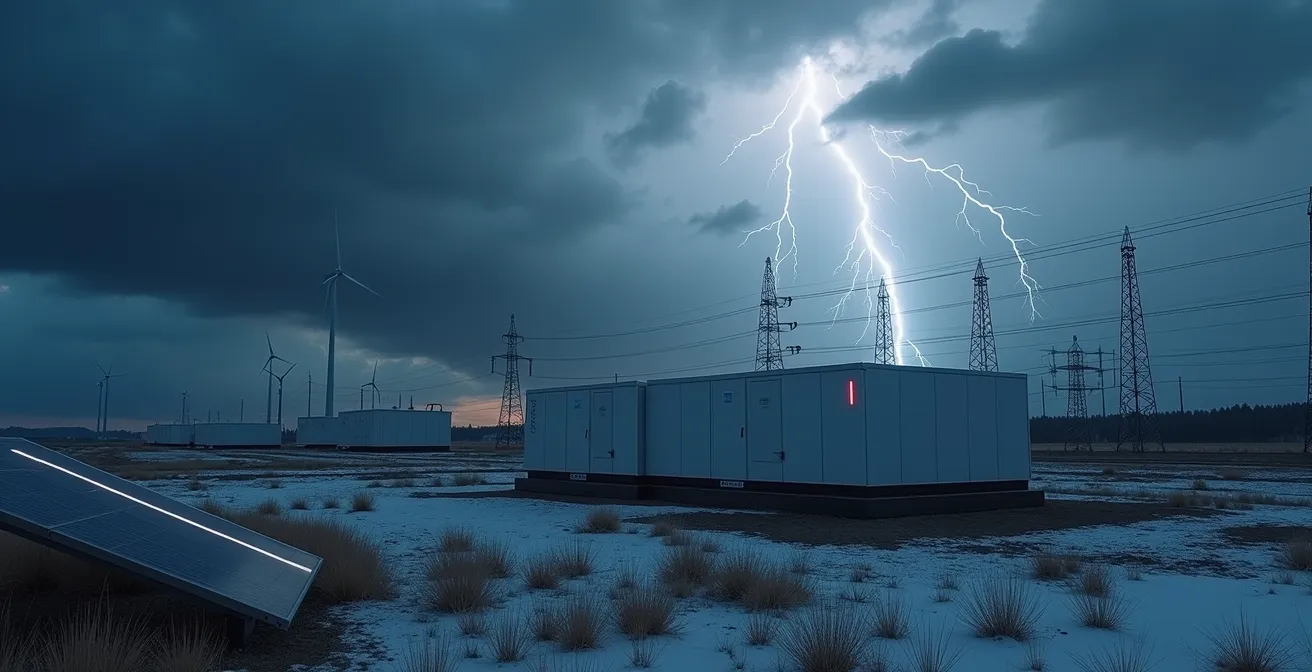
Decentralized energy storage is no longer just backup power; it’s a strategic community asset essential for surviving extreme weather events.
- Centralized grids are inherently vulnerable to cascading failures, whereas distributed microgrids offer contained, localized resilience.
- The decision is not just about having batteries, but about making critical operational trade-offs between technology (V2G vs. dedicated), safety protocols, and economic models.
Recommendation: Municipal planners must shift from a reactive mindset to proactively developing a strategic plan that integrates these distributed energy resources to ensure community safety and grid stability.
As extreme weather events become more frequent and intense, the vulnerability of our centralized power grid is no longer a hypothetical risk—it’s a recurring crisis. For community leaders and emergency planners, the standard advice to “get a backup generator” or “install batteries” feels dangerously simplistic. It addresses a symptom—the blackout—but ignores the root cause: a fragile, top-down infrastructure prone to widespread, cascading failures. The conversation about energy resilience has been stuck on individual survival, focusing on keeping the lights on in one house while the rest of the community goes dark.
But what if the true solution isn’t just about surviving an outage, but preventing the grid from collapsing in the first place? The key lies in a paradigm shift: viewing distributed energy storage not as a collection of individual lifeboats, but as an interconnected fleet of strategic resilience assets. This approach moves beyond simple backup power and reframes every home battery and electric vehicle as an active node capable of supporting the entire grid. To achieve this, however, planners must navigate complex operational trade-offs involving technology choices, non-negotiable safety standards, and sophisticated economic models that can fund the very infrastructure designed to protect us.
This article provides a framework for that strategic thinking. We will dissect the physical limitations of batteries, provide tools for accurate energy planning, evaluate the core technology choices, and address the critical safety and cybersecurity concerns. Ultimately, we will explore how to transform a defensive cost into a self-sustaining system that ensures true community-wide resilience.
This guide breaks down the essential considerations for integrating decentralized storage into a robust community resilience plan. Explore each section to build a comprehensive strategy.
Summary: A Planner’s Guide to Decentralized Energy for Grid Resilience
- Why Do Lithium-Ion Batteries Lose Capacity in Extreme Cold?
- Why Is Replicating the Energy Density of Oil So Difficult for Batteries?
- How to Calculate the kWh Needed to Power a Fridge and Heating for 3 Days?
- Powerwall vs V2G Car: Which Is the Cheaper Backup Solution for Families?
- The Ventilation Mistake That Creates Fire Hazards in Garage Battery Setups
- Top-Down Grid vs Microgrid Clusters: Which Is More Resilient to Cyberattacks?
- How Smart Grids Reduce Energy Waste by 15% Through Real-Time Load Balancing?
- When to Sell Stored Energy Back to the Grid for Maximum Profit?
Why Do Lithium-Ion Batteries Lose Capacity in Extreme Cold?
The first reality every emergency planner must confront is that batteries are not infallible. Their performance is fundamentally tied to chemistry, which is highly sensitive to temperature. For lithium-ion batteries, the workhorse of modern energy storage, extreme cold is a significant adversary. As temperatures drop, the electrochemical reactions that allow the battery to charge and discharge slow down dramatically. The electrolyte inside the battery becomes more viscous, increasing internal resistance and impeding the flow of lithium ions between the anode and cathode.
This isn’t a minor inconvenience; it’s a critical planning parameter. As a technical guide from Wiltson New Energy Technology notes, “Most lithium batteries are rated at 25°C. When operated at 0°C, –10°C, or –20°C, reaction efficiency can drop by 30–70% depending on the chemistry.” This means a fully charged battery system might only deliver a fraction of its expected power when it’s needed most—during a winter storm. This phenomenon is well-documented; a recent study confirmed that EVs experienced a significant drop in efficiency as temperatures decreased, directly impacting their available range and, by extension, their capacity for V2G support.
Real-world examples from extreme environments underscore this vulnerability. During a scientific expedition across the Antarctic Plateau, where temperatures are persistently sub-zero, four lithium-ion batteries showed not only a 5% capacity fade but also a 30% increase in internal resistance. For a community relying on these assets during a blizzard, factoring in this temperature-induced degradation is not just wise—it’s essential for accurate resilience planning.
Why Is Replicating the Energy Density of Oil So Difficult for Batteries?
The second fundamental constraint for planners is energy density. Fossil fuels like gasoline and diesel pack an immense amount of energy into a small volume and weight, a feat that electrochemical storage has yet to match. A gallon of gasoline contains approximately 33.7 kWh of energy. To store the same amount of energy, a modern lithium-ion battery pack would weigh over 500 pounds. This disparity is rooted in basic chemistry: burning hydrocarbons is a highly efficient, one-way chemical reaction that releases massive energy, whereas batteries must store energy in a stable, reversible electrochemical process.
This challenge of energy density directly impacts the scale, cost, and footprint of any meaningful battery storage project. While a fuel tank can be refilled in minutes, recharging a large battery bank can take hours. This means that for a prolonged outage, the initial stored capacity (kWh) is all a community has until power is restored. It highlights why “just getting more batteries” is an oversimplification; the physical space and capital investment required to match the energy reserves of traditional fuel are immense.
However, the field is rapidly advancing. New chemistries are emerging that promise better performance in challenging conditions. For instance, recent research on sodium-ion batteries has shown remarkable potential for cold-weather applications. Pouch cells demonstrated a specific energy of 74 Wh/kg at –25°C and could even retain usable capacity at an astonishing –100°C. While still far from the density of oil, these innovations show a pathway toward more robust and resilient storage solutions specifically designed for the extreme weather events that challenge today’s technology.
How to Calculate the kWh Needed to Power a Fridge and Heating for 3 Days?
With a clear understanding of battery limitations, the next step is practical application: quantifying your community’s critical needs. A “back-of-the-napkin” calculation is insufficient for emergency planning. A resilience-focused calculation must account for real-world variables, including initial power surges, weather volatility, and system inefficiencies. To power critical loads like refrigeration and heating for a 72-hour period, a systematic approach is required.
First, identify the baseline consumption. A typical refrigerator runs at 150-200 watts, but its compressor requires a significant “inrush current” to start, often 3-5 times its running wattage. Heating systems are far more demanding, ranging from 500W for a gas furnace blower to over 5,000W for electric resistance heat. Next, you must add a variability buffer. A 25% buffer is a prudent minimum to account for colder-than-forecast temperatures that increase heating cycles. Finally, factor in system inefficiencies. The process of converting DC power from the battery to AC power for your appliances will result in 10-15% energy loss. This systematic approach ensures you are planning for a realistic worst-case scenario, not an idealized best-case one.
The choice of heating technology is often the single largest variable in these calculations, as shown by comparative data from the U.S. Department of Energy. A home with a gas furnace (which only needs power for its fan) has a drastically lower energy burden than one with electric resistance heating.
| Heating Type | Average Power Draw | 3-Day kWh (Normal) | 3-Day kWh (Extreme Cold) |
|---|---|---|---|
| Heat Pump (COP 3.0) | 1-2 kW | 72-144 kWh | 108-216 kWh |
| Electric Resistance | 3-5 kW | 216-360 kWh | 270-450 kWh |
| Gas Furnace (w/ blower) | 0.5-1 kW | 36-72 kWh | 45-90 kWh |
This data makes it clear that a “one-size-fits-all” battery recommendation is unworkable. A community-level plan must segment energy needs based on the housing stock’s infrastructure.
Powerwall vs V2G Car: Which Is the Cheaper Backup Solution for Families?
Once energy needs are quantified, planners face a key strategic choice: should the community incentivize dedicated home batteries (like a Tesla Powerwall) or leverage existing assets through Vehicle-to-Grid (V2G) technology? From a purely financial perspective for a family that already owns an EV, V2G is often the cheaper initial option, as it utilizes the car’s large battery (typically 60-100 kWh) that has already been purchased. It avoids the high cost of a separate, dedicated battery system.

However, for a municipal planner, the decision is more complex. A dedicated battery is a permanent, stationary asset. It’s always available, fully charged, and ready for an outage. A V2G solution, on the other hand, depends on the vehicle being present, sufficiently charged, and connected. What if a family evacuates? What if the car is at a workplace when the outage hits? This introduces a significant reliability variable into the community’s resilience posture. The trade-off is between the lower cost and higher capacity of V2G and the higher reliability of a dedicated system.
The true potential of these systems emerges when they are viewed not just as backup, but as active grid-support assets. During the 2021 Texas Winter Storm Uri, this concept was proven at scale. As traditional power plants failed in the freezing temperatures, FlexGen-powered battery storage sites achieved 99.7% uptime, powering nearly 26,000 homes and generating millions in revenue by selling power to the crippled grid. This demonstrates that a well-orchestrated network of distributed batteries—whether stationary or mobile—can create a powerful, revenue-generating resilience infrastructure that benefits the entire community.
The Ventilation Mistake That Creates Fire Hazards in Garage Battery Setups
As communities encourage the adoption of energy storage, planners have a non-negotiable duty to educate residents on safe installation and operation. The most common location for a home battery system—the garage—is also one of the riskiest if proper protocols are not followed. The single most dangerous mistake is inadequate ventilation. Under certain fault conditions, some batteries can off-gas hydrogen, an odorless and highly flammable gas. In a poorly ventilated, enclosed space, this gas can accumulate and reach its lower flammable limit of 4% concentration in the air, creating a serious explosion risk.
The other primary hazard is thermal runaway. This occurs when a single battery cell overheats, creating a chain reaction that spreads to adjacent cells. Without proper safety mechanisms, this cascading failure can lead to an intense fire that is notoriously difficult to extinguish. As EticaAG highlights in their safety report, this is a primary concern in the industry:
Lithium-ion battery fires have raised real concerns about energy storage safety. EticaAG addressed this with LiquidShield™ technology using fire-retardant, non-toxic liquid to fully submerge battery cells, eliminating the risk of fire spreading from cell to cell.
– EticaAG, Microgrids and Battery Energy Storage Safety Report
A robust safety plan relies on a “hierarchy of controls.” The first line of defense is the Battery Management System (BMS), which monitors cell health and can automatically disconnect the system. The second is proper ventilation to manage both heat and potential gas buildup. The third is physical design, ensuring adequate spacing between modules to prevent thermal runaway from propagating. For community leaders, establishing clear installation codes and inspection protocols based on these principles is not optional—it’s a fundamental responsibility.
Top-Down Grid vs Microgrid Clusters: Which Is More Resilient to Cyberattacks?
Beyond physical threats like weather, a modern resilience plan must also account for cyber threats. Here, the architectural choice between a traditional, top-down grid and a network of decentralized microgrids presents a clear trade-off. The centralized grid has a smaller, more concentrated “attack surface,” but the impact of a successful breach can be catastrophic, leading to cascading failures and regional blackouts that take days or weeks to resolve.
In contrast, a system of interconnected microgrid clusters presents a larger, more distributed attack surface. However, its greatest strength is its ability to “island” itself from the main grid. If one microgrid is compromised, it can be isolated, containing the failure to a localized area (e.g., a neighborhood or a hospital campus) while the rest of the network continues to function. This dramatically reduces the potential for cascading blackouts and allows for much faster recovery times. As Hamidreza Nazaripouya stated in the IEEE Smart Grid Bulletin, this capability is a game-changer:
During unusual grid events, like extreme weather or cyber-physical attacks, a network of energy storage units can improve grid resilience by restoring load and energizing the grid, optimizing energy resource utilization, and maintaining supply-demand balance.
– Hamidreza Nazaripouya, IEEE Smart Grid Bulletin
This architectural choice is summarized in the following comparison, which highlights the inherent resilience of a decentralized model.
This comparative analysis from IEEE clearly shows the trade-offs.
| Aspect | Centralized Grid | Microgrid Clusters |
|---|---|---|
| Attack Surface | Smaller, concentrated | Larger, distributed |
| Failure Impact | Cascading regional blackouts | Localized, contained failures |
| Recovery Time | Days to weeks | Hours to days |
| Software Diversity | Standardized, tested | Varied vendors, potential vulnerabilities |
| Islanding Capability | Limited | High – can disconnect and operate independently |
For planners, the conclusion is clear: while no system is immune, a microgrid architecture offers a fundamentally more robust defense against the kind of systemic collapse that a successful cyberattack on a centralized grid could trigger.
Key Takeaways
- Decentralized storage is not just backup power; it’s a strategic resilience asset that requires community-level planning.
- Real-world limitations like cold-weather capacity loss and lower energy density compared to fossil fuels must be factored into any serious plan.
- Safety is non-negotiable. Planners must enforce strict protocols for ventilation and thermal management to prevent fire and explosion hazards.
How Smart Grids Reduce Energy Waste by 15% Through Real-Time Load Balancing?
The true power of a decentralized network of batteries is unlocked by the “brains” that coordinate them: the smart grid. A traditional grid is a one-way street, pushing power from a central plant to consumers. This is incredibly inefficient. When renewable sources like solar and wind overproduce on a sunny, breezy day, that excess energy has nowhere to go, leading to “curtailment”—the intentional shutdown of clean energy generation. This problem is massive; one report highlighted California’s 2,400 GWh waste in 2022, enough to power hundreds of thousands of homes.
A smart grid transforms this wasteful, one-way system into a dynamic, two-way network. Using real-time data and communication, it can perform load balancing with surgical precision. When solar panels are overproducing at noon, the smart grid can direct that cheap, clean energy to charge the batteries in homes and EVs across the community. Later, during peak evening demand when the sun has set, it can draw on that stored energy, reducing the strain on the grid and avoiding the need to fire up expensive, polluting “peaker” plants.
This intelligent coordination is what turns a collection of individual batteries into a virtual power plant. As Illinois energy policy experts explain, this capability is transformative because “battery storage can release energy at the exact moment the grid is stressed, making renewables dependable across the clock and keeping prices from spiking during extreme weather events.” By absorbing excess supply and discharging it during peak demand, smart grids and distributed storage can reduce overall energy waste by up to 15%, making the entire system cheaper, cleaner, and far more resilient.
When to Sell Stored Energy Back to the Grid for Maximum Profit?
For a community planner, the question of selling energy back to the grid is not about “maximum profit,” but about “sustainable funding for resilience.” By participating in grid services, a network of distributed batteries can generate revenue that offsets its own cost, turning a community expense into a self-sustaining asset. The key is strategic, proactive energy arbitrage: charging batteries when electricity is cheap and abundant (e.g., midday solar) and selling it back when prices are high during peak demand (e.g., 4-9 PM).

This isn’t just a theoretical concept. During a grid stress event in December 2023, batteries in the California electric grid provided over 8 GW in just 5 hours, demonstrating their immense capacity to stabilize the grid while generating significant revenue. To implement this effectively, a community needs a clear strategy that goes beyond simple arbitrage. It involves monitoring utility demand response programs, participating in frequency regulation markets, and using AI-powered software to forecast price spikes and consumption patterns.
Crucially, a resilience-focused strategy must always prioritize safety over profit. This means establishing a non-negotiable “resilience reserve”—a minimum charge level (e.g., 30-40%) that is never sold back to the grid. This reserve ensures that even after participating in the market, the community retains enough backup power to weather an unexpected outage. This dual-purpose approach allows decentralized storage to pay for itself during normal operations while standing ready to protect the community when a crisis hits.
Action Plan: Strategic Energy Arbitrage for Community Resilience
- Monitor utility demand response event notifications to identify high-value windows during grid stress.
- Establish a non-negotiable ‘resilience reserve’ level (e.g., 30%) that is never discharged for profit, ensuring emergency preparedness.
- Utilize AI-powered energy management software to analyze weather forecasts and predict consumption patterns for optimized trading.
- Track time-of-use (TOU) rates to pinpoint peak pricing periods, typically 4-9 PM on weekdays, for maximum sell-back value.
- Explore participation in advanced frequency regulation markets to create additional revenue streams beyond simple peak shaving.
The time for reactive, piecemeal solutions is over. For community leaders and emergency planners, the path forward is to develop a comprehensive, proactive decentralized energy strategy. Begin today by assessing your community’s specific risks and starting the conversation about building a truly resilient energy future.
Frequently Asked Questions on Why Decentralized Storage Is the Key to Grid Stability During Extreme Weather?
What is the specific risk of hydrogen gas accumulation in battery installations?
Certain fault conditions in lead-acid and some lithium-ion batteries can produce hydrogen gas, which has a Lower Flammable Limit (LFL) of 4% concentration in air, creating explosion risk in enclosed spaces.
How does thermal runaway propagation occur between battery modules?
When one cell experiences thermal failure, heat can transfer to adjacent cells if spacing is inadequate, causing a cascading failure that becomes unstoppable without proper module separation and cooling.
What is the hierarchy of controls for battery safety?
Primary: Battery Management System with cell-level monitoring and automatic disconnects. Secondary: Proper ventilation to remove heat/gases. Tertiary: Adequate spacing between modules to prevent cascade failures.