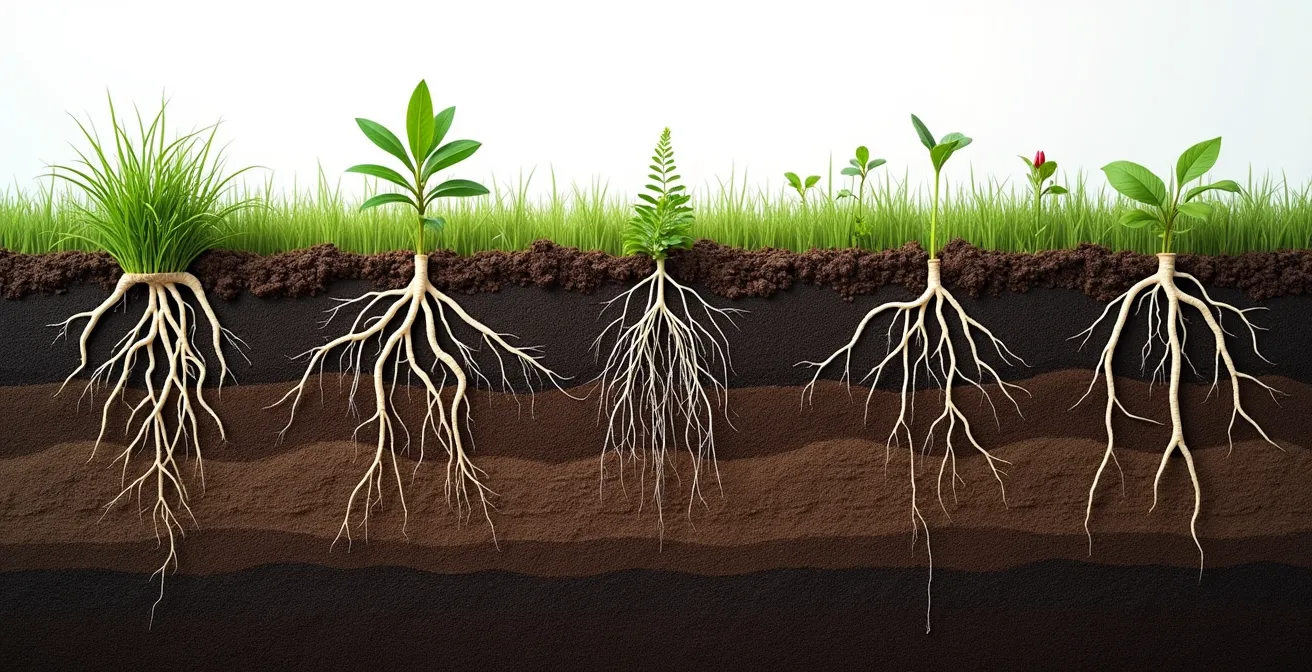
The common belief that more species automatically equals healthier soil is a dangerous oversimplification; resilience comes from having a diverse *workforce*, not just a crowded ecosystem.
- A high species count can mask a lack of critical functions, and can even include a higher number of pathogens in disturbed soils.
- Focusing on functional traits—what organisms *do*—allows for strategic management that builds true resilience against drought, pests, and disease.
Recommendation: Shift your management mindset from being a passive curator of species to an active “HR Manager” for your soil, hiring for the specific jobs your land needs done.
For decades, land managers have been guided by a simple mantra: biodiversity is king. We’ve been taught to equate a high species count—or species richness—with a healthy, resilient ecosystem. The more types of plants, insects, and microbes, the better. While this isn’t entirely wrong, it misses the most critical point. It’s like judging the success of a company solely by the number of employees on its payroll, without asking what any of them actually do. This focus on numbers has led many well-intentioned farmers down a path of false security, leaving their land vulnerable despite appearing “diverse.”
The inconvenient truth is that soil health isn’t a numbers game. It’s a functional one. The real engine of a productive, self-sustaining landscape isn’t the sheer quantity of species, but the variety of *jobs* being performed by the organisms within it. This is the concept of functional diversity. It asks not “how many species are here?” but “what essential tasks are being accomplished?” Are there organisms fixing nitrogen? Are there others mining for phosphorus? Who is building soil structure, and who is defending against pathogens? A high species count with no one performing these key roles is functionally bankrupt.
This article reframes the conversation. We will move beyond the simple metric of species richness and explore why functional diversity is the superior framework for building long-term soil productivity and resilience. We’ll examine the specific roles, or “jobs,” that different functional groups perform and see how a lack of this diversity creates the fragility seen in modern agriculture. It’s time to stop counting species and start managing for function.
To help you navigate this new perspective, this guide is structured to explore the specific roles and consequences of functional diversity—or the lack thereof—across key areas of land management. You’ll gain a deeper understanding of how to build a truly resilient soil workforce.
Summary: Rethinking Soil Health Through a Functional Lens
- Why Do Nitrogen-Fixing Plants Boost Yields Without Chemical Inputs?
- How to Calculate the Functional Divergence Index for Restored Wetlands?
- Native Grasses or Legumes: Which Functional Group Best Prevents Erosion on Slopes?
- The Monoculture Trap That Leaves Fields Vulnerable to Pest Outbreaks
- How to Select Tree Species That Maximize Carbon Storage in 10 Years
- Why Are Fungi Essential for Closing the Phosphorus Cycle in Forests?
- Why Does Overgrazing Stunt Root Growth and Dry Out Soil?
- Why Large-Scale Monocultures Are More Susceptible to Rapid Disease Spread?
Why Do Nitrogen-Fixing Plants Boost Yields Without Chemical Inputs?
Think of nitrogen-fixing plants, like legumes, as the in-house fertilizer factories of your soil workforce. They perform a highly specialized and valuable job: converting atmospheric nitrogen, which is unavailable to most plants, into a usable form. This is achieved through a symbiotic relationship with Rhizobium bacteria, which form nodules on the plant’s roots. This biological process is a cornerstone of functional diversity, providing a steady, slow-release source of nitrogen that fuels the entire plant community without the cost and environmental impact of synthetic fertilizers.

The power of this function is not just theoretical. This biological engine is a key part of the soil’s metabolic machinery; in fact, recent research reveals that microbial diversity provides 80-90% of soil metabolic activity driving critical ecosystem services. By “hiring” these specialists, you directly support this engine. For example, a case study on wheat fields demonstrated that introducing another functional group—mycorrhizal fungi—through inoculation led to a 15% reduction in nitrogen fertilizer use without compromising yield. This shows how adding a specific job (in this case, enhanced nutrient uptake by fungi) can immediately reduce reliance on external inputs and increase system efficiency.
Instead of just broadcasting fertilizer, you are cultivating a self-sustaining system where essential nutrients are generated internally. This is the first step in moving from a chemically dependent system to a biologically empowered one.
How to Calculate the Functional Divergence Index for Restored Wetlands?
While the concept of “jobs” is a useful metaphor, scientists need concrete ways to measure functional diversity. One such tool is the Functional Divergence (FDiv) index. In simple terms, this index quantifies how spread out or “divergent” the functional traits are within a community. A high FDiv score means you have a wide range of specialists performing very different jobs. A low score suggests that even with many species, most are performing similar tasks, indicating low functional redundancy and potential vulnerability.
For a restored wetland, you wouldn’t just count the number of sedges and rushes. You would measure key functional traits: Are there deep-rooted plants stabilizing the sediment? Are there emergent plants providing habitat? Are there species with high nutrient uptake capacity to filter water? The FDiv index synthesizes these trait measurements into a single, powerful metric that tells you if your restored ecosystem has a well-rounded workforce or is just a crowd of look-alikes.
The importance of this functional measurement extends belowground. For instance, specific soil functions are tied directly to microbial roles. Recent research demonstrates that microbial diversity showed stronger effects on phosphatase activity—the “job” of releasing phosphorus—under drought conditions. This shows that having a functionally diverse microbial team is crucial for maintaining nutrient cycling, especially under stress. An index like FDiv helps managers assess whether their restoration efforts are building this kind of deep, functional resilience.
Ultimately, such indices provide a data-driven way to evaluate whether a management strategy is truly building a resilient system or just checking a “species richness” box.
Native Grasses or Legumes: Which Functional Group Best Prevents Erosion on Slopes?
When it comes to the crucial job of preventing soil erosion, not all plants are created equal. This is a classic example of where choosing the right functional group is more important than simply planting a variety of species. The choice between native grasses and legumes for a sloped area depends entirely on the *functional traits* of their root systems.
Native grasses, particularly perennial bunchgrasses, are the premier architects of soil stability. Their functional superpower is a dense, fibrous, and web-like root system that permeates the topsoil. These roots act like a natural rebar, creating countless small aggregates and physically binding soil particles together. This structure creates a sponge-like effect, increasing water infiltration and dramatically reducing surface runoff. Their “job description” is to build a resilient, erosion-resistant soil structure.
Legumes, on the other hand, are often characterized by a different root architecture: the taproot. While excellent for breaking up compaction and, as we’ve seen, fixing nitrogen, a taproot-dominant system is less effective at holding surface soil in place. While some legumes have more fibrous secondary roots, their primary functional role is nutrient cycling, not structural engineering. Planting a slope exclusively with legumes would miss the critical job of topsoil stabilization.
The ideal solution, therefore, is not an either/or choice but a combination. A mix of native grasses (for structure) and legumes (for fertility) creates a multifunctional community where different workers are performing complementary jobs. This is functional diversity in action, creating a system that is both stable and fertile.
The Monoculture Trap That Leaves Fields Vulnerable to Pest Outbreaks
A monoculture is the ultimate example of a functionally bankrupt system. By relying on a single species, you have a workforce where every employee has the exact same job description, the same strengths, and, most dangerously, the same weaknesses. This lack of functional diversity creates a fragile, brittle system that is exquisitely vulnerable to collapse—what we can call the monoculture trap. It’s an architectural system built with only one type of support beam; once that beam fails, the entire structure is at risk.

This vulnerability is most obvious with pest and disease outbreaks. In a diverse system, plants with different chemistries, root depths, and associated microbes create natural barriers. A pest that targets one species cannot simply sweep through the entire field. But in a monoculture, a pest or pathogen finds a non-stop, all-you-can-eat buffet. There are no functional firebreaks to slow its spread. It’s a system with no resilience because it has no functional redundancy—no one else is on standby to do a different job that might impede the pest.
This trap extends to the soil microbiome. It’s tempting to think more microbes are always better, but function is what matters. As a European research team noted in Nature Communications:
Greater microbial taxonomic richness does not necessarily imply beneficial outcomes, as highly-perturbated soils harboured a greater prevalence of potentially undesired taxa (e.g. pathogens).
– European research team, Nature Communications
In other words, a disturbed monoculture system might have a high *count* of microbial species, but many of them could be pathogenic. The management practices often tied to monocultures, like intensive tillage, further degrade functional diversity. For example, studies show that increased tillage shifts the fungal:bacterial biomass ratio, favoring bacteria and harming the fungal networks essential for soil structure and nutrient transport.
Escaping this trap requires reintroducing functional diversity through practices like intercropping, cover cropping, and crop rotation, effectively “hiring” a varied team to build a more resilient agricultural architecture.
How to Select Tree Species That Maximize Carbon Storage in 10 Years
Carbon sequestration is one of the most valuable “jobs” an ecosystem can perform, and trees are the star employees. However, not all trees are equally skilled at this task, especially on a 10-year timeline. To maximize carbon storage, you must think like a strategic manager, hiring for specific functional traits that contribute to both rapid accumulation and long-term stability of carbon in biomass and soil.
The key is to create a team of both fast-growing “pioneer” species and slow-growing “climax” species. Pioneer species, like birch or alder, grow incredibly fast, quickly capturing atmospheric carbon in their early years. Their job is rapid, initial drawdown. Climax species, like oak or beech, grow slowly but produce very dense wood. Their job is long-term, secure carbon storage. A mix of both ensures you get the benefit of quick gains while building a resilient, high-density carbon sink for the future.
This functional approach goes beyond just growth rate. Other traits like root depth, mycorrhizal associations, and leaf litter chemistry all play a role in the total carbon equation. Deep-rooting species, for example, deposit carbon far down in the soil profile where it is more stable. The following table, based on data about tree functional traits, illustrates how to compare species for the specific job of carbon sequestration.
This comparative data, derived from an analysis of European forest biodiversity, provides a framework for selecting a functional team.
| Functional Trait | Pioneer Species | Climax Species | Carbon Storage Impact |
|---|---|---|---|
| Growth Rate | Fast (1-2m/year) | Slow (0.3-0.5m/year) | Quick initial capture vs long-term storage |
| Wood Density | Low (0.3-0.5 g/cm³) | High (0.6-0.9 g/cm³) | Higher density = more carbon per volume |
| Root Depth | Shallow (1-2m) | Deep (3-5m+) | Deep roots increase soil carbon |
| Mycorrhizal Type | AM fungi dominant | ECM fungi dominant | ECM better for mineral carbon mining |
| Leaf Litter C:N | Low (20:1) | High (50:1) | Higher ratio = slower decomposition |
By assembling a team with diverse functional traits, you create a more effective and resilient carbon sink than any single species could achieve alone.
Why Are Fungi Essential for Closing the Phosphorus Cycle in Forests?
Phosphorus (P) is a critical nutrient for plant growth, but it’s often locked up in the soil in forms that plants cannot access. This is where fungi, particularly mycorrhizal fungi, perform one of the most vital and underappreciated jobs in the soil workforce: they are the master key keepers, unlocking phosphorus and making it available to the entire forest ecosystem.
These fungi form vast, microscopic networks of hyphae that extend far beyond a plant’s own roots, effectively outsourcing the job of nutrient acquisition. They produce powerful enzymes that can break down organic matter and even weather mineral particles, releasing bound phosphorus. In exchange for sugars from the plant, the fungi deliver this essential nutrient directly to the roots. This symbiotic partnership is the primary mechanism for closing the phosphorus loop in a forest, ensuring that this precious resource is efficiently recycled and not lost from the system.
Without a healthy and diverse fungal community, the phosphorus cycle grinds to a halt. Plants would be starved of a key nutrient, even if the soil technically contains large reserves of P. This highlights a critical lesson in functional diversity: the mere presence of a nutrient is useless without a worker capable of making it available. As multiple authors highlighted in Frontiers in Forests and Global Change, this is part of a larger team effort, stating that “Belowground biodiversity is essential for decomposition, mineralization, and nutrient cycling, including macroarthropods, earthworms, collembola, bacteria, and fungi.”
Protecting and promoting this fungal workforce through practices that minimize soil disturbance and maintain continuous living cover is not just a “good idea”—it is a direct investment in the long-term fertility and resilience of your land.
Why Does Overgrazing Stunt Root Growth and Dry Out Soil?
Overgrazing is a management failure that fundamentally misunderstands the job of a forage plant. When a cow grazes, it’s not just removing leaves; it’s impacting the entire plant’s energy balance. A plant’s leaves are its solar panels, and its roots are its pantry and water uptake system. There’s a delicate equilibrium between the two. When an animal removes too much leaf area—grazing below the “take half, leave half” rule of thumb—the plant panics. It can no longer produce enough energy to support its extensive root system, so it begins to sacrifice them, a process known as root pruning.
This stunting of root growth has catastrophic functional consequences. Shorter roots mean the plant can no longer access deeper water reserves, making it extremely vulnerable to drought. A diminished root system also means less organic matter is being deposited in the soil, starving the microbial workforce. The soil structure begins to degrade, water infiltration decreases, and the ground becomes compacted and prone to drying out. You’ve effectively fired the workers responsible for building drought resilience.
Worse, the loss of plant cover leaves the soil surface bare and exposed. This “bare soil,” as explained in a case study on regenerative grazing, “leaves plants vulnerable to pathogens prompting fungicide use, while surface residue in no-till systems acts as a buffer and supports microbial communities.” You’ve removed the soil’s natural armor. To prevent this cascade of functional failures, a manager must adopt principles that respect the plant’s work.
Action Plan: Principles for Preventing Overgrazing Damage
- Graze Smart: Graze only the top third of plants to take the most nutritious parts without stressing the plant’s energy reserves.
- Allow Full Recovery: Provide adequate recovery time before re-grazing the same area, allowing plants to fully regrow their leaf area and replenish root stores.
- Monitor Root-Shoot Balance: Periodically check root health to ensure your grazing plan is not causing root sacrifice.
- Mimic Nature: Use high-density, short-duration rotational grazing to mimic the natural behavior of herd animals, which prevents selective overgrazing of preferred species.
- Leave Residue: Always leave enough plant residue behind to maintain photosynthesis during recovery and protect the soil surface.
By managing grazing to support the plant’s function, you are in turn supporting the function of the entire soil ecosystem, building a more drought-resilient and productive pasture.
Key takeaways
- Functional diversity is about the variety of *jobs* performed, not the number of species present.
- A resilient soil system has high functional redundancy, meaning multiple species can perform the same critical job.
- Management practices like tillage, monocropping, and overgrazing directly degrade functional diversity, creating system fragility.
Why Large-Scale Monocultures Are More Susceptible to Rapid Disease Spread?
We’ve established that monocultures are the epitome of low functional diversity. This lack of a varied workforce is precisely why they are so incredibly susceptible to the rapid, devastating spread of disease. It’s a problem of both missing defenders and a lack of functional “firebreaks.” In a complex, diverse ecosystem, a potential pathogen encounters a hostile environment. It must compete with thousands of other microbes, navigate the chemical defenses of different plant species, and survive in a varied soil structure. The system itself is the defense.
In a monoculture, all these barriers are removed. A pathogen finds an endless, uniform landscape of genetically identical, vulnerable hosts. There is no competition and no resistance. The disease can spread like wildfire through a dry forest because every plant is a perfect fuel source. The system lacks the functional roles of “gatekeepers,” “competitors,” and “natural barriers” that would be present in a polyculture. The result is a dependency on chemical intervention—fungicides and pesticides—to do the job that a diverse ecosystem would have done for free.
This vulnerability is a direct consequence of ignoring the complexity of the soil workforce. Researchers are increasingly realizing that our old assumption—that soil functions were highly redundant—was wrong. As a study in PLOS Biology warns, losses in microbial diversity can result in proportional or even exponential losses of soil function. This means that as we simplify our agricultural landscapes, we are not just losing species; we are losing critical jobs at an even faster rate, including the vital job of disease suppression.
By re-introducing functional diversity through cover crops, rotations, and integrating livestock, you are not just planting more things; you are re-hiring the diverse security team that your farm needs to defend itself, building a system that is inherently more resilient and less dependent on costly chemical inputs.