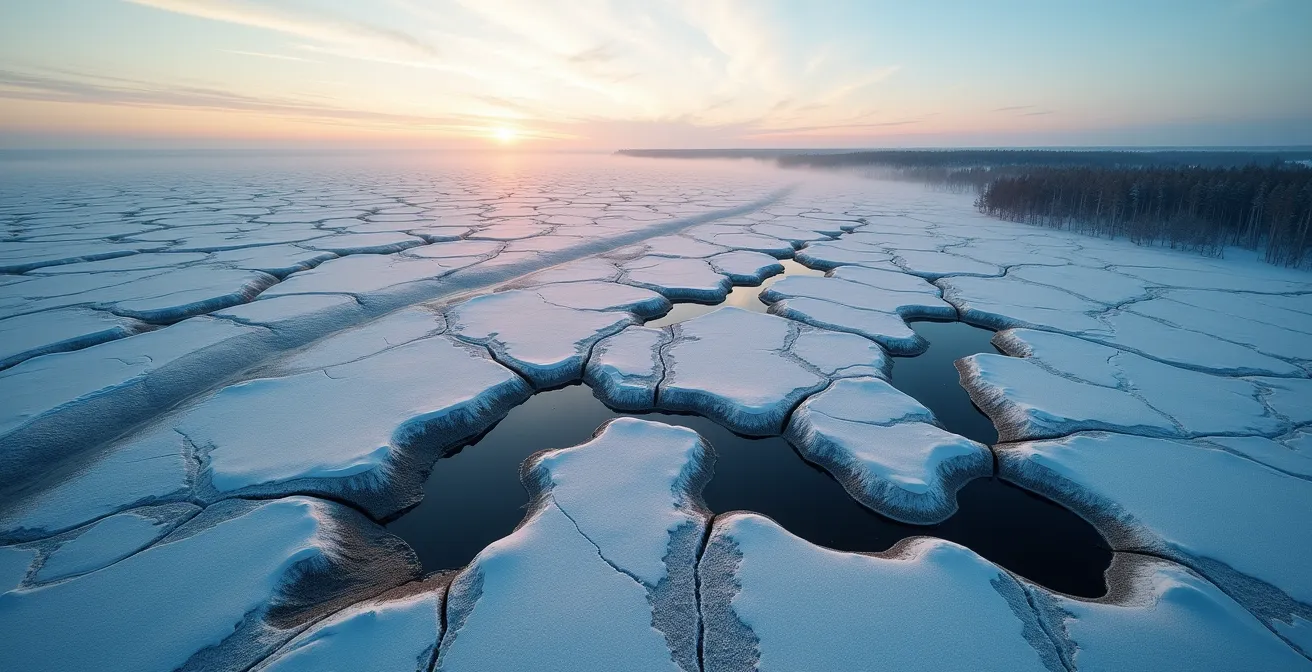
Permafrost thaw is not a single climate problem; it is a series of distinct geotechnical and biogeochemical failures that demand a specific, engineering-focused response.
- Waterlogged soils don’t just release carbon; they switch to releasing methane (CH4), a gas with over 80 times the warming potential of CO2 in the near term.
- Abrupt thaw events like thermokarst formation accelerate carbon release by up to 190% compared to gradual melting, representing a non-linear, high-impact risk to infrastructure and climate stability.
Recommendation: Planners must shift from general climate awareness to specific, site-based analysis of thaw mechanics to preempt catastrophic infrastructure failure.
For decades, we have referred to thawing permafrost as a “sleeping giant.” This metaphor, while evocative, is dangerously misleading for those of us tasked with building and maintaining infrastructure in northern regions. It implies a slow, monolithic awakening. The reality is far more granular and immediate: a series of distinct, accelerating, and often predictable geotechnical failures. The ground beneath our feet is not just melting; it is undergoing a fundamental state change that triggers specific biogeochemical switches and structural collapse mechanisms.
While the global discussion centers on the feedback loop, engineers and climate strategists must focus on the mechanics of that loop. The critical questions are no longer just *if* the permafrost will thaw, but *how* it will fail. Will it release carbon dioxide or the far more potent methane? Will the ground subside gradually, or will it collapse abruptly into a thermokarst lake? Ignoring these distinctions is a critical planning error, akin to designing a coastal structure without understanding the difference between tides and tsunamis.
This article moves beyond the broad warnings to provide a pragmatic, engineering-focused breakdown of the key failure modes associated with permafrost thaw. We will dissect the chemical processes that favor methane release, analyze the principles of foundation design for unstable ground, and differentiate the carbon-release speeds of various thaw types. By understanding these specific mechanisms, we can move from passive observation to proactive risk mitigation and more resilient infrastructure design.
This guide breaks down the core technical challenges and strategic imperatives posed by thawing permafrost. Each section addresses a specific mechanism or planning dilemma, providing the detailed perspective necessary for informed decision-making in the face of this accelerating crisis.
Summary: Decoding the Permafrost Thaw
- Why Does Thawing Soil Release Methane Instead of CO2 in Waterlogged Areas?
- How to Design Foundations That Withstand Permafrost Slump?
- Thermokarst Lakes vs Active Layer Deepening: Which Releases Carbon Faster?
- The Stabilization Error of Ignoring Tilted Trees Near Pipelines
- When to Deploy Mobile Sensors to Detect Methane Burps from Thawing Lakes?
- Why Are Fungi Essential for Closing the Phosphorus Cycle in Forests?
- When to Retrofit Storm Drains: Waiting for Failure vs Preemptive Action
- Why Methane Reduction Is the Fastest Way to Slow Near-Term Warming?
Why Does Thawing Soil Release Methane Instead of CO2 in Waterlogged Areas?
The distinction between carbon dioxide (CO2) and methane (CH4) emissions from thawing permafrost is not academic; it is the single most important biogeochemical switch an engineer must understand. The determining factor is the presence of water. When permafrost thaws and the ground remains well-drained, aerobic microbes decompose the newly available organic matter, releasing CO2. However, in the increasingly common scenario where thaw leads to soil saturation, slumping, and the formation of ponds and wetlands, the environment becomes anoxic (oxygen-deprived). This is a critical tipping point.

In these waterlogged conditions, a different class of microbes—methanogens—takes over. Through anaerobic digestion, they break down the carbon and release methane instead of CO2. This is a game-changing event for near-term warming, as methane is a far more potent greenhouse gas. The formation of these thermokarst lakes and wetlands creates highly efficient methane factories. In fact, recent research reveals that an estimated 65.5 ± 10.0 Gg of carbon as CH4 is released annually from thermokarst lakes that cover a mere 0.2% of the permafrost region. These areas act as emission “hotspots” with disproportionate impact.
Ground measurements from a thermokarst hotspot in Alaska confirmed this extreme potential, recording methane fluxes up to 24,200 mg CH4 m−2 d−1. From a planning perspective, this means that any project that alters local hydrology—such as road construction that dams natural drainage or foundations that cause subsidence—can inadvertently flip this switch from CO2 to methane, dramatically increasing the site’s climate impact.
How to Design Foundations That Withstand Permafrost Slump?
For an infrastructure planner, permafrost is not just frozen soil; it’s a structural component. When it thaws, it fails, leading to differential settlement—uneven sinking of the ground—that twists, cracks, and ultimately destroys foundations, pipelines, and runways. With nearly 70% of infrastructure built on permafrost at risk by 2050, reactive maintenance is no longer a viable strategy. The only sound approach is proactive design that anticipates and accommodates thaw.
Traditional shallow foundations that rest directly on permafrost are obsolete in high-risk zones. The engineering imperative is to isolate the structure from the unstable active layer. The primary methods include:
- Deep Piles: Driving steel, concrete, or timber piles deep into the stable, permanently frozen ground below the anticipated maximum thaw depth. The structure rests on these piles, bridging the unstable layer.
- Thermosyphons: Installing passive heat exchange systems around foundations. These devices use the cold winter air to supercool the ground, actively removing heat and maintaining a solid, frozen bulb of permafrost around piles, thus ensuring their stability.
- Adjustable Foundations: For smaller structures, designing foundations with integrated screw jacks or shims that allow the building to be periodically re-leveled as the ground beneath it shifts.
The failure to adopt these techniques has severe consequences. In Tuktoyaktuk, Canada, entire homes have been abandoned as the coastline erodes and the ground gives way beneath them, forcing residents to relocate inland. This is not a future scenario; it is a present-day reality driven by inadequate foundation design meeting a changing environment.
Action Plan: Pre-Construction Geotechnical Audit for Permafrost Zones
- Core Sampling & Ice Content Analysis: Drill boreholes to determine the soil composition and, critically, the percentage of ground ice. Ice-rich soils are prone to significant volume loss and slumping upon thaw.
- Thermal Modeling & Active Layer Projection: Use site-specific climate projections to model the future depth of the active layer (the layer that thaws annually) over the planned lifespan of the infrastructure.
- Differential Settlement Risk Mapping: Analyze borehole data to create a map of the site, identifying zones with varying ice content. This predicts where uneven settling is most likely to occur, informing foundation placement.
- Foundation Technology Review: Based on the settlement risk, select the appropriate technology. Low-risk areas might use reinforced slabs, while high-risk zones will require deep piles with or without thermosyphons.
- Long-Term Monitoring Plan Definition: Install thermistor strings and survey monuments to monitor ground temperature and surface elevation changes after construction, allowing for preemptive maintenance.
.
Thermokarst Lakes vs Active Layer Deepening: Which Releases Carbon Faster?
Not all permafrost thaw is created equal. From a risk assessment standpoint, it is crucial to distinguish between two primary modes of degradation: gradual active layer deepening and abrupt thaw. Active layer deepening is the slow, progressive downward melting of the permafrost table year after year. It is relatively predictable and releases carbon at a steady, manageable rate. Abrupt thaw, however, is a non-linear, catastrophic event characterized by the rapid formation of thermokarst lakes and wetlands as massive blocks of ice-rich permafrost collapse.
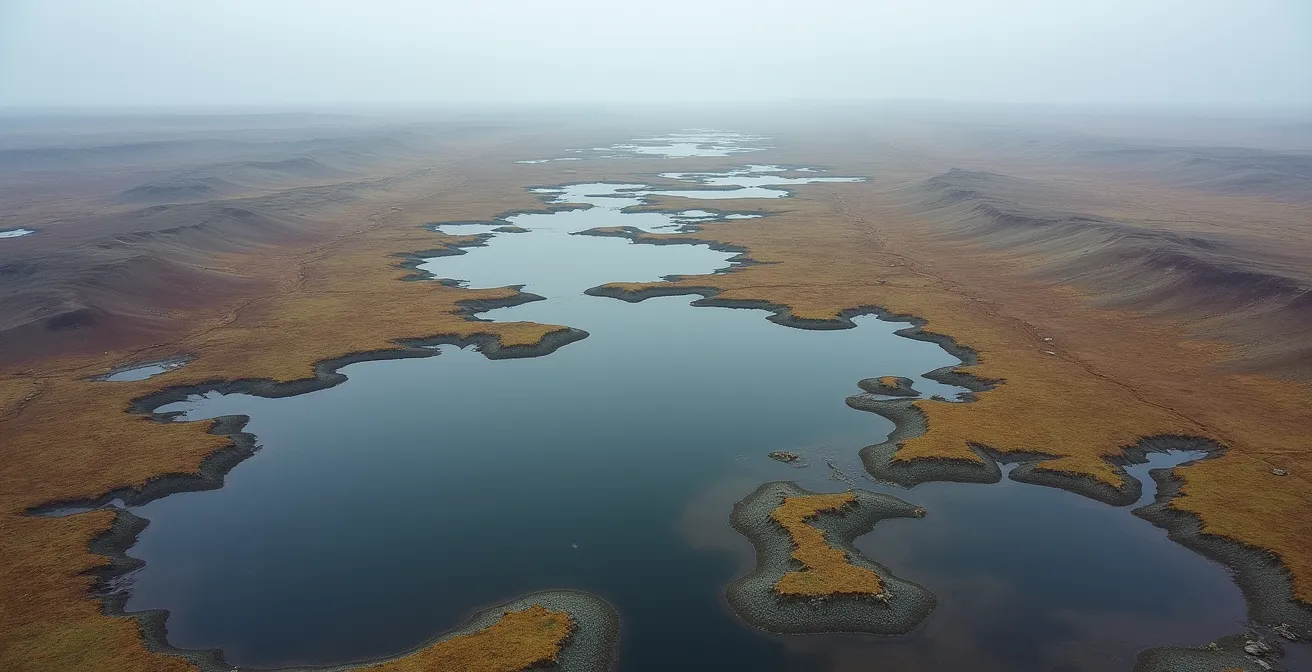
The data is unequivocal: abrupt thaw is the far greater near-term threat. While it affects a smaller land area, its speed and intensity are orders of magnitude higher. Modeling studies demonstrate that abrupt thaw increases carbon emissions by 125–190% compared to the effects of gradual thaw alone. This is because the collapse exposes deep, ancient organic material to rapid decomposition in the anoxic, waterlogged environment of a new lakebed—perfect conditions for massive methane release.
This dramatic acceleration is what makes abrupt thaw a true tipping point. As leading permafrost expert Merritt Turetsky stated in a Nature Geoscience study:
We are watching this sleeping giant wake up right in front of our eyes… abrupt permafrost thawing affects less than 20 percent of the permafrost region, but carbon emissions from this relatively small region have the potential to double the climate feedback.
– Merritt Turetsky, Nature Geoscience study on rapid permafrost thaw
For a strategist, this means that focusing solely on the average rate of thaw across the Arctic is a grave error. Risk models must prioritize the identification of landscapes with high ground-ice content, which are susceptible to this rapid collapse. These are the areas where the “sleeping giant” is not just stirring, but thrashing violently, with immediate consequences for both local infrastructure and the global climate.
The Stabilization Error of Ignoring Tilted Trees Near Pipelines
In permafrost regions, the landscape itself is a diagnostic tool. “Drunken forests,” where trees tilt at odd angles, are not a quaint ecological quirk; they are a critical visual indicator of active layer instability and differential settlement. For an engineer monitoring a pipeline, road, or building, ignoring this sign is a fundamental stabilization error. The tilted trees are the surface-level symptom of subsurface ground movement that is actively stressing linear infrastructure.
The tilting occurs as the ice wedges and lenses within the permafrost melt unevenly. This causes the ground to heave and slump, destroying the root foundations of the trees. The same forces that tilt a 50-foot spruce tree are acting on the foundations of a pipeline support or a building. Relying solely on sensors placed directly on the infrastructure itself means you are measuring a problem that has already begun. Observing the surrounding landscape provides an early warning system.
However, visual indicators are only the beginning of the story. The most dangerous movements are often invisible to the naked eye. Advanced remote sensing techniques, such as Interferometric Synthetic Aperture Radar (InSAR), are essential for a complete picture. Research using this technology has quantified widespread, previously undetected permafrost disturbances across the Arctic. InSAR can reveal millimeter-scale ground movements over vast areas, identifying zones of subsidence long before trees start to tilt or cracks appear in a road. This data allows for the creation of risk maps that guide preemptive stabilization efforts, rather than costly and dangerous reactive repairs.
The combination of on-the-ground visual inspection (like monitoring forest health near a right-of-way) and large-scale remote sensing provides a comprehensive view of ground stability. Ignoring the former is to miss the obvious; neglecting the latter is to miss the inevitable.
When to Deploy Mobile Sensors to Detect Methane Burps from Thawing Lakes?
Deploying sensors to monitor methane from thawing lakes requires a strategic approach that acknowledges the nature of the emissions. A significant portion of methane is not released through slow, steady diffusion. Instead, it is released in powerful, episodic bursts known as ebullition—or methane “burps.” This occurs when pockets of gas trapped in lakebed sediment or under ice are suddenly released. Field measurements confirm the dominance of this process; ebullition constitutes 84% of CH4 emissions from thermokarst lakes. Deploying static, long-term sensors can easily miss these short-lived, high-flux events, leading to a dangerous underestimation of total emissions.
Therefore, the timing of sensor deployment must be dynamic. The most critical periods for deploying mobile sensors—whether on drones, aircraft, or boats—are during two key transitional phases:
- Spring Thaw: As the lake ice breaks up, it releases a massive, concentrated pulse of methane that was trapped beneath it all winter. Deploying sensors during this one-to-three-week window is essential for capturing this peak annual emission event.
- Late Summer: When lake water temperatures are at their highest, microbial activity in the sediment peaks, leading to the highest rate of methane production and ebullition. This is the optimal time to survey for persistent emission hotspots.
The strategy should not be to blanket the landscape with sensors, but to use mobile platforms for targeted campaigns. Airborne imaging spectroscopy is a particularly powerful tool for this. A recent study using this technology successfully identified previously undiscovered CH4 hotspots confined to less than 1% of a lake’s area. These small zones were acting as super-emitters, with ground-truthing confirming average daily fluxes of 1,170 mg CH4 m−2 d−1. Without the mobility and high resolution of the airborne platform, these critical hotspots would have remained invisible to a static sensor network.
Why Are Fungi Essential for Closing the Phosphorus Cycle in Forests?
While the immediate threats of permafrost thaw are geotechnical and atmospheric, a critical second-order effect is the profound disruption of terrestrial ecosystems, particularly the nutrient cycles that govern them. As the ground thaws and stabilizes, the question becomes: what will grow here, and how? The answer is intrinsically linked to the health of the soil’s microbial community, especially mycorrhizal fungi. These fungi form symbiotic relationships with tree roots and are the undisputed masters of nutrient acquisition, most notably for phosphorus.
Phosphorus is a limiting nutrient in many boreal and arctic ecosystems. It is often locked up in mineral or organic forms unavailable to plants. Mycorrhizal fungi act as a vast, microscopic extension of a tree’s root system, secreting enzymes that liberate phosphorus and transporting it back to the tree in exchange for carbon. This fungal network is the engine that closes the phosphorus cycle, enabling forests to thrive in nutrient-poor soils. When permafrost thaws, this delicate partnership is shattered.
The scale of the landscape transformation is immense. As Dr. Susan M. Natali of the Woodwell Climate Research Center explains, the stakes are enormous:
There’s so much carbon stored in permafrost, and it’s frozen now. It’s locked away, and when that thaws, it then becomes vulnerable for being released into the atmosphere to exacerbate global climate change.
– Dr. Susan M. Natali, Woodwell Climate Research Center
In this newly thawed, often waterlogged, and structurally chaotic soil, the fungal networks are destroyed. Without them, new vegetation struggles to establish itself. The inability to close the phosphorus cycle becomes a major bottleneck for ecosystem recovery and long-term carbon sequestration by new forests. For a climate strategist, this means that even if a thawed landscape is physically stabilized, it may remain a net carbon source for decades if its biological engine cannot be restarted.
When to Retrofit Storm Drains: Waiting for Failure vs Preemptive Action
For a municipal engineer in the north, storm drains and culverts are the canary in the coal mine for permafrost degradation. These seemingly simple structures are extremely vulnerable to differential settlement. As the ground heaves and slumps, culverts can be sheared, crushed, or tilted, blocking drainage. This blockage then causes water to pool, which accelerates local permafrost thaw, creating a vicious feedback loop that can lead to a catastrophic road washout.
The core dilemma facing planners is one of timing: should one wait for a failure to occur, or invest in a costly program of preemptive retrofitting? The “wait for failure” approach is fiscally appealing in the short term but carries immense risk. A single culvert failure can shut down a critical transportation corridor for weeks, isolating a community and incurring emergency repair costs that far exceed the price of a planned retrofit. The current observations of infrastructure damage already occurring in Fairbanks from permafrost degradation serve as a stark warning against this passive stance.
A preemptive strategy involves several key actions:
- Upsizing and Upgrading: Replacing older, undersized metal culverts with larger, more durable high-density polyethylene (HDPE) pipes that can better accommodate both increased water flow from a wetter climate and minor ground movement.
- Flexible Joints: Using culverts with flexible, watertight joints that can tolerate a degree of angular deflection or settlement without separating or leaking.
- Insulation and Geotextiles: Insulating the ground around the culvert or using specialized geotextiles to reinforce the soil and slow the rate of thaw beneath the structure.
The experience of communities like Tuktoyaktuk, where permafrost thaw regularly threatens roads and creates hazardous sinkholes, underscores the flaw in a reactive approach. For critical infrastructure, the question is not *if* a structure on degrading permafrost will fail, but *when*. Preemptive action is not just an expense; it is an investment in operational continuity and public safety.
Key Takeaways
- Waterlogging is a critical switch, turning CO2 emissions into far more potent methane (CH4) emissions, which is a key variable in site-specific risk.
- Abrupt thaw is not linear; it can double the climate feedback from permafrost while affecting only a small percentage of the land area, demanding focused monitoring.
- Visible indicators like tilted trees are warnings of deeper, non-uniform ground subsidence that requires advanced monitoring (InSAR, sensors) to quantify before failure occurs.
Why Methane Reduction Is the Fastest Way to Slow Near-Term Warming?
The intense focus on methane throughout this analysis is not arbitrary; it is a strategic imperative. While carbon dioxide drives long-term temperature rise, methane dominates the near-term warming equation. According to scientific assessments, methane’s global warming potential is around 80 times larger than that of CO2 over a 20-year period. This means that every ton of methane released from thawing permafrost has a disproportionately powerful impact on the climate we will experience in the next two decades—a critical timeframe for infrastructure planning.
The sheer volume of carbon locked in the permafrost makes this a global-scale threat. Dr. David Armstrong McKay, a leading researcher on climate tipping points, puts the numbers in stark perspective:
Around about 1500 gigatons of carbon locked in this permafrost that becomes available for release when it thaws. That’s actually about two and a half times the amount that humanity has emitted so far… it’s a feedback loop where global warming releases carbon, which speeds up warming.
– Dr. David Armstrong McKay, PBS Weathered documentary
Because methane has a relatively short lifespan in the atmosphere (around 12 years, compared to centuries for CO2), reductions in methane emissions have a rapid and noticeable effect on the rate of warming. For a climate strategist, this makes methane the most powerful lever available to slow warming in the near term and “shave the peak” off projected temperature rise. This can buy crucial time for both global decarbonization efforts and local adaptation measures to take hold.
Therefore, any strategy that mitigates methane release from permafrost—whether it’s through better water management in construction projects, preemptive stabilization of thaw-prone areas, or simply a better understanding of the emission hotspots—is not just an environmental action. It is a direct and highly effective tactic for reducing the immediate risk of accelerated warming and its cascading impacts on our climate and infrastructure.
For those responsible for northern infrastructure, the time for passive observation is over. The next logical step is to integrate detailed, site-specific geotechnical thaw modeling into all long-term capital planning and risk assessment protocols.