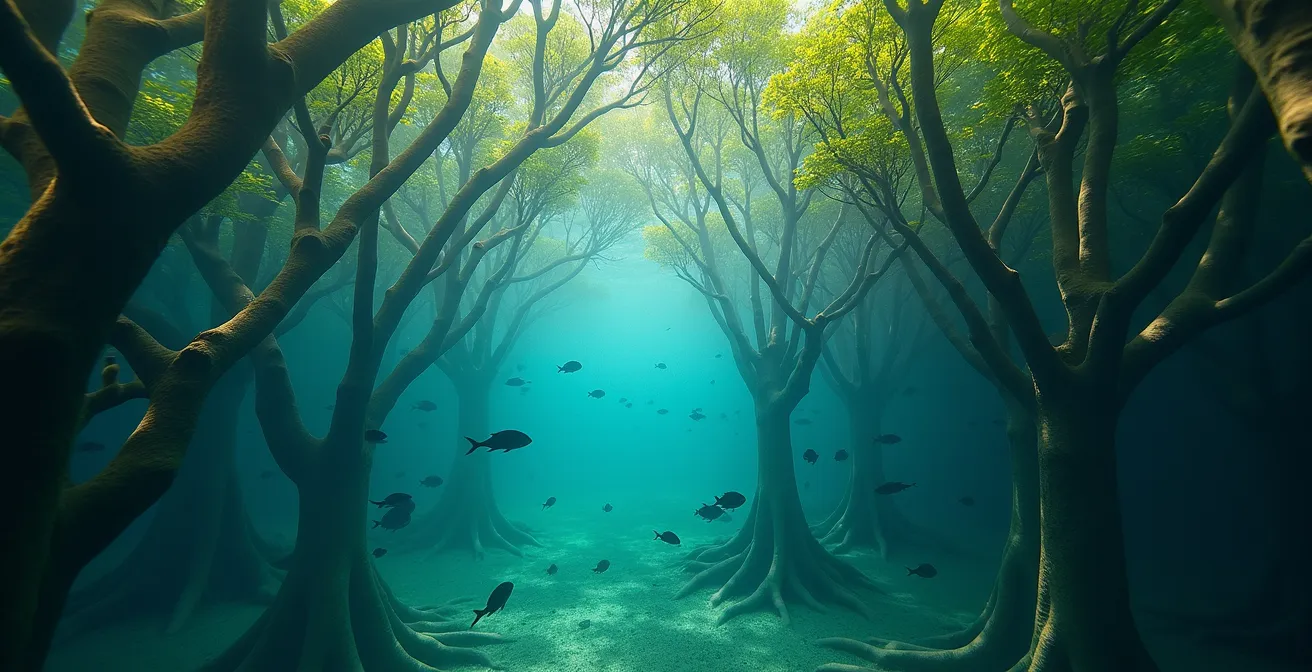
Protecting coastal nurseries is not an environmental expense; it is the most direct investment in the capital-producing infrastructure of the global fishing industry.
- Healthy mangrove and seagrass ecosystems directly determine the abundance and size of offshore commercial fish stocks.
- Natural habitats offer superior, self-maintaining storm protection and greater economic co-benefits compared to engineered seawalls.
Recommendation: Fisheries management must integrate habitat health as a core balance sheet asset to ensure long-term, sustainable yields and mitigate economic risk.
For decades, the discourse surrounding fishery management has centered on quotas, gear technology, and fleet capacity. These are critical operational concerns, but they focus almost exclusively on the point of extraction. This perspective overlooks the most fundamental driver of long-term profitability: the health of the production source. The commercial fishing industry is not merely extracting a wild resource; it is harvesting the annual output of a complex biological factory. The most critical and vulnerable part of this factory is not in the deep ocean, but in the shallow, tangled roots of coastal estuaries.
While the phrase “nurseries of the sea” has become a familiar platitude, its profound economic implications are often underestimated. What if the most critical variable determining future catch volumes and market stability isn’t found on the open ocean, but is instead a direct function of the acreage and health of coastal mangrove forests and seagrass beds? This analysis reframes the conversation. It moves beyond ecological sentiment to present a stark economic argument for commercial fishing associations and marine policy makers.
This is not an environmental plea; it is a strategic business case. We will treat coastal ecosystems as a form of biological infrastructure, evaluating their performance against engineered alternatives and quantifying their role as the primary engine of stock replenishment. By viewing these habitats as a core capital asset on the industry’s balance sheet, their protection and restoration cease to be a cost and become the most logical investment in a secure and profitable future.
This article provides an economic breakdown of this dependency, exploring the direct financial links between healthy habitats and robust fisheries. The following sections offer a clear-eyed assessment of the value these ecosystems provide, the costs of their degradation, and a strategic framework for their management as a non-negotiable economic asset.
Summary: An Economic Framework for Coastal Habitat as a Fishery Asset
- Why Do 75% of Commercial Fish Species Spend Their Youth in Estuaries?
- How to Replant Seagrass Beds to Boost Local Fish Stocks by 20%?
- Seawalls or Mangroves: Which Protects Investments Better Against Storm Surges?
- The Dredging Mistake That Collapsed the Local Shrimp Fishery in 5 Years
- When to Close Coastal Areas to Fishing to Maximize Spawning Success
- Why Is a Wetland Worth More Than a Parking Lot in Flood Prone Areas?
- Fisheries vs Oil Fields: Which Resource Stock Can Be Managed Indefinitely?
- Earth Overshoot Day: Why We Burn Through the Planet’s Budget by July?
Why Do 75% of Commercial Fish Species Spend Their Youth in Estuaries?
The economic foundation of most global fisheries rests on a simple biological reality: the overwhelming dependence of commercial species on coastal nurseries. These estuarine environments, particularly mangrove forests and seagrass meadows, are not incidental to the life cycle of fish; they are a mandatory developmental stage. Research from the American Museum of Natural History confirms that over 75% of commercially caught fish species spend their juvenile phase in these habitats. This is not a preference, but a strategic necessity for survival, providing nutrient-rich food sources and critical protection from predation when the fish are at their most vulnerable.
From an economic standpoint, these nurseries function as the primary production facilities for future fish stocks. The health and extent of this biological infrastructure directly dictate the “production volume” of juvenile fish that will eventually recruit into the offshore adult population available for harvest. A decline in nursery habitat is a direct constraint on future supply. The case of the goliath grouper provides a stark example. This large, commercially valuable fish spends up to six years in its mangrove nursery, only migrating offshore after reaching a significant size. Scientists have established a direct, quantifiable link between the abundance of coastal mangroves and the subsequent abundance of adult grouper in offshore fisheries. Where mangroves are lost, the fishery inevitably declines.
This principle, known in fisheries science as yield-per-recruit, demonstrates that the ultimate harvestable weight of a fish stock is critically dependent on the survival rate of its youngest members. By destroying nursery habitats, we are not just impacting “the environment”; we are fundamentally sabotaging the production line of a multi-billion dollar industry. Protecting these areas is therefore not a conservation cost but a direct investment in future inventory.
How to Replant Seagrass Beds to Boost Local Fish Stocks by 20%?
Alongside mangroves, seagrass beds form another pillar of the coastal nursery infrastructure. These underwater meadows serve a similar function, offering shelter and foraging grounds for a different but overlapping set of commercially valuable species, including various finfish, scallops, and crustaceans. The degradation of these habitats through pollution, coastal development, and destructive fishing practices represents a direct reduction in the productive capacity of a fishery. However, unlike a depleted oil well, this biological infrastructure can be repaired and expanded through targeted investment in restoration.
Replanting seagrass is essentially a form of recapitalization for the fishery. It is an active investment to rebuild a degraded asset and enhance its future output. While historically challenging, restoration techniques have advanced significantly. The key to success lies in operating at a scale sufficient to create a resilient, self-sustaining ecosystem. Piecemeal efforts often fail, but large-scale projects show significant promise. This is not just theoretical; a global meta-analysis of restoration projects found that scaling up efforts can lead to a 20% increase in restoration success, establishing a clear link between investment level and a positive return.
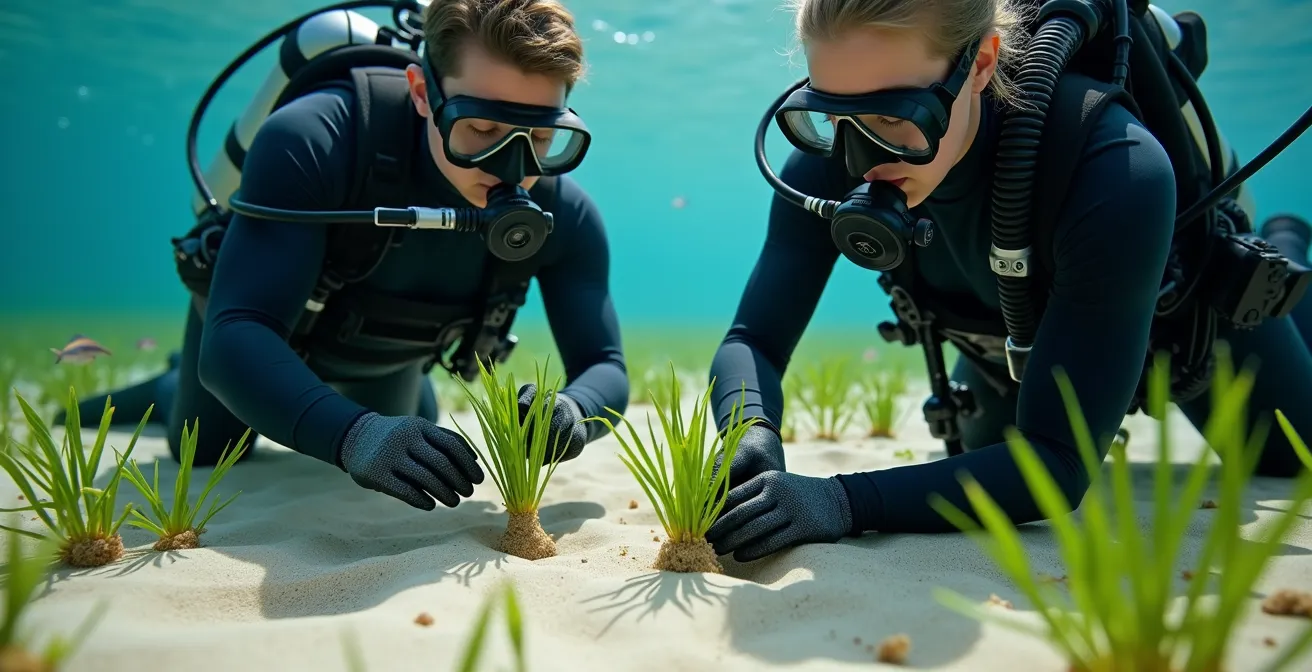
The return on this investment is measured in increased fish stocks. Restored seagrass beds quickly become populated with juvenile fish, leading to a measurable boost in the local fish population within a few years. For fishing associations and policy makers, this presents a clear value proposition: investing in seagrass restoration is a direct, quantifiable method to increase the future supply of the commercial resource. It transforms a passive, degrading asset into an actively managed and appreciating one, bolstering both ecological health and economic returns for the local fishing community.
Seawalls or Mangroves: Which Protects Investments Better Against Storm Surges?
Beyond their role as fish nurseries, coastal habitats provide another critical economic service: risk mitigation. For coastal communities and fishing fleets, storm surges and flooding represent a significant financial threat to vessels, processing plants, and port infrastructure. The conventional solution has been “grey infrastructure”—concrete seawalls and revetments. However, a purely economic comparison reveals that “green infrastructure” in the form of healthy mangrove forests offers a superior investment.
A concrete seawall is a single-purpose, depreciating asset with high maintenance costs. It reflects wave energy, which can exacerbate erosion elsewhere, and when it fails, the failure is often catastrophic. Mangroves, by contrast, are a multi-purpose, self-maintaining, and appreciating asset. Their complex root systems and dense trunks are incredibly effective at absorbing and dissipating wave energy, reducing wave height and power before they reach the coastline. Furthermore, they provide a host of co-benefits that a seawall cannot, including nursery habitat for fisheries, carbon sequestration, and water filtration. The economic value of this protection is immense; recent UC Santa Cruz research shows that mangroves provide an estimated $855 billion in annual flood protection benefits globally.
| Characteristic | Seawalls | Mangroves |
|---|---|---|
| Wave energy reduction | Reflects waves (can amplify damage elsewhere) | Absorbs 70-90% of wave energy |
| Maintenance | High cost, regular repairs needed | Self-maintaining, grows stronger over time |
| Failure mode | Catastrophic when breached | Gradual, partial protection maintained |
| Additional benefits | Single function (protection) | Multiple: fisheries, carbon storage, water filtration |
| Long-term resilience | Degrades over time | Adapts to rising sea levels |
Given these findings, it is economically irrational to exclude mangroves from infrastructure budgets. As argued by a study featured in The Conversation, mangroves should be viewed as essential national infrastructure, eligible for the same funding from hazard mitigation and disaster recovery budgets as engineered structures. For a fishing association, investing in mangrove restoration is a dual-purpose strategy: it rebuilds the fish factory while simultaneously providing a cost-effective insurance policy against damage to its physical assets on shore.
The Dredging Mistake That Collapsed the Local Shrimp Fishery in 5 Years
The economic link between nursery habitat and fishery profit is most starkly illustrated when it is broken. The cautionary tale of coastal development projects that neglect habitat impacts is a common one, with dredging for port expansion or channel deepening being a frequent culprit. A hypothetical but all-too-common scenario involves a decision to dredge a channel through a mangrove estuary to improve port access. The short-term economic benefits of increased shipping traffic are easily calculated and presented as justification.
What is often missing from this balance sheet is the long-term cost of destroying the nursery habitat that underpins a multi-million dollar local shrimp fishery. The physical act of dredging and the subsequent changes in water flow and sedimentation can decimate seagrass beds and uproot mangrove prop roots. This directly removes the critical shelter and food source for juvenile shrimp. In fact, specific research shows that two commercially important penaeid prawn species are highly dependent on these very habitats during their early life stages. Without this nursery, the survival rate of juvenile shrimp plummets.
The consequences are not immediate. For the first year or two, the fishery may seem unaffected as the existing adult stock is harvested. But within three to five years, as the generations of shrimp that failed to survive their juvenile stage would have entered the fishery, catches begin to decline precipitously. The result is the collapse of the local shrimp fishery—a permanent loss of a renewable asset in exchange for a marginal improvement in an unrelated industry. This is a classic example of an unforced economic error, where a failure to properly value the services of natural capital leads to a net financial loss for the regional economy. The dredging project did not just move sediment; it liquidated the primary asset of an entire industry.
When to Close Coastal Areas to Fishing to Maximize Spawning Success
Effective management of the fishery asset requires protecting not just its “production facility” (the nursery) but also its “reproduction process” (spawning). Fish often gather in dense spawning aggregations at specific times and locations, making them highly vulnerable to overfishing. Harvesting fish before they have had a chance to reproduce is akin to slaughtering livestock before it can breed—it is a direct depletion of the capital stock. Traditional management has relied on fixed, calendar-based closures, but this approach is often inefficient, closing areas when fish are not present or opening them at the peak of spawning.
A more sophisticated, data-driven approach is Dynamic Ocean Management (DOM). This strategy treats closures not as rigid lines on a map but as flexible zones that move in response to the real-time location of the fish. By integrating data from acoustic fish tracking and satellite oceanography, managers can identify the precise location and timing of spawning aggregations and implement targeted, temporary closures. This maximizes spawning success while minimizing unnecessary disruption to fishing activities in adjacent areas.
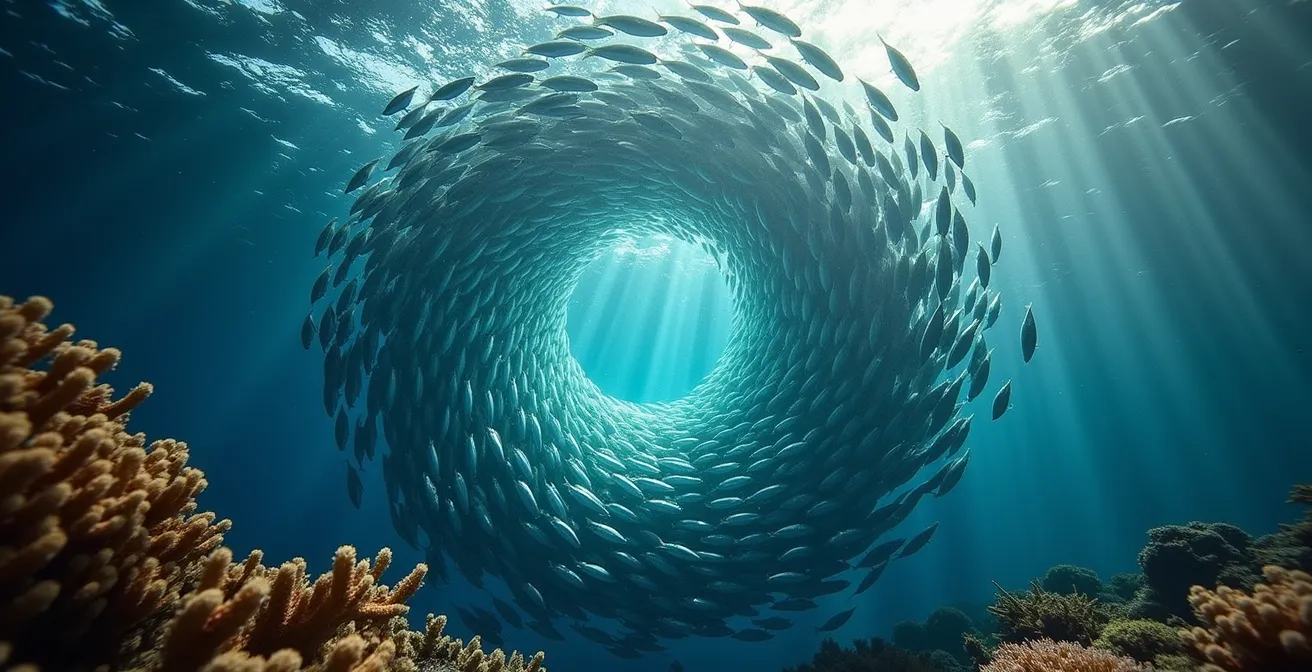
This approach protects the entire reproductive cycle, ensuring a healthy new generation of fish to replenish the stock. It represents a shift from static, often ineffective rules to an agile, responsive system that protects the core reproductive process of the fishery asset. For policy makers, it offers a way to achieve conservation goals with greater precision and economic efficiency, demonstrating a commitment to the long-term sustainability of the resource.
Action Plan: Implementing Dynamic Spawning Closures
- Deploy acoustic fish tracking systems to monitor real-time spawning aggregation movements.
- Integrate satellite oceanography data to identify optimal spawning conditions like temperature and currents.
- Implement flexible closure zones that adapt to actual fish locations rather than fixed calendar dates.
- Monitor spillover effects to adjacent fishing grounds to demonstrate direct benefits to local fishermen.
- Protect pre-spawning staging areas and post-spawning recovery zones for complete reproductive cycle protection.
Why Is a Wetland Worth More Than a Parking Lot in Flood Prone Areas?
The economic valuation of coastal wetlands often suffers from a failure of imagination. A developer may see a mangrove forest and calculate the potential revenue from converting it into a waterfront parking lot or condominium. This calculation is fundamentally flawed because it only considers the value of a single, extractive use while ignoring the multiple, ongoing economic services the intact wetland provides. In a flood-prone area, a parking lot contributes to runoff and provides zero protection. A wetland does the opposite: it absorbs floodwaters, reduces storm surge, and actively generates economic value.
The most significant of these services for the fishing industry is, again, its role as a biological production center. The sheer productivity of these ecosystems is staggering. Healthy mangrove ecosystems support over 700 billion juvenile fish and invertebrates annually across the globe. This is not an abstract ecological number; it is a direct quantification of the “inventory” being produced for the world’s fisheries. In the United States alone, coastal wetlands are the engine for an industry that supported 1.7 million jobs and generated $238 billion in sales in 2018, as they are essential for approximately half of all commercially harvested seafood.
When a wetland is paved over, this production ceases permanently. The one-time revenue from the parking lot is dwarfed by the perpetual stream of revenue lost from the fishery it once supported, not to mention the lost value of flood protection and water filtration. The parking lot becomes a net liability in a flood, while the wetland was a protective, productive asset. This highlights a critical principle of natural capital accounting: a resource must be valued for the totality of its economic services, not just the potential profit from its liquidation.
Fisheries vs Oil Fields: Which Resource Stock Can Be Managed Indefinitely?
To fully grasp the unique economic nature of a fishery, it is useful to compare it to a non-renewable resource like an oil field. Both are valuable natural assets, but their management principles are fundamentally different. An oil field is an extractive asset. Its value is realized through liquidation—pumping it dry. Once the oil is gone, the asset is worthless, often leaving behind significant decommissioning liabilities. It is a one-time transaction.
A well-managed fishery, supported by healthy mangrove and seagrass nurseries, is a renewable asset. Its value is realized not through liquidation, but through the sustainable harvest of its annual surplus, or “interest.” As the Natural Capital Economics Institute notes in its analysis:
Managing a fishery sustainably is like living off the interest of a natural capital account, which can be done forever. Extracting oil is like liquidating the entire account, a one-time transaction.
– Natural Capital Economics Institute, Comparative Analysis of Renewable vs Non-Renewable Resource Management
This distinction has profound implications for long-term economic strategy, especially in an era of decarbonization. The future value of oil fields is declining due to the risk of them becoming “stranded assets” in a low-carbon world. The value of sustainable fisheries, as a source of healthy protein for a growing global population, is poised to increase. Investing in the biological infrastructure that supports these fisheries is a future-proof strategy; investing in fossil fuel extraction is not.
| Aspect | Fisheries (with healthy mangroves) | Oil Fields |
|---|---|---|
| Renewability | Perpetual if managed sustainably | Finite, non-renewable |
| Future value trajectory | Increasing as protein demands rise | Declining (stranded assets risk) |
| End-of-life scenario | Ecosystem remains productive | Decommissioning liabilities |
| Climate resilience | Adaptable, future-proof | Incompatible with decarbonization |
| Community benefits | Ongoing employment and food security | Temporary economic boost |
Key Takeaways
- Coastal nurseries are not an environmental externality; they are the core productive infrastructure of the fishing industry.
- Natural infrastructure like mangroves provides superior, multi-benefit, and self-maintaining services compared to single-purpose engineered structures.
- Managing a fishery is managing a renewable capital asset; its long-term value depends on preserving the production source, not just regulating extraction.
Earth Overshoot Day: Why We Burn Through the Planet’s Budget by July?
The concept of Earth Overshoot Day—the date when humanity has used up all the biological resources that Earth can regenerate in that year—is the ultimate macroeconomic indicator of our mismanagement of natural capital. The fact that this day now falls in July signifies that we are liquidating our global asset base at an alarming rate, drawing down the principal rather than living off the interest. The degradation of mangrove forests is a significant contributor to this deficit.
When we destroy a mangrove forest, we are not just cutting down trees; we are dismantling a highly efficient factory that produces fish, protects coastlines, and sequesters carbon. We are spending down the planet’s ecological budget. Reversing this trend requires a global effort to reinvest in our natural infrastructure. Recognizing this, initiatives like the Global Mangrove Alliance have set ambitious targets, aiming to restore 50% of lost mangroves by 2040. This is not just an environmental goal; it is a fundamental economic imperative to rebuild our depleted capital base.
For the global fishing industry, contributing to this goal is an act of enlightened self-interest. Every hectare of restored mangrove is a direct investment in the future supply of fish. In South Florida, for instance, an estimated 90 percent of commercial species depend on these ecosystems. By advocating for and investing in the protection and restoration of these critical nursery habitats, the industry can help push back Earth Overshoot Day. More importantly, it secures its own long-term viability by ensuring the biological factory that produces its core product remains productive for generations to come. The choice is between managing a perpetual asset or presiding over its liquidation.
Therefore, the clear next step for fisheries associations and policy makers is to formally integrate coastal habitat valuation into all economic planning, treating mangrove and seagrass restoration not as a cost, but as the most critical infrastructure investment for the future of the industry.