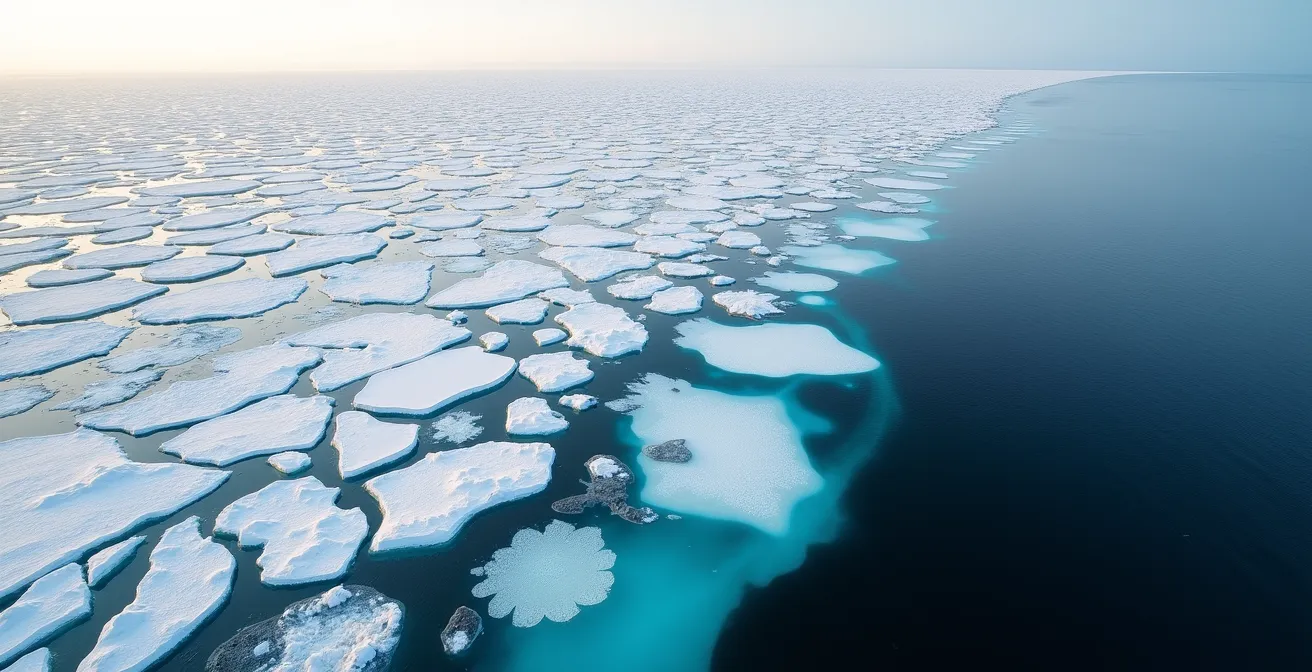
The diminishing Arctic cryosphere is no longer just a consequence of climate change; it has become a dominant, quantifiable driver of global radiative forcing.
- Albedo change, driven by surface melt dynamics, has a warming effect equivalent to 25% of all anthropogenic CO2 forcing since 1979, profoundly altering Earth’s energy balance.
- This feedback is non-linear and systematically underestimated in climate models, which fail to capture observed Arctic amplification rates of nearly four times the global average.
Recommendation: Climate models require urgent refinement of their cryospheric components, particularly melt pond physics and aerosol deposition, to reduce the profound uncertainty in future warming projections.
For decades, the prevailing narrative surrounding the Arctic has been one of passive response: as anthropogenic emissions warm the planet, the polar ice cap melts. This linear cause-and-effect understanding is now dangerously obsolete. The Arctic has transitioned from a remote victim of climate change to an active and powerful amplifier of global warming. The fundamental physics of this transition is rooted in a concept known as the ice-albedo feedback, but its real-world implications are far more complex and alarming than the simple textbook explanation.
While the basic principle—that reflective white ice is being replaced by absorbent dark ocean—is widely understood, this simplification obscures the cascade of non-linear processes now at play. The critical question for climate modelers and polar researchers is no longer *if* this feedback exists, but *how fast* it is accelerating, *what specific mechanisms* are driving its intensity, and *why* our predictive models are consistently failing to capture its true magnitude. The “30%” acceleration figure often cited is not a simple metric; it represents a fundamental and rapid shift in Earth’s energy balance, a shift whose physical drivers must be deconstructed to have any hope of producing reliable future climate projections.
This analysis moves beyond the basics to deconstruct the core physics of albedo reduction, examine the satellite data that provide irrefutable evidence of the trend, and quantify the feedback’s staggering contribution to planetary warming. By confronting these realities, we can identify the critical gaps in our current predictive models and understand the urgency required to address them.
Summary: Why the Loss of Arctic Sea Ice Accelerates Global Warming by 30%?
- Why Does White Ice Reflect 80% of Sunlight While Dark Ocean Absorbs It?
- How to Interpret CERES Satellite Data to Track Global Albedo Trends?
- Surface Melt vs Ice Shelf Collapse: Which Drives Albedo Reduction Faster?
- The Soot Mistake: How Industrial Pollution Darkens Ice and Speeds Melting
- How to Artificially Increase Cloud Brightness to Cool the Arctic?
- Why Does Melting Arctic Ice Accelerate Global Warming by 25%?
- Why Is the Earth Absorbing More Energy Than It Emits back to Space?
- How Positive Feedback Loops Make Climate Predictions Unreliable?
Why Does White Ice Reflect 80% of Sunlight While Dark Ocean Absorbs It?
The fundamental engine of the Arctic’s role as a climate accelerator is albedo—the measure of a surface’s ability to reflect solar radiation. The dramatic difference in albedo between the cryosphere and the ocean is the starting point for this critical feedback loop. According to the National Snow and Ice Data Center, open ocean water is one of the darkest natural surfaces on the planet, reflecting a mere 6% of incoming solar energy and absorbing the other 94%. In stark contrast, sea ice reflects between 50% and 70% of incoming radiation. This effect is even more pronounced when the ice is covered by a layer of fresh snow.
Indeed, fresh, bright white snow is the most reflective natural surface on Earth. Research shows that pristine, snow-covered sea ice can reflect as much as 90% of solar radiation back into space, acting as a highly effective thermal shield for the planet. As temperatures rise, however, this protective snow cover melts first, exposing the darker, bare ice underneath. This initial change alone can cut the surface’s reflectivity by nearly half, initiating a cycle of increased energy absorption and further melt.
The process becomes even more complex with the formation of melt ponds. These pools of liquid water on the ice surface have an albedo of 0.4 to 0.5, meaning they absorb roughly twice as much energy as the surrounding ice. As these ponds absorb sunlight, they warm the ice beneath and around them, causing them to deepen and expand. This creates a localized, self-perpetuating melt dynamic that dramatically lowers the average albedo of the entire ice floe long before it breaks up, accelerating its demise from within.
How to Interpret CERES Satellite Data to Track Global Albedo Trends?
The theoretical understanding of albedo is confirmed by direct, long-term satellite observation. The primary instrument for this task is the Clouds and the Earth’s Radiant Energy System (CERES), a suite of sensors aboard NASA satellites that have been measuring the Earth’s total energy budget since the late 1990s. By measuring both incoming solar radiation and the outgoing radiation reflected by surfaces and clouds, CERES provides a precise, planet-wide accounting of albedo and its changes over time.
For the Arctic, the story told by CERES is one of rapid and accelerating darkening. Analysis of this satellite data is unequivocal: the region is absorbing significantly more solar energy than it did just a few decades ago. This is a direct consequence of the diminishing ice pack. Data from multiple satellite missions, including CERES, show that since record-keeping began, Arctic sea ice retreat has decreased by 40%. This staggering loss of reflective surface area has a direct and measurable impact on the planet’s radiative balance, turning a vast thermal mirror into a heat-absorbing surface.

Interpreting CERES data requires separating the signal from the noise. Scientists must account for variables like cloud cover, which has its own complex effect on the energy budget, and seasonal variations. However, the long-term trend is unmistakable. The “albedo anomaly”—the deviation from the historical average—shows a persistent and growing positive value in the Arctic, meaning less energy is being reflected out to space. This empirical, satellite-verified data provides the hard evidence that the ice-albedo feedback is not a future possibility but a current, powerful reality.
Surface Melt vs Ice Shelf Collapse: Which Drives Albedo Reduction Faster?
While the image of a massive ice shelf calving into the ocean is a dramatic symbol of climate change, recent research indicates that the more gradual process of surface melt is a far more potent driver of albedo reduction. The key insight is that the Arctic’s overall albedo begins to plummet long before the ice cover itself has substantially vanished. This is because the *quality* of the ice surface changes first. As discussed, the transition from bright snow to melt-pond-riddled ice drastically increases solar absorption.
This phenomenon has been quantified using innovative techniques. For example, GPS satellite radiometric measurements reveal a startling disconnect: during the 40 days surrounding the summer solstice, the amount of reflected sunlight in the Arctic decreases by 20-35%, while the total sea ice coverage over the same period only decreases by 7-9%. This demonstrates that changes in the ice’s surface properties are responsible for the majority of the albedo loss during the peak of the melt season, not simply the reduction in ice area.
A specific regional analysis of the Pacific Arctic Sector reinforces this conclusion. This region has seen the most significant summer ice reductions in the entire Arctic Ocean. A study found that since the 2000s, surface melt has become the dominant factor driving albedo change there. The region’s shift from a system dominated by thick, multi-year perennial ice to one of thin, seasonal ice has intensified this ice-ocean albedo feedback, as the young ice is more susceptible to rapid surface melt and pond formation. This regional dynamic, driven by surface physics, explains a remarkable 86% of the total variance in ice retreat across the entire Arctic Ocean.
Checklist for Auditing Albedo Feedback in Climate Models
- Surface Albedo Parameterization: Inventory all surface types (open water, melt ponds, bare ice, snow-covered ice) and their assigned albedo values. Are they static or dynamic based on solar angle and surface state?
- Melt Pond Dynamics: Does the model explicitly simulate the formation, growth, and deepening of melt ponds, or does it use a simplified fractional area approach that may underestimate absorption?
- Aerosol Deposition: Check for the inclusion of black carbon and dust deposition on snow and ice surfaces. Does the model account for how these impurities reduce albedo and accelerate melt?
- Cloud-Radiation Interaction: Assess how the model handles low-level Arctic clouds. Does it accurately capture their dual effect (longwave warming in winter, shortwave cooling in summer) and their response to a changing surface?
- Feedback Coupling Strength: Quantify the ice-albedo feedback strength (in W/m²/K) in a transient run. How does this simulated value compare against observational data and multi-model intercomparison project (CMIP) ensembles?
The Soot Mistake: How Industrial Pollution Darkens Ice and Speeds Melting
The reduction of Arctic albedo is not driven solely by the physical state change of water. A significant and often underestimated accelerator is the deposition of light-absorbing particles, primarily black carbon—or soot—originating from industrial processes and wildfires in the mid-latitudes. Transported northward by atmospheric circulation, these dark particles settle on the bright surfaces of snow and ice, acting like a dusting of black powder on a white canvas.
Even in small concentrations, black carbon can significantly lower the albedo of snow and ice, causing it to absorb more solar energy and melt faster. This creates another positive feedback loop: as the surface melts, the concentration of soot in the remaining snow or on the bare ice surface increases, further darkening the surface and accelerating the process. This “soot mistake” demonstrates how pollution from thousands of miles away has a direct and tangible impact on the stability of the cryosphere.
The scale of total ice loss is immense. Comprehensive studies document that between 1994 and 2017, the Earth lost a staggering 28 trillion tonnes of ice, with Arctic sea ice melt accounting for 7.6 trillion tonnes of that total. This loss is not linear; analysis shows the rate of ice loss has risen by 57% since the 1990s. While this acceleration is primarily driven by rising temperatures, the added effect of aerosol deposition on albedo contributes to this non-linear trend, making the ice more vulnerable to warming than it would be in a pristine environment. This highlights the interconnectedness of the Earth system, where industrial pollution and cryospheric physics intersect to amplify warming.
How to Artificially Increase Cloud Brightness to Cool the Arctic?
Given the alarming speed of Arctic warming, some scientists are exploring proposals for geoengineering—deliberate, large-scale interventions in the Earth’s climate system. One of the most discussed concepts for the Arctic is Marine Cloud Brightening (MCB). The idea is to spray microscopic seawater aerosols into the lower atmosphere, where they would act as cloud condensation nuclei. This would theoretically create clouds with a higher number of smaller droplets, making them brighter and more reflective, thus bouncing more sunlight back to space and exerting a cooling effect on the ocean and ice below.
However, such interventions carry profound risks and uncertainties. One of the greatest concerns is the potential for a “termination shock.” If a large-scale MCB program were implemented and then suddenly stopped for any reason (political, economic, or technical), the planet would experience a terrifyingly rapid jump in temperature as the artificial cooling effect vanishes, unleashing all the masked warming at once. Furthermore, the complex interactions within the Arctic system are not fully understood. Altering cloud properties could have unforeseen consequences on precipitation patterns and atmospheric circulation.
Moreover, geoengineering does not address the root cause of the problem—greenhouse gas emissions. It would also fail to stop other feedback loops, such as the thawing of permafrost. The Arctic ice and permafrost store immense quantities of methane, a potent greenhouse gas. As temperatures rise and the ground thaws, this methane is released, which in turn causes more warming and more thawing. This self-reinforcing cycle means that a geoengineering solution targeting only albedo could be quickly overwhelmed by other feedbacks, creating a false sense of security while the underlying system continues its slide toward an irreversible tipping point.
Why Does Melting Arctic Ice Accelerate Global Warming by 25%?
The impact of the ice-albedo feedback is not just a regional phenomenon; it is a global force. Climate scientists have worked to quantify its contribution to the planet’s overall energy imbalance. The results are sobering. By calculating the change in radiative forcing—the net change in the energy balance of the Earth system in W/m²—due to the observed loss of Arctic sea ice, we can compare its impact directly to that of greenhouse gases. The conclusion is that the Arctic ice decline between 1979 and 2011 had the same radiative forcing effect as 25% of the CO2 emissions during that same period. This is the origin of the stark acceleration figure: one-quarter of the warming effect from our primary greenhouse gas over three decades was matched by the consequences of melting ice.
This powerful feedback helps explain the phenomenon of Arctic amplification, where the polar region is warming much faster than the rest of the globe. While global averages can be misleading, the data from the Arctic is clear. A landmark 2022 study found that over the period from 1979 to 2021, the Arctic has been warming nearly four times faster than the global average. This extreme amplification is a direct result of the ice-albedo feedback, compounded by other regional feedbacks.
This observed rate of warming presents a major challenge to climate models, which have historically struggled to replicate the intensity of Arctic amplification. As the authors of the study note, this discrepancy is a serious concern for the reliability of future projections. They state:
The observed four-fold warming ratio over 1979–2021 is an extremely rare occasion in the climate model simulations.
– Rantanen et al., Communications Earth & Environment
This “extremely rare occasion” in models is the observed reality on the ground, indicating that our primary predictive tools are underestimating the potency of these positive feedback loops.
Why Is the Earth Absorbing More Energy Than It Emits back to Space?
At its core, global warming is a problem of fundamental physics: the Earth is experiencing a persistent energy imbalance. Due to the accumulation of greenhouse gases in the atmosphere, the planet is absorbing more energy from the sun than it is radiating back out to space. This net energy gain is what drives the warming of the oceans, land, and atmosphere. The melting of Arctic sea ice is both a symptom and a powerful amplifier of this core imbalance.
The trend of ice loss shows no sign of abating. According to NOAA’s 2024 Arctic Report Card, the evidence of a system in rapid decline is overwhelming. The report confirms that the last 18 September sea ice extents (2007-2024) are the 18 lowest in the satellite record. Each year, the end-of-summer minimum carves out a new benchmark for a diminished Arctic, leaving more dark ocean exposed to absorb solar radiation for a longer period, thus intensifying the energy imbalance for the following year.
This feedback loop directly contributes to the planet’s net energy gain. One analysis calculated the total warming impact from ice loss in both the Arctic and Antarctic between 1992 and 2018. The study concluded this loss had the same warming impact as 10% of all greenhouse gases emitted over that period. The mechanism is clear: as reflective ice vanishes, it is replaced by the highly absorbent ocean, which takes in over 90% of incoming solar radiation. This captured energy doesn’t just warm the Arctic; it is integrated into the entire Earth system, contributing to the overall planetary energy imbalance and driving global mean temperature rise.
Key takeaways
- Quantifiable Driver: The ice-albedo feedback is not a minor factor; its radiative forcing effect since 1979 is equivalent to 25% of the warming caused by CO2 emissions over the same period.
- Non-Linear Acceleration: The Arctic is warming nearly four times faster than the global average, a rate that current climate models consistently fail to reproduce, indicating they underestimate feedback strength.
- Impending State Shift: With 95% of the oldest, thickest ice already gone, the Arctic is approaching a critical tipping point toward a seasonally ice-free state, which could trigger irreversible changes in the global climate system.
How Positive Feedback Loops Make Climate Predictions Unreliable?
The greatest challenge in climate science is not in understanding individual processes, but in predicting how they will interact. The Arctic is a nexus of multiple, interconnected positive feedback loops that create non-linear dynamics, making long-term predictions inherently unreliable. The ice-albedo effect is the most powerful of these, but it does not operate in isolation. It interacts with the permafrost-methane feedback, changes in atmospheric and oceanic circulation, and cloud dynamics in ways that can lead to abrupt and surprising shifts.
This web of feedbacks means the Arctic system is highly sensitive to “tipping points,” thresholds beyond which a small change can trigger a large, rapid, and often irreversible shift into a new state. The potential for a seasonally ice-free Arctic is one such tipping point. Projections based on current emissions trends suggest this could occur as early as 2040. Such an event would represent a fundamental system state shift for the planet, with unknown but likely severe consequences for global weather patterns.
The evidence that we are approaching this threshold is mounting. Over the past 30 years, the oldest and thickest multi-year ice—the resilient heart of the Arctic ice pack—has declined by an astonishing 95%. The system’s buffer is almost gone. The failure of climate models to fully capture the observed rate of Arctic amplification, as noted by researchers, is a stark warning that their predictive power may be limited precisely when we need it most. The models are built on our best understanding of physics, but they struggle to resolve the complex, emergent behavior of these intertwined feedback loops, making them prone to underestimating the speed and severity of change.
To reduce the unacceptable level of uncertainty in climate projections, the research community must prioritize the integration of these complex, non-linear cryospheric dynamics into the next generation of Earth System Models. Accurately modeling these feedback loops is not an academic exercise; it is an essential prerequisite for building a resilient global society in the face of accelerating climate change.