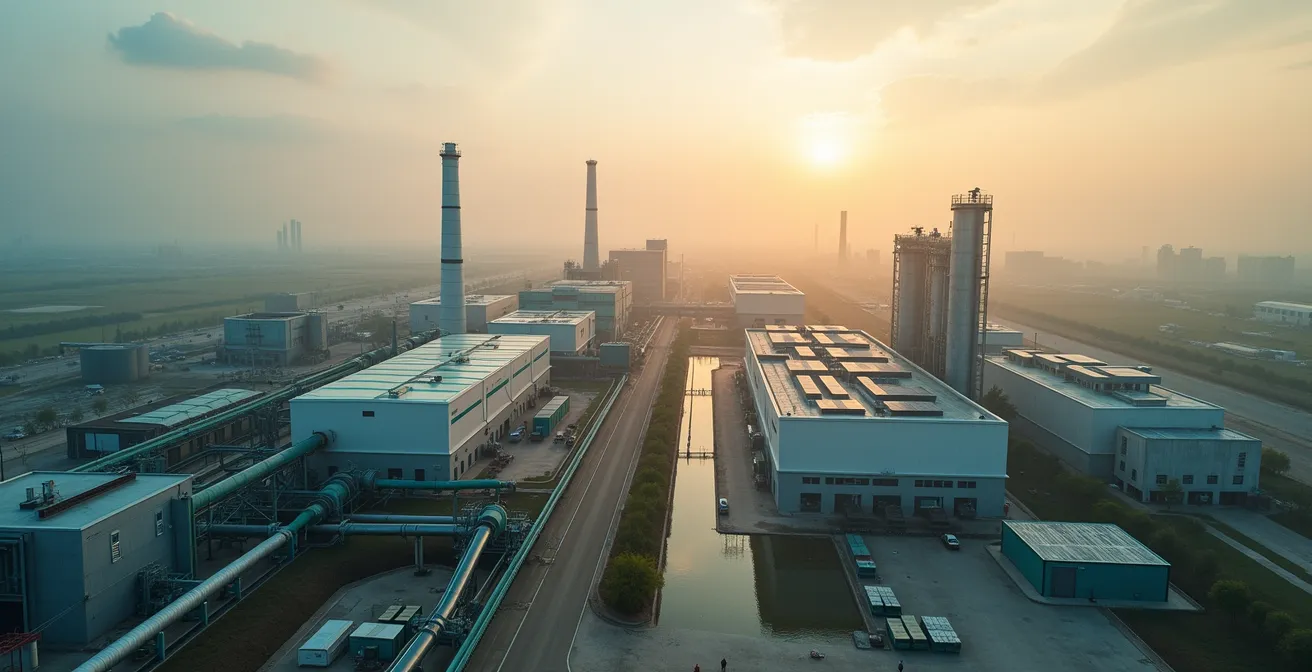
The traditional ‘Take-Make-Waste’ manufacturing model is an obsolete operating system that actively leaks value, exposes your business to extreme risk, and is being outmaneuvered by competitors.
- Linear production treats finished materials as a liability (waste) instead of an asset, costing you twice—once to acquire, and again to dispose.
- Service-based circular models generate predictable, recurring revenue streams while insulating your company from raw material price shocks.
Recommendation: Begin by mapping your material flows to identify the most significant points of value leakage and regulatory risk; this is the first step in future-proofing your entire operation.
For decades, the logic of manufacturing seemed simple: take resources, make a product, and sell it. The end of that product’s life—the “waste”—was someone else’s problem. As a business leader, you have likely perfected this linear model for maximum efficiency. However, in today’s landscape of volatile commodity prices, tightening regulations, and shifting consumer expectations, this model has become a significant liability. The very system that built industrial empires is now a major source of financial instability and risk.
The common response is to focus on incremental improvements: reducing factory waste, optimizing energy consumption, or launching a “green” product line. While commendable, these are merely patches on an outdated operating system. They fail to address the fundamental flaw: a business model that relies on infinitely available, cheap resources and a planet that can absorb infinite waste. This assumption is now demonstrably false and costly.
What if the key to resilience and future growth isn’t just about being more efficient at taking, making, and wasting? What if it’s about fundamentally redesigning the system to eliminate the concept of “waste” entirely? This is the strategic promise of the circular economy. It’s not about environmentalism as a PR exercise; it is a transformative business strategy focused on retaining material value, building stronger customer relationships, and creating new, more resilient revenue streams. It’s an essential upgrade to your business’s core operating system.
This article will deconstruct the hidden costs of the linear model and provide a strategic framework for manufacturing leaders to navigate the transition. We will explore how to identify financial hotspots in your supply chain, evaluate the powerful shift from volume sales to service models, and understand the critical role of design in preempting regulation and building lasting brand value.
Contents: Why the “Take-Make-Waste” Model Is Bankrupting Manufacturers
- Why Does Sending Waste to Landfill Cost You Double in Lost Material Value?
- How to Map Your Supply Chain to Identify “Take-Make-Waste” Hotspots?
- Volume Sales vs Service Models: Which Generates Better Recurring Revenue?
- The Design Mistake That Alienates Customers and Invites Regulation
- When to Abandon Linear Product Lines to Preempt Regulatory Bans?
- How to Design a Municipal Composting System That Reduces Landfill Waste by 30%?
- How to Audit Your Supply Chain for Conflict Minerals Using Blockchain?
- Zero-Waste Manufacturing: How to Close the Industrial Production Loop Completely?
Why Does Sending Waste to Landfill Cost You Double in Lost Material Value?
The term “waste” is a dangerous misnomer in a modern balance sheet. What you send to a landfill isn’t just an environmental issue; it’s a direct financial hemorrhage. First, you pay for the raw material. Then, you pay for the energy and labor to process it. Finally, you often pay a third time to have the resulting “waste”—a valuable material in the wrong place—hauled away and disposed of. This is not waste; it is destroyed value. Every discarded offcut, every unsold product, and every item that cannot be repaired represents a tangible asset that has been paid for and then subsequently paid to get rid of.
The scale of this lost value is staggering. In the fashion industry alone, it’s estimated that over $500 billion in value is lost every year due to underutilization and the failure to recycle clothing. This isn’t just about textiles; the same logic applies to plastics, metals, and electronics. This financial leakage is what we call Material Liability. It’s a hidden cost baked into the linear model, where the value of materials plummets to zero (or negative, considering disposal fees) the moment a product leaves the factory or its initial use cycle ends.
Viewing waste through this lens transforms it from an operational nuisance into a strategic imperative. The core question for any CFO should not be “How can we dispose of waste more cheaply?” but rather “How can we design our products and business model to retain the value of the materials we’ve already paid for?” This shift in perspective is the first step toward building a more resilient and profitable manufacturing operation, one that treats materials as permanent assets, not disposable inputs.
How to Map Your Supply Chain to Identify “Take-Make-Waste” Hotspots?
To move beyond the linear model, you must first understand it with forensic detail. A “hotspot” is any point in your value chain where material value is significantly diminished or destroyed. This could be a manufacturing process that generates excessive by-products, a product designed for single use, or a distribution model that makes returns and recovery impossible. Mapping your material flows is the diagnostic tool that makes these invisible financial leaks visible and actionable.
This process is more than a simple audit of your direct operations; it requires a holistic view from raw material extraction to the product’s end-of-life. The goal is to create a “digital twin” of your material flow, tracking every gram of input and understanding where it ends up. Is a valuable metal alloy being lost in shavings on the factory floor? Are you shipping products in packaging that is immediately discarded? Are your customers left with a product they cannot repair or recycle?

As this visualization suggests, material flow mapping illuminates the pathways of value. By tracking where materials enter, how they are transformed, and where they exit the system (often as “waste”), you can pinpoint the most impactful areas for intervention. This data-driven approach moves the conversation from abstract sustainability goals to concrete, measurable opportunities for cost savings and revenue generation. It provides the business case needed to justify investment in new technologies, processes, or business models.
Action Plan: Mapping Your Material Flows
- Track Material Extraction: Begin by cataloging the volume and origin of all raw materials, noting that global extraction has tripled in recent decades, increasing your exposure to price volatility.
- Identify Scarcity Risks: Pinpoint your dependence on finite resources like specific minerals, clean water, or high-quality soil that are becoming increasingly scarce and regulated.
- Map Production Waste: Analyze each step of your production process to identify by-products currently considered “waste” that could be repurposed, sold, or used as a new input.
- Analyze for Closed Loops: Evaluate where materials from post-consumer products or manufacturing by-products can be fed directly back into your production lines, creating a closed-loop system.
- Assess Product Lifecycle: Implement systems to track products in the field, identifying opportunities for reuse, refurbishment, and remanufacturing to extend their value-generating life.
Volume Sales vs Service Models: Which Generates Better Recurring Revenue?
The traditional manufacturing business model is built on a simple premise: sell more units. This relentless pursuit of volume creates a transactional relationship with customers and makes your revenue entirely dependent on the next sale. A circular economy offers a powerful alternative: shifting from selling products to selling a service or an outcome. This is the Product-as-a-Service (PaaS) transition, and it fundamentally realigns your incentives with those of your customers and the principles of durability.
When you sell a product, its failure can lead to another sale. When you sell “performance” or “uptime” as a service, failure is a cost you bear directly. This forces a focus on designing products that are durable, easy to maintain, and simple to upgrade. The manufacturer retains ownership of the material asset, allowing it to be recovered, refurbished, and redeployed at the end of a service contract. This captures the end-of-life value that is completely lost in a linear sales model. As Frans van Houten, former CEO of Philips, stated, “In circular economy business models I would like products to come back to me as the original designer and manufacturer.” This is not an act of charity; it is a strategic move to reclaim valuable assets.
This shift transforms your business from a volatile, transaction-based model to a stable, relationship-based one with predictable, recurring revenue streams. Instead of a one-time profit margin, you secure a long-term cash flow while building deep customer loyalty and insulating your business from the whims of raw material markets.
The table below, drawing from concepts discussed by the World Economic Forum, starkly contrasts the financial and strategic implications of these two approaches.
| Model Aspect | Linear Volume Sales | Circular Service Model |
|---|---|---|
| Revenue Type | One-time transaction | Recurring subscription |
| Customer Relationship | Transactional | Continuous engagement |
| Material Ownership | Transfers to customer | Retained by manufacturer |
| End-of-Life Value | Zero (customer waste) | Material recovery value |
| Innovation Driver | New product sales | Service optimization |
The Design Mistake That Alienates Customers and Invites Regulation
The most significant financial decisions about a product’s lifecycle are often made long before the first unit is produced. They are made on the design floor. Designing a product that cannot be easily repaired, upgraded, or disassembled is the single biggest “take-make-waste” mistake. This practice, often a form of planned obsolescence, not only creates a mountain of waste but also fosters deep customer frustration and attracts the unwanted attention of regulators. In an age of “Right to Repair” movements and growing consumer awareness, selling a black-box product is a recipe for brand damage.
This design philosophy is directly responsible for a huge portion of global waste. A report highlighted by the Earthshot Prize notes that of the waste generated by cities, paper is 17% and plastic is 12%, much of it from packaging and disposable products. This waste is a symptom of a design failure, a conscious or unconscious choice to prioritize short-term sales over long-term value and customer satisfaction. Every time a customer has to replace an entire device because a single component failed, trust is eroded.
The strategic antidote is Design-for-Disassembly. Companies like Fairphone have proven this is not a utopian fantasy. By creating modular phones where users can easily replace batteries, cameras, and other components, they turn maintenance into a positive brand interaction. This approach builds immense customer loyalty, differentiates them in a crowded market, and future-proofs their business against regulations mandating product longevity and repairability. Designing for the entire lifecycle—including repair, reuse, and recycling—is no longer a niche concept; it is a critical competency for any manufacturer wishing to thrive in the 21st century. It transforms the product from a disposable commodity into a durable platform for ongoing value creation.
When to Abandon Linear Product Lines to Preempt Regulatory Bans?
For a CFO or CEO, one of the greatest risks is being legislated out of business. The linear “take-make-waste” model is increasingly in the crosshairs of regulators globally. From single-use plastic bans to extended producer responsibility (EPR) laws that make manufacturers financially liable for end-of-life product management, the regulatory landscape is shifting irrevocably. Waiting for a ban to be announced is not a strategy; it’s a failure of foresight. The key is to see regulation not as a threat, but as a predictable market trend and to pivot before it becomes a costly, reactive crisis.
The pressure for this change is rooted in a simple, alarming fact. Research from Leeds University grimly points out that for over 30 years, no single country has met its residents’ basic needs without overconsuming natural resources. This unsustainable trajectory guarantees more aggressive government intervention. Furthermore, projections show that the total demand for resources is expected to reach 130 billion tons by 2050, a massive increase from 50 billion in 2014. This collision course between demand and planetary limits makes regulatory action a certainty, not a possibility.
The strategic move is Regulatory Preemption. This involves analyzing which of your product lines are most vulnerable to future bans or taxes (e.g., those reliant on single-use plastics, hard-to-recycle materials, or designed obsolescence) and proactively developing circular alternatives. By abandoning these high-risk linear lines before you are forced to, you turn a compliance cost into a first-mover advantage. You gain market share while competitors scramble to react, enhance your brand’s reputation as a forward-thinking leader, and build a more resilient business model that is insulated from the next wave of inevitable regulation.
How to Design a Municipal Composting System That Reduces Landfill Waste by 30%?
While a municipal system may seem distant from a manufacturing plant, the underlying principles of its design offer powerful lessons in industrial symbiosis and value recovery. A well-designed composting system is a perfect microcosm of the circular economy: it takes a “waste” stream (organic materials) that would otherwise generate methane in a landfill and transforms it into a valuable product (fertilizer and biofuels). For manufacturers, this model demonstrates how to turn a liability into an asset.
The key is to stop seeing waste streams as monolithic. Just as a city separates glass, paper, and organics, a factory can separate its by-products. Are there metal off-cuts that can be sold to another industry? Are there organic residuals that could become a source of energy? The Sanergy project in Nairobi, a 2021 Earthshot Prize Finalist, exemplifies this. They collect sanitation and kitchen waste and use insects to convert it into high-value agricultural fertilizer and animal feed. They didn’t just find a way to dispose of waste; they created a new, profitable business by seeing a resource where others saw a problem.
For a manufacturing CEO, the lesson is to look beyond your own factory walls. Could your by-products be the raw material for another business? Could you partner with other industries in your region to create a closed-loop ecosystem where one company’s “waste” is another’s input? This approach, known as industrial symbiosis, mirrors the logic of a municipal composting system but at an industrial scale. It requires a shift from an isolated, competitive mindset to a collaborative one focused on maximizing regional resource efficiency. It’s about building a business ecosystem that is more resilient, less wasteful, and ultimately more profitable for all participants.
How to Audit Your Supply Chain for Conflict Minerals Using Blockchain?
The challenge of auditing for conflict minerals reveals a deeper truth about modern supply chains: they are dangerously opaque. This lack of transparency is a major blind spot not just for ethical sourcing, but for any company trying to move away from the “take-make-waste” model. You cannot manage, recover, or reuse materials if you don’t know what they are or where they came from. Therefore, the tools and strategies used for ensuring ethical sourcing, like blockchain, are the very same ones needed to enable a circular economy.
The pressure on our supply chains is immense and growing. The annual global extraction of materials has tripled in the last forty years, forcing manufacturers to source from ever more complex and remote networks. In this environment, a technology like blockchain provides an immutable ledger, capable of tracking a mineral from the mine to the final product. It offers a “digital passport” for materials, verifying their origin and chain of custody. This is critical for avoiding conflict minerals, but its strategic value is far broader.
For a circular economy, this level of transparency is revolutionary. Imagine if every component in your product had a digital passport detailing its material composition, origin, and a record of its maintenance. At the product’s end-of-life, you would know exactly what you are getting back. You could sort materials with near-perfect accuracy, identify components for refurbishment, and safely channel materials back into production. This is the foundation of a true closed-loop system. Auditing your supply chain for transparency is therefore not just a compliance exercise; it is a foundational investment in your company’s circular future, enabling you to track and recover the value embedded in your products.
Key Takeaways
- The linear “Take-Make-Waste” model is a direct financial liability, converting valuable assets into costly waste.
- Transitioning to service-based models (PaaS) creates recurring revenue and insulates your business from raw material volatility.
- Designing products for disassembly and repair is not an expense but a strategic investment in brand loyalty and regulatory preemption.
Zero-Waste Manufacturing: How to Close the Industrial Production Loop Completely?
Achieving true zero-waste manufacturing—a complete closed-loop system—is the ultimate goal of the circular economy. This is not about simply having better recycling bins at the end of the line. It’s a fundamental re-imagining of production where the very concept of waste is designed out from the beginning. It represents a system where every output is either a primary product or a valuable input for another process, either within your own company or for an industry partner.
This requires a radical commitment to innovative design. Consider the example of Apeel, a company that developed an edible, plant-based coating for fresh produce. This coating slows spoilage, tackling food waste, and eliminates the need for single-use plastic shrink wrap. They didn’t just make a better package; they eliminated the need for the package itself by redesigning the product’s surface. This is the level of thinking required to truly close the loop. It is about solving the root problem, not just managing the symptoms.

As advocate Lars Zimmermann puts it, “It is about enabling ecosystem: you need to make sure that someone someday somewhere can repair it, reuse it, refurbish parts, or recycle it.” This means creating products and systems with their entire lifecycle in mind. Closing the industrial loop is less a single technical problem and more of an ecosystem-building challenge. It requires collaboration with suppliers, partners, and even competitors to ensure that every material remains in a high-value state for as long as possible. For a business leader, this is the final frontier of operational excellence—transforming your linear production line into a resilient, profitable, and self-sustaining industrial circle.
The transition from a linear to a circular model is not a simple task, but a strategic necessity for any manufacturer looking to thrive in the 21st century. It requires a shift in mindset from top to bottom, recognizing that materials are assets to be preserved, not inputs to be consumed. To begin this journey and transform your operational risks into strategic advantages, the next step is to conduct a thorough analysis of your own value chain to identify the most immediate opportunities for change.