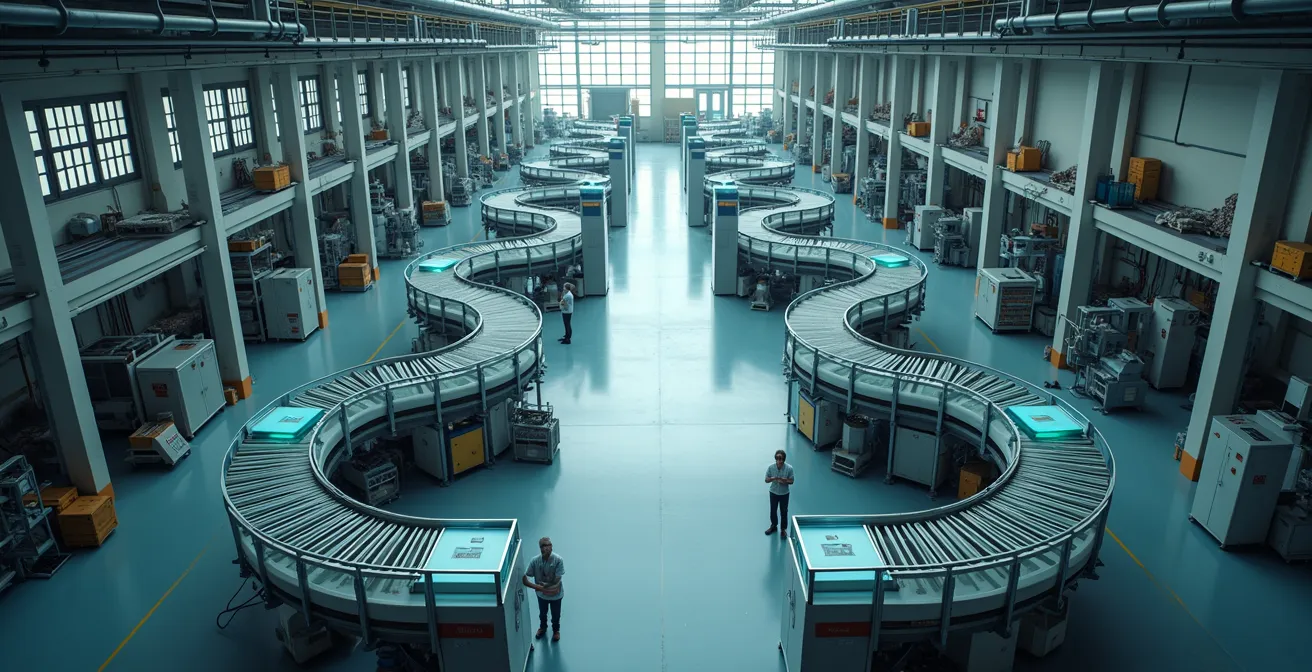
The key to a zero-waste factory isn’t better recycling; it’s re-engineering production to treat ‘waste’ as a mislabeled, high-value asset leaking from your process.
- A closed-loop system is a process optimization challenge, not an environmental one, with ROI often achieved in under 18 months.
- The biggest failure point is material contamination during sorting, which destroys its value and prevents re-entry into the production line.
Recommendation: Begin with a systematic waste audit not to count trash, but to map the financial value of every material leak in your current system.
For most factory managers, waste is a line item, a disposal cost, a regulatory headache. The standard approach involves finding cheaper hauling services or negotiating better rates at the local landfill. This entire mindset is fundamentally flawed and expensive. It treats the symptom—the existence of scrap—rather than the root cause: a leak in the material value chain. The platitudes of “recycling more” or “going green” miss the point entirely from a process engineering perspective.
A truly efficient manufacturing operation doesn’t produce waste; it produces finished goods and in-process raw materials. Anything else is a sign of a suboptimal process. The shift from “waste management” to “asset recovery” is the single most critical leap for achieving a closed-loop system. This isn’t about environmentalism; it’s about obsession with efficiency, maximizing the value of every gram of material you’ve already paid for, and eliminating the compounding costs of disposal.
But what if the key wasn’t just collecting scrap, but systematically engineering its flawless re-entry into the production hopper? The real challenge lies in maintaining material purity and quality, a hurdle that trips up most initiatives. This guide deconstructs the problem from an engineering standpoint, moving from the physical factory floor to high-level design principles. We will explore how to identify hidden value, choose the most profitable recovery methods, and ultimately design processes where the concept of “waste” becomes obsolete.
This article provides a systematic roadmap for process engineers and factory managers to diagnose and seal material leaks within their operations. Explore the sections below to understand each critical step in transforming your facility into a true zero-waste, maximum-efficiency system.
Summary: Zero-Waste Manufacturing: A Systematic Guide to Closing the Production Loop
- Why Are Scrap Conveyors the Most Underrated Asset in a Factory?
- How to Conduct a Waste Audit to Find Hidden Value in Your Trash?
- Downcycling vs Closed Loop: Which Recovery Method Saves More Money?
- The Sorting Mistake That Renders Factory Scraps Unusable for Re-entry
- When to Reintroduce Regrind into the Hopper for Consistent Product Quality?
- Why Does Sending Waste to Landfill Cost You Double in Lost Material Value?
- How to Design a Municipal Composting System That Reduces Landfill Waste by 30%?
- Eco-Design Principles: How to Reduce Product Impact by 80% During the Concept Phase?
Why Are Scrap Conveyors the Most Underrated Asset in a Factory?
In the hierarchy of factory equipment, scrap conveyors are often viewed as little more than automated trash cans—a low-tech necessity for housekeeping. This is a profound miscalculation. A modern, automated conveyor system is the circulatory system of your material recovery strategy. It’s the first and most critical component in transforming discarded scrap from a liability into a high-value, in-process asset. Treating it as an afterthought is equivalent to ignoring the arteries in a living system.
The business case is not subtle. By integrating automated sorting, processing, and collection, these systems create immediate financial returns. For instance, some recycling firms targeting metal, plastic, and e-waste reported ROI gains of 15-25% from automated systems alone. This isn’t just about labor savings; it’s about the increased value of the material itself. As an example, PRAB customers have seen scrap value increase by up to 25% through densification, with a payback period on equipment often falling between 6 and 9 months. This turns a cost center into a self-funding profit engine.
The true power, however, lies in data. Smart conveyors equipped with sensors are not just moving material; they are collecting critical process data on volume, composition, and flow rates.

As this image suggests, modern sensors provide a granular view of your waste stream. This data is the foundation of any serious closed-loop initiative, allowing you to identify process inefficiencies in real time, quantify the asset leak from specific production lines, and make data-driven decisions about equipment and process upgrades. An intelligent conveyor is not just moving scrap; it is the primary data source for optimizing your entire material value chain.
How to Conduct a Waste Audit to Find Hidden Value in Your Trash?
A waste audit is the single most important diagnostic tool for a process engineer. However, the goal is not to simply weigh bags of trash. A correctly executed audit is a forensic analysis of your production process’s inefficiencies. It maps the flow of materials, identifies points of value leakage, and quantifies the financial opportunity locked within your dumpsters. It’s the starting point for transforming your operation from a linear “take-make-dispose” model to a circular, high-efficiency system.
The objective is to gather data that answers critical questions: Which processes generate the most valuable scrap? What is the level of contamination in each waste stream? What is the cost of this lost material versus the cost of recovery? A 2022 audit by a U.S. automotive manufacturer, for example, revealed a potential for 15% waste reduction yielding $500,000 annual savings. This is not an anomaly; it’s the norm. This “hidden” money is bleeding out of most factories every single day, disguised as routine operational waste.
The process must be systematic. It involves physically sorting, categorizing, and weighing waste streams to create a detailed baseline. This isn’t a one-time event but should be a recurring process to track the effectiveness of improvement initiatives. A successful audit provides a clear, data-backed business case for investing in closed-loop technologies and process modifications, turning abstract goals into a concrete action plan with a calculated hidden ROI.
Your 5-Step Waste Value Recovery Plan
- Observe & Map: Conduct detailed in-plant observation and data collection to pinpoint every single operation that generates waste, creating a complete map of your material leaks.
- Optimize & Segregate: Implement rigorous operating practices, including preventive maintenance and absolute segregation of waste streams at the source to prevent cross-contamination.
- Substitute Inputs: Systematically review all input materials and actively replace toxic, non-recyclable, or complex substances with non-toxic, easily recoverable alternatives.
- Redesign Technology: Analyze and upgrade process technology with improved controls, sensors, and redesigned workflows aimed at minimizing material loss as a primary design goal.
- Close the Loop: Establish and operationalize immediate, in-process recycling loops to reintroduce purified materials directly back into the production process, treating scrap as a priority raw material.
Downcycling vs Closed Loop: Which Recovery Method Saves More Money?
Once your audit identifies valuable scrap streams, the next critical decision is strategic: what is the recovery objective? Many companies settle for downcycling—turning high-grade plastic scrap into park benches or shredding metal for lower-grade applications. While better than landfilling, downcycling is a strategic failure. It represents a one-time, low-value recovery that permanently removes the material from your high-value production loop. It’s a missed opportunity to capture the full economic value of an asset you’ve already purchased.
A true closed-loop system, by contrast, aims to reintroduce recovered material directly back into the same production process it came from. This maintains the material at its highest possible value and directly reduces the need to purchase virgin raw materials. The economic difference is stark. According to EPA data from 2023, 96% of industrial waste is already managed through some form of treatment or recovery, but the quality of that recovery determines the financial outcome.
The goal is to move from a linear system with a small recycling detour to a fully circular one where “waste” is just a temporary state for an in-process material. The comparison below illustrates why this is a financial imperative, not an environmental one.
| Metric | Closed-Loop System | Traditional Linear System |
|---|---|---|
| Secondary Material Usage | Up to 100% reintegration | 7.2% of inputs (global average) |
| ROI Timeline | 12-18 months | N/A – ongoing costs |
| Material Value Recovery | 25% increase in scrap value | Complete loss to landfill |
| Compliance Risk | Reduced – meets circular economy regulations | High – penalties up to 4% annual revenue |
The Sorting Mistake That Renders Factory Scraps Unusable for Re-entry
The single greatest obstacle to a profitable closed-loop system is process contamination. A batch of high-grade ABS plastic scrap is a valuable asset. The same batch contaminated with just a small amount of PVC, metal filings, or even paper labels becomes worthless, and in some cases, hazardous. This sorting mistake is the point where the entire circular economy model breaks down. It’s an engineering problem with catastrophic financial consequences, as it instantly turns a recoverable asset into costly trash.
Manual sorting is notoriously unreliable, subject to human error, fatigue, and inconsistency. For a closed-loop system to function, material purity must be near 100%. This level of precision is virtually unattainable without technological intervention. Modern AI-powered sorting systems are the solution to this critical problem. Using high-speed cameras and machine learning algorithms, these systems can identify and eject contaminants in real-time on a conveyor belt with astonishing accuracy. For example, leading AI-powered systems can identify over 95% of recyclable materials, a level of efficiency that fundamentally changes the economics of material recovery.
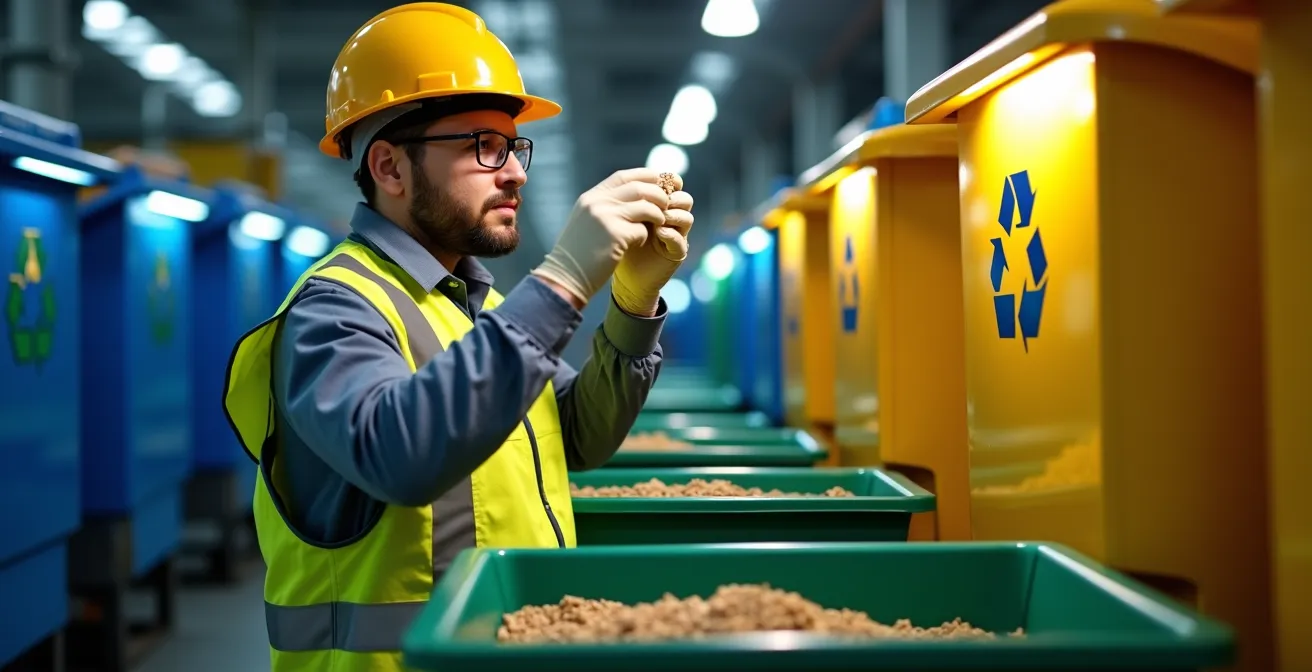
Even with advanced technology, human process remains vital. Effective segregation starts at the source. Clear, color-coded bins, dedicated containers for each material type at every workstation, and rigorous training are non-negotiable prerequisites. Technology and human discipline must work in tandem. The AI system on the main conveyor is the final quality check, but the process of maintaining purity must be embedded throughout the factory floor. Without pristine sorting, the goal of reintroducing material back into the hopper is a dangerous fantasy.
When to Reintroduce Regrind into the Hopper for Consistent Product Quality?
Successfully collecting and sorting clean scrap is only half the battle. The final, and most delicate, step is the systematic re-entry of this regrind material back into the production process. The question is not just *if*, but *when* and *how*. Introducing regrind is a process variable that must be controlled with the same rigor as temperature, pressure, or cycle time. An uncontrolled approach will inevitably lead to inconsistent product quality, dimensional instability, and cosmetic defects—eroding the very cost savings the program was meant to create.
The primary risk is introducing contaminated or degraded material. Even with excellent sorting, regrind can have different properties than virgin material (e.g., lower viscosity, different melt flow index). The consequences of getting this wrong are severe. For example, equipment downtime rises when plastic films and wires jam sorters, cutting the daily throughput by up to 20%. The same principle applies at the hopper: bad material in, bad product out, and likely a jammed machine to fix.
A systematic approach is essential. The key is to start with a controlled blending ratio. Many operations begin with a low percentage of regrind (e.g., 5-10%) mixed with virgin material. The finished products from this batch must be subjected to rigorous quality control testing, comparing them against a baseline of 100% virgin material. Only when quality is confirmed to be identical can the ratio be incrementally increased. This process requires meticulous lot tracking and data logging. Every batch containing regrind must be monitored, and any deviation in product quality must be traced back to the specific regrind ratio and source. This data-driven feedback loop is what separates a successful regrind program from a chaotic and costly experiment.
Why Does Sending Waste to Landfill Cost You Double in Lost Material Value?
The invoice from your waste hauling company is a lie. It only tells you a fraction of the story. The true cost of sending materials to a landfill is at least double what you see on that bill. This is because you are paying twice: once for the service of hauling the material away (the explicit cost), and a second, much larger time for the lost value of the material itself (the hidden, or opportunity, cost).
Every ton of scrap metal, plastic, or cardboard that leaves your facility in a dumpster represents a 100% loss on an asset you have already purchased. You paid for that raw material to enter your factory; paying again to have it removed is the definition of process inefficiency. A leading electronics manufacturer demonstrated this by establishing an internal recycling loop. The result was not only a 30% reduction in landfill contributions but, more importantly, a 12% reduction in raw material costs. That 12% is the “second cost” of landfilling—the money you are throwing away by not recovering your own assets.
The financial penalty extends even to the explicit costs. Inefficient waste management leads to unnecessary expenses. For example, an analysis of smart bin technology showed that simply by using sensors to prevent unnecessary pickups of half-empty containers, companies can achieve up to a 40% reduction in hauling costs. When you combine the direct savings on hauling with the recovery of material value, the business case for eliminating landfill use becomes overwhelming. It is not an environmental choice; it is the only financially logical one.
How to Design a Municipal Composting System That Reduces Landfill Waste by 30%?
While the title mentions “municipal systems,” for an industrial operation, the principle remains the same: organic waste is a recoverable asset, not trash. Many manufacturing plants, particularly in the food, beverage, and paper sectors, generate significant organic waste streams. Applying the same closed-loop, efficiency-obsessed mindset to these materials can unlock surprising value and drastically reduce landfill dependency. The European Commission’s push for a circular economy, which has seen a double-digit improvement in circular material use since 2020, puts pressure on all industries to address every waste stream, including organics.
The first step, mirroring the process for plastics or metals, is a frank audit to identify and quantify all organic waste. This includes everything from product offcuts and processing sludge to cafeteria food scraps and soiled paper products. Once mapped, the goal is to apply closed-loop principles. Can this waste be immediately repurposed in another process? For example, can fruit peels from a juice factory be processed into pectin or animal feed?
Where direct reuse isn’t possible, industrial composting or anaerobic digestion becomes the next logical step. This is more than just a “green” initiative; it’s about creating a valuable byproduct. High-quality compost is a saleable commodity. Biogas from anaerobic digesters can be used to generate electricity, directly reducing the factory’s energy costs. The key is to establish partnerships. Finding a local agricultural business that needs compost or a specialty firm that can process your specific organic byproduct transforms a waste stream into a new revenue stream. This approach expands the material value chain beyond your factory walls, ensuring no asset is ever truly lost.
Key Takeaways
- Industrial waste is a process failure and an asset leak, not an environmental problem.
- The financial viability of a closed-loop system depends entirely on preventing material contamination through rigorous sorting.
- The ultimate goal is to move solutions upstream through eco-design, making products that are inherently circular.
Eco-Design Principles: How to Reduce Product Impact by 80% During the Concept Phase?
All the strategies discussed so far—audits, sorting, recovery—are reactive. They are efficient ways to deal with the waste your current processes and products create. The final and most powerful stage of closing the loop is to become proactive. Eco-design, or Design for Circularity, moves the solution to the very beginning of the value chain: the product concept phase. This is where you have the leverage to design waste out of the system entirely.
This approach requires a radical shift in thinking for designers and engineers. Instead of just designing for function, aesthetics, and cost, they must design for the entire product lifecycle, especially disassembly and recovery. This means making deliberate choices like using reversible fasteners (screws instead of glue), creating modular components that can be easily replaced, and, critically, standardizing on a limited palette of materials that are known to be compatible with existing recycling infrastructure. More than four in ten manufacturers are already planning to increase automation to drive these kinds of sustainable practices.
A core element of modern eco-design is the creation of a “digital product passport.” This involves incorporating material data, chemical composition, and recycling history directly into the product’s digital record. This information is invaluable at the end of the product’s life, telling recovery facilities exactly what the product is made of and how to best recapture its value. It is the ultimate tool for creating a transparent and efficient material value chain.

By applying these principles, you are not just reducing a product’s “impact”; you are engineering a product that is an asset from creation to recovery. You are building a system where the end of one product’s life is the seamless beginning of another’s. This is the zenith of process efficiency—a system so well-designed that the concept of waste ceases to exist.
Stop viewing waste as a cost center and start treating it as an untapped asset. The first step is to initiate a systematic waste audit, not to comply with regulations, but to reveal the hidden financial value currently bleeding out of your production lines. This is the foundation of a more profitable, and ultimately, more resilient manufacturing operation.